Featuring
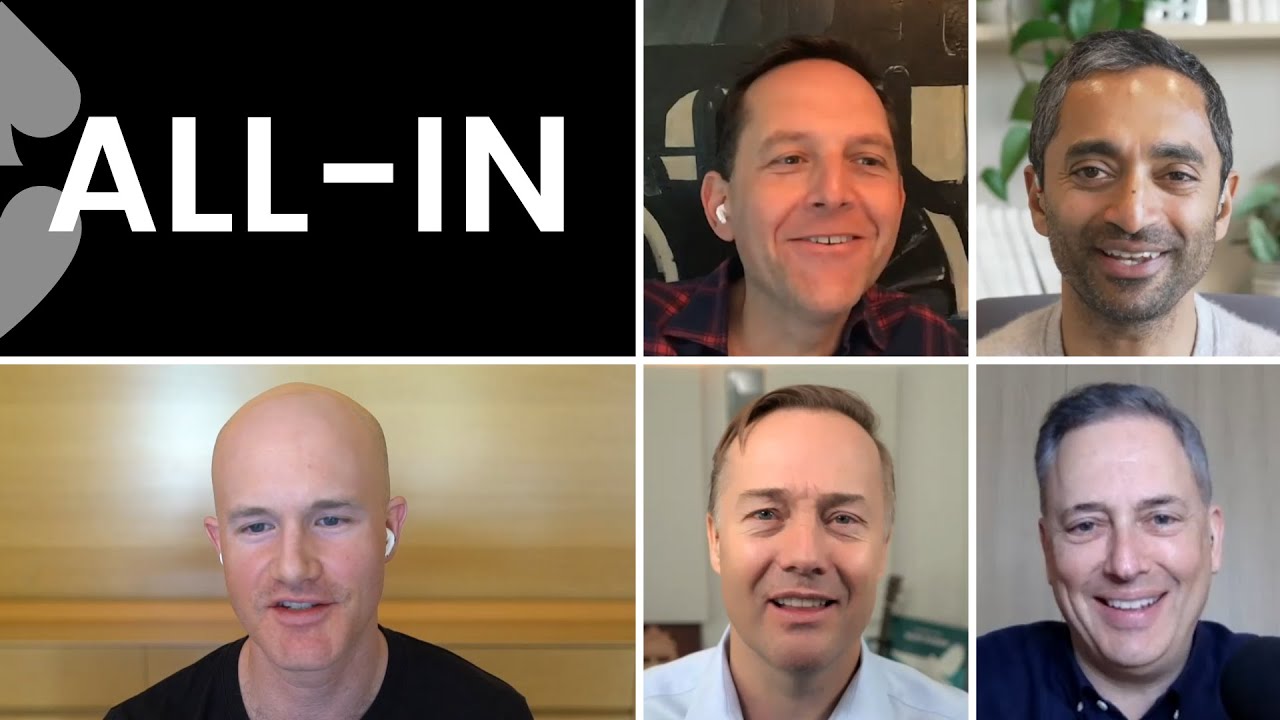
Episode 77 is mostly a Brian Armstrong stress test: first on whether companies should force mission focus, then on whether Washington can regulate crypto without crushing the parts that behave more like networks than stocks, and finally on why Netflix suddenly looks mortal. The crypto segment is the sharpest because Friedberg presses the old anti-swindle case for securities law while Brian, Sacks, and Chamath push for clearer category lines instead of endless ambiguity. Brian has the best overall episode: he is measured on culture, strongest on practical crypto policy, and candid enough on stablecoin trust and custody tradeoffs to keep the interview from turning into boosterism.
Spice rack
Should U.S. crypto policy move toward clearer category-specific rules and utility-token carveouts, or should policymakers keep a much stricter investor-protection-first posture that treats most token activity with deep skepticism?
Original point: Brian argues that ambiguity is worse than tailored regulation: crypto is not one thing, so the U.S. should stop trying to squeeze the entire sector through one legacy lens and instead build clearer category-specific rules that preserve consumer protection without crushing utility-layer innovation.
What everyone argued
Chamath Palihapitiya
Chamath says the executive order effectively signaled that crypto was now too large to be regulated out of existence, so Congress should stop leaving SEC-CFTC turf fights unresolved and instead pass a sensible line-drawing framework. He also adds that merely solving AML and KYC is not enough because hacks, disclosure duties, and operational controls still need a real accountability structure.
Jason Calacanis
Jason pushes on the boundary cases. He worries that most buyers are chasing appreciation rather than utility, asks how a real utility-token test should work, and later proposes investor-literacy tests, safe-harbor periods, and director-style duties so founders cannot simply launch a token and disappear.
David Sacks
Sacks defends the big-picture framework that splits security tokens from utility tokens. His claim is that many network tokens are closer to software fuel than to equity, so imposing full securities-style friction on utility usage would break functioning networks and punish builders who are not actually issuing synthetic shares.
David Friedberg
Friedberg is the real skeptic. He reminds the others that securities law exists because retail investors repeatedly got conned by persuasive stories, says the state has a legitimate role in protecting the people least able to protect themselves, and warns that digital systems can also become chokepoints once governments decide to intervene hard.
Brian Armstrong
Brian argues for a practical middle path: go get licenses, do the compliance work, but stop treating every crypto asset as though it obviously belongs under one regulator. His case is that crypto already spans commodities, securities, currencies, and non-investment uses, so the U.S. should build an explicit taxonomy rather than rely on entrepreneurs hiring expensive lawyers to reverse-engineer 1930s doctrine.
Winner circle
Brian has the strongest position because he makes the narrow claim reality can support: crypto assets do different jobs, so policy should regulate the actual function instead of pretending every token is the same instrument. Sacks is a close second for explaining the utility-token distinction cleanly, and Chamath usefully insists that clarity must still come with real accountability for hacks, custody, and disclosures. Friedberg is right about why investor protection exists, but his caution does not defeat the case for explicit categorization; it just tells you what the explicit categories must guard against.
Commentary
Chamath Palihapitiya
Assumptions and fact checks
Congressional line-drawing between crypto categories would produce a more workable market than leaving agencies to fight asset-by-asset through legacy law alone.
Why it mattersThat is the direction the policy conversation kept moving. Even where agencies remained aggressive, the long-run pressure was toward explicit category-specific frameworks rather than pure improvisation.
Crypto innovation can be preserved without tolerating a governance vacuum around hacks, custody, disclosure, and user protection.
Why it mattersThat synthesis is the most durable part of Chamath's position. The sector kept discovering that 'move fast' does not excuse missing controls once ordinary users bear losses.
The Biden administration's March 9, 2022 digital-assets executive order called for a coordinated federal approach while explicitly pairing responsible innovation with consumer, investor, financial-stability, and national-security protections.
CheckThe White House order states that the United States has an interest in responsible financial innovation while also listing consumer protection, financial stability, illicit-finance risk, and competitiveness among its core objectives.
The Ronin/Axie Infinity response included a $150 million raise to compensate hack victims after a roughly $625 million theft.
CheckTechCrunch's April 6, 2022 report described Sky Mavis raising $150 million to compensate victims after the Ronin exploit, which the article pegged at about $625 million.
Jason Calacanis
Jason is most valuable here as the friction generator. He keeps asking the question crypto advocates usually do not want to answer cleanly: where exactly does consumer protection bite once the marketing copy says 'utility'?
Assumptions and fact checks
A large share of token buyers in 2022 were behaving more like speculators than network users.
Why it mattersThat was plainly true across much of the market. Even if a utility thesis existed on paper, speculative behavior dominated many token purchases.
Sophistication tests or staged safe harbors could protect users without recreating wealth-based accreditation barriers.
Why it mattersThe idea is directionally attractive because it does not rely purely on wealth screens, but it also risks becoming a clunky bureaucracy and still does not solve project-level fraud or governance failures by itself.
David Sacks
Sacks is the cleanest expositor in the segment. The limitation is that his argument works best once someone else, here Jason and Chamath, has already forced the conversation to include fraud, hacks, and downstream duties.
Assumptions and fact checks
A workable regulatory regime can distinguish genuine utility-layer tokens from de facto capital-raising instruments often enough to matter in practice.
Why it mattersDifficult edge cases remain, but the distinction is real enough to be legally and economically useful. Treating every network token as obvious equity would have been too crude.
Forcing securities-style onboarding onto simple network-usage tokens would do real harm to open crypto applications.
Why it mattersThat is persuasive because it targets the functional layer directly. If buying a token is equivalent to paying network gas, blanket investor-screening logic becomes mismatched to the use case.
The SEC's digital-asset framework describes the Howey test as asking whether there is an investment of money in a common enterprise with a reasonable expectation of profits derived from the efforts of others.
CheckThe SEC's framework says an investment contract under Howey exists when money is invested in a common enterprise with a reasonable expectation of profits to be derived from the efforts of others.
David Friedberg
Friedberg does the best job defending why government and disclosure rules exist at all. What he never fully answers is how long ambiguity remains acceptable once useful non-equity network activity clearly exists.
Assumptions and fact checks
The historical reason for securities regulation remains relevant to crypto because storytelling and retail speculation can still outpace reality in new wrappers.
Why it mattersThat is plainly right. Crypto changed the medium, not the existence of speculative promotion or asymmetric information.
A freer token market without strong guardrails would disproportionately harm the least sophisticated participants.
Why it mattersThat risk remained visible across hacks, blowups, and promotional excess. Friedberg is right that the losers in these regimes are rarely the best-informed insiders.
Brian Armstrong
Brian wins because he is the only participant who consistently holds both halves of the problem together: innovation dies in endless ambiguity, but trust dies when platforms dodge real obligations. His version of clarity is not laissez-faire; it is taxonomy plus accountability.
Assumptions and fact checks
Regulatory clarity itself would meaningfully improve the market rather than simply bless the same risky behavior with better paperwork.
Why it mattersClarity would not cure fraud, but it would reduce wasteful lawyering and let regulators focus on the right risk buckets instead of fighting basic jurisdictional questions.
A utility bucket can exist without becoming a loophole factory if policymakers pair it with better rules on custody, disclosure, and use-case boundaries.
Why it mattersThat is plausible and probably necessary, but the hard part is exactly where the line is drawn and how aggressively bad actors try to game it.
The White House's March 2022 order explicitly contemplates that digital assets may be securities, commodities, derivatives, or other financial products rather than one single legal thing.
CheckThe order's definitions section says a digital asset may be a security, a commodity, a derivative, or another financial product, reinforcing Brian's point that a single bucket is inadequate.
Brian's summary of the Howey framework around investment, common enterprise, and expectation of profit tracks the SEC's own digital-asset guidance.
CheckThe SEC's framework uses those same core Howey elements in its digital-asset analysis, even though actual application still depends on facts and circumstances.
Were Netflix's 2022 problems mainly the result of macro advertising and customer-acquisition headwinds, or was the real issue that competition, pricing, and content quality had eroded Netflix's specific edge?
Original point: Chamath argues that Netflix is partly suffering a company-specific content problem but that the deeper macro story is Apple's privacy changes making online advertising less effective, which in turn raises customer-acquisition costs across the internet economy and exposes Netflix as an early canary.
What everyone argued
Chamath Palihapitiya
Chamath says Netflix has both a macro and a micro problem. His macro case is that Apple's privacy changes are degrading digital advertising efficiency and making customer acquisition harder across the board. His micro case is that Netflix is spending enormous sums on content without producing enough durable library value, while competitors have improved rapidly and capitalism is competing away the monopoly economics Netflix once enjoyed.
Jason Calacanis
Jason leans toward the relative-value explanation. He says the total streaming pie is still growing, but Netflix's share is slipping because HBO Max, Disney Plus, and others now offer stronger or cheaper reasons to subscribe. He also pushes back on the idea that the Chappelle controversy proves Netflix caved completely, arguing that the company ultimately heard the complaints and still held the line.
David Sacks
Sacks agrees that competition matters but adds a cultural critique: Netflix's programming has become less compelling because the people making content and programming decisions have drifted away from mainstream audience taste. In his view, the Chappelle fight exposed how much internal ideological pressure now distorts the product.
David Friedberg
Friedberg's lane is the competitive-product explanation. He says streaming demand overall is still there, but Netflix's relative share is slipping because rival platforms now have strong libraries, repeatable franchises, and differentiated content while Netflix lacks the same lock-in and has weaker network advantages than people once assumed.
Winner circle
Friedberg has the best argument because he keeps the diagnosis tied to customer choice and competitive substitution instead of trying to force Netflix into a grand macro morality tale. Jason's relative-value framing is a strong complement to that view. Chamath is right that Netflix also faced a harsher market environment, but he oversells the ATT story, and Sacks oversells the culture-war explanation even more. The later recovery of Netflix helps separate what was cyclical noise from what was actually wrong with the product and business model.
Commentary
Chamath Palihapitiya
Chamath usefully broadens the frame, but he overweights the sexy macro explanation. The later recovery of Netflix makes his ATT-heavy diagnosis look too clever by half.
Assumptions and fact checks
A material part of Netflix's subscriber miss was an internet-wide customer-acquisition shock tied to privacy-driven ad inefficiency.
Why it mattersThat may have been a marginal factor, but hindsight points much more strongly toward Netflix-specific saturation, pricing, competition, password sharing, and later execution changes than toward ATT as the central driver.
Netflix's old monopoly-style economics were inevitably going to be competed down once large media rivals got serious.
Why it mattersThat is substantially right. Even though Netflix later recovered, it did so in a much more competitive environment than the one that originally built its aura.
Netflix lost 200,000 subscribers in the first quarter of 2022 after previously guiding to a gain of about 2.5 million, and the Russia exit accounted for roughly 700,000 subscribers.
CheckPBS's earnings-report coverage says Netflix lost 200,000 subscribers in Q1 2022, notes management had guided to a 2.5 million gain, and says the withdrawal from Russia cost about 700,000 subscribers.
Apple's CODA became the first Best Picture winner distributed by a streaming platform at the 2022 Oscars.
CheckThe Academy's 2022 ceremony page lists CODA as the Best Picture winner, validating Chamath's point that Apple beat Netflix to that symbolic milestone.
Jason Calacanis
Jason's consumer-budget lens ages better than most of the hotter takes in this segment. He sees that Netflix's problem is not simply ideological; it is that the bar for keeping the subscription got higher.
Assumptions and fact checks
Consumers in 2022 were increasingly comparing Netflix against bundles of cheaper or more differentiated services rather than treating it as the unquestioned core subscription.
Why it mattersThat describes the competitive reality well. Netflix was still huge, but it no longer occupied the uncontested center of the streaming stack.
The Chappelle controversy showed internal pressure without proving that Netflix had fully surrendered editorial control.
Why it mattersThat is the more disciplined reading. The episode showed stress and managerial hedging, but it was not evidence that employees literally dictated all programming outcomes.
Bill Ackman exited his Netflix stake in April 2022 with a loss of more than $430 million.
CheckBloomberg's April 20, 2022 report pegged Ackman's loss on the quick Netflix trade at more than $430 million.
David Sacks
Sacks gives the segment its spiciest soundbite, but the evidence burden matters here. He turns one visible cultural conflict into a monocausal business thesis that later events did not really vindicate.
Assumptions and fact checks
Internal ideological drift had become a major cause of Netflix's product weakness by April 2022.
Why it mattersThat claim overshoots the evidence. Culture may have affected some decisions, but hindsight does not support it as the main driver of Netflix's stumble.
Mainstream audience demand was diverging enough from elite programming tastes to hurt Netflix materially.
Why it mattersThat is plausible in some cases, but the episode does not show that this divergence, rather than ordinary competition and hit volatility, was doing most of the financial work.
David Friedberg
Friedberg wins because he explains the problem at the level where the business actually competes: what customers pay for, what alternatives they have, and whether the product still feels essential.
Assumptions and fact checks
Netflix's moat in 2022 was narrower than investors had been pricing because content competitors had become good enough to force real substitution.
Why it mattersThat is the most convincing hindsight view. The market eventually stopped valuing Netflix like a category of one.
Content and consumer choice, more than advertising mechanics, were the decisive drivers of Netflix's stumble.
Why it mattersThat fits the later path better. Netflix's fixes centered on monetization, pricing, password sharing, and stronger programming cadence rather than on solving some ATT-shaped acquisition puzzle.
Chamath's best contribution is that he refuses the lazy pro-crypto move of treating clarity and accountability as opposites. His weakest line is the rhetorical flourish that the sector is simply too large to fail, which is more swagger than legal argument.