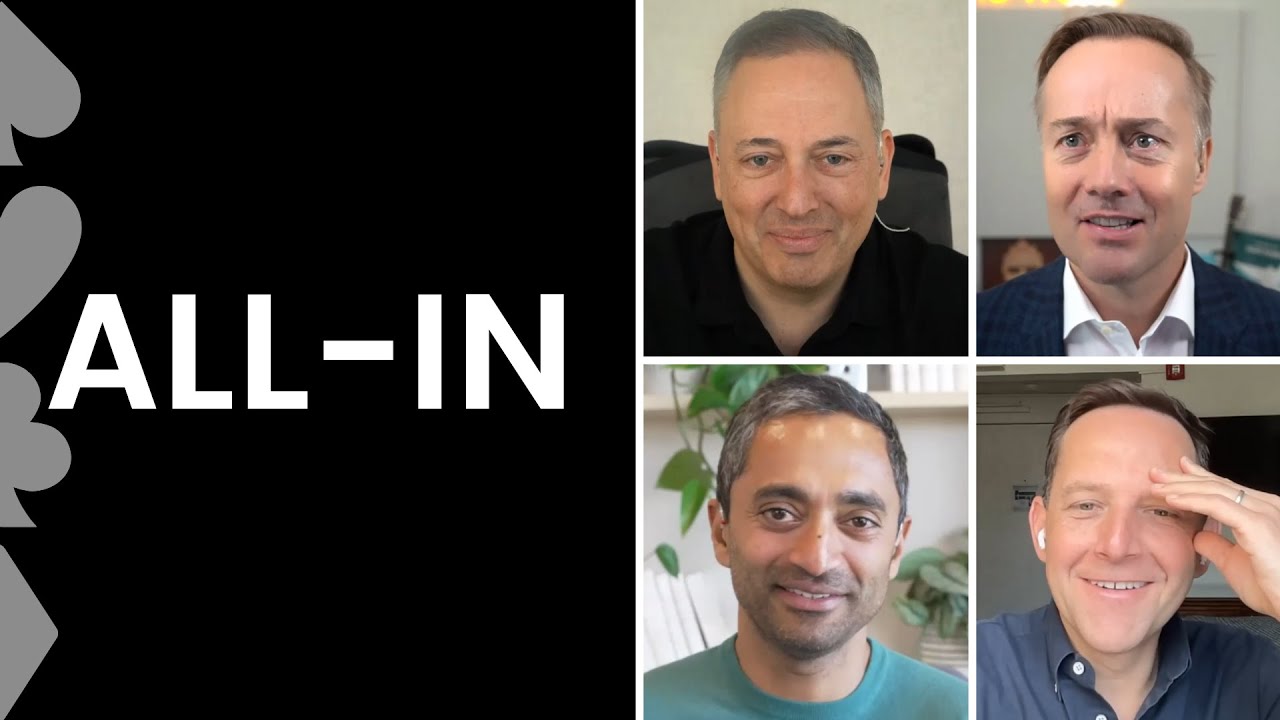
Featuring
Episode 76.5 is more compact than a usual numbered All-In, but it still gives you two clean disputes: whether softer inflation prints would mean real relief or just nicer year-over-year math, and whether France's 2022 warning sign was mainly about Ukraine backlash or a deeper three-way political fracture. Friedberg's opening China-and-food thesis is the boldest monologue of the episode, even if nobody really steps in to fight him on it. Sacks has the strongest hindsight-correct inflation argument, while Chamath gives the better high-level read on the French election.
Spice rack
Was 2022 inflation likely to fade in a way households would actually feel, or would any easing mostly be a statistical optical effect that still left Americans stuck with painfully higher prices?
Original point: Chamath argues that pandemic-era liquidity, home-equity withdrawals, stimulus, and labor-force distortion help explain the CPI spike, and that once that cash burns off inflation may prove more transitory than the market fears.
What everyone argued
Chamath Palihapitiya
Chamath says the inflation story is less mysterious than it looks: households were sitting on stimulus checks, unemployment support, and large amounts of tappable housing wealth, so demand stayed hotter for longer than the labor market could handle. From that premise he argues inflation may be more transitory than the mood suggests, while warning that the bigger danger is the Fed over-tightening into a recession after that temporary cash surge fades.
Jason Calacanis
Jason plays the consumer-side pressure test. He focuses on expensive gas, flights, hotels, and the possibility that households will start cutting trips and discretionary spending, which could turn inflation pain into a real growth slowdown. He is less interested in macro theory than in the practical question of whether consumers are about to slam on the brakes.
David Sacks
Sacks pushes back on the easy-relief story. He argues that even if the year-over-year headline cools later in 2022, that will mostly reflect base effects rather than consumers suddenly getting cheaper groceries or gas. His core point is that lower inflation is not the same thing as lower prices, so the White House may celebrate improving prints while the public still feels poorer.
Winner circle
Sacks takes this debate. Chamath offers a useful liquidity story and correctly spots recession risk as a live policy concern, but he overstates how quickly inflation would become meaningfully 'transitory' in practice. Sacks is more precise about what the public would actually experience: headline disinflation without restored price levels. Hindsight rewards that distinction because inflation eventually cooled while the sticker shock remained very real.
Commentary
Chamath Palihapitiya
Assumptions and fact checks
A meaningful share of the post-pandemic demand surge came from stimulus, unemployment support, and housing-linked liquidity rather than from a durable improvement in productive capacity.
Why it mattersThat is a reasonable reading of the environment. The transcript's exact home-equity number is difficult to pin down from the available source set, but the broader point that households were still able to spend against inflated balance sheets is well supported.
Once that excess cash was exhausted, inflation would cool enough that the market was underestimating how transitory the problem still was.
Why it mattersInflation did eventually fall, but it proved more persistent and policy-sensitive than this framing implied. The later path is much closer to 'painfully sticky before easing' than to 'mostly self-correcting once the slosh is gone.'
The bigger macro mistake in April 2022 was a likely Fed overreaction rather than still-embedded inflation pressure.
Why it mattersThe over-tightening risk was real, but hindsight does not support treating it as the dominant danger at that moment. Inflation remained serious enough that the Fed's tightening cycle was not obviously excessive.
Jason Calacanis
Jason is strongest when he translates macro abstractions into household behavior. He does not fully resolve the debate, but he keeps it tied to the lived question that eventually matters most: whether people actually feel any relief.
Assumptions and fact checks
Higher fuel and travel costs would materially change consumer behavior and become a visible drag on discretionary demand.
Why it mattersThat is a straightforward and reasonable assumption. Even without an immediate recession, households did not treat 2022's energy and travel inflation as harmless noise.
David Sacks
Sacks wins because he keeps the metric straight. Chamath is doing macro storytelling; Sacks is answering the narrower question the audience will actually feel in the grocery aisle.
Assumptions and fact checks
Headline inflation could improve while households still feel little actual relief because the price level remains much higher.
Why it mattersThat is exactly how disinflation works. Slower price growth is economically meaningful, but it does not undo the earlier jump in the price level.
Political backlash would remain strong even if later monthly reports looked better on paper.
Why it mattersThat held up well. Voters and consumers usually experience inflation through current prices, not through the distinction between a rising level and a falling rate of increase.
Inflation was around 2.5 percent a year earlier, rose above 5 percent by the summer of 2021, and was about 7 percent by December 2021.
CheckThe BLS CPI API implies year-over-year CPI of about 2.6% in March 2021, 5.4% in July 2021, and 7.0% in December 2021.
Was Marine Le Pen's 2022 surge mainly a backlash to inflation and Macron's Ukraine alignment, or a broader sign that France was splintering into unstable left, center, and right blocs?
Original point: Sacks argues that Marine Le Pen is gaining because she is tying inflation and cost-of-living pain to Macron's alignment with a prolonged Ukraine conflict and deference to Washington.
What everyone argued
Chamath Palihapitiya
Chamath reframes the French result as a deeper structural warning. His point is that the scary part is not only Le Pen's message on Ukraine or inflation, but the fact that France now has three powerful currents at once: a centrist Macron bloc, a far-right Le Pen bloc, and a far-left Mélenchon bloc that also cleared the low-20s. That, to him, is the real canary-in-the-coal-mine signal about democratic fragmentation.
David Sacks
Sacks says Le Pen is gaining because she is making a focused pitch around inflation, cost of living, French autonomy, and opposition to a protracted Ukraine war shaped by U.S. priorities. He expects that message to resonate more broadly across Europe if the war drags on and recession risk deepens.
Winner circle
Chamath wins the interpretation battle. Sacks correctly identifies one of Le Pen's effective messages, but he over-explains the result through Ukraine and Washington. Chamath's three-bloc frame is the more durable reading because it captures both the first-round arithmetic and the longer-run instability behind it. The later record is much closer to 'France is politically fragmenting' than to 'France was mainly rebelling against Macron's Ukraine stance.'
Commentary
Chamath Palihapitiya
Chamath does the more serious political diagnosis here. Sacks sees a real symptom, but Chamath better identifies the underlying disease.
Assumptions and fact checks
France's real warning sign was a broader three-way fracture rather than a simple referendum on Ukraine policy.
Why it mattersThat is the stronger reading of the first-round map and the later political trajectory. The electorate was clearly fragmenting along more than one axis.
The same fragmentation dynamic could plausibly spread elsewhere in Europe.
Why it mattersThat was a reasonable forward-looking call. Even where the exact party mix differed, Europe's center-ground was under visible populist pressure across multiple countries.
The first round effectively featured three major candidates clustered in the low-to-high 20s, and Mélenchon told supporters not to give a single vote to Le Pen.
CheckAvailable result summaries show Macron at 27.85%, Le Pen at 23.15%, and Mélenchon at 21.95% in the first round, and Le Monde's English coverage reported that Mélenchon urged supporters not to vote for Le Pen.
David Sacks
Sacks is directionally right about the economic message Le Pen was using, but he narrows the aperture too much. He treats one force inside the election as if it were the election's full meaning.
Assumptions and fact checks
The French movement toward Le Pen in 2022 is best explained by backlash to inflation and Macron's Ukraine posture.
Why it mattersThose forces mattered, but they are not sufficient by themselves. The first-round structure and later political context support a broader fragmentation story.
A longer Ukraine war would cause European electorates to question American leadership more openly.
Why it mattersThat risk was real and did surface in parts of Europe, but it did not cleanly define the 2022 French result on its own.
Le Pen campaigned on the rising cost of living and argued that stronger energy sanctions on Russia would be economically damaging for France.
CheckAxios's debate coverage reported that Le Pen attacked Macron over the rising cost of living and opposed a ban on Russian oil and gas because she said it would be catastrophic for France.
Macron defeated Le Pen in the runoff with about 58 percent to 42 percent.
CheckTime's election-night coverage reported estimated results of 58.2% for Macron and 41.8% for Le Pen, which is effectively the official outcome band.
Chamath's best contribution is the balance-sheet lens. His weakest move is collapsing 'inflation may eventually come down' into 'inflation is more transitory than people think,' which understates how long elevated prices can still hurt even after the rate of change slows.