Featuring
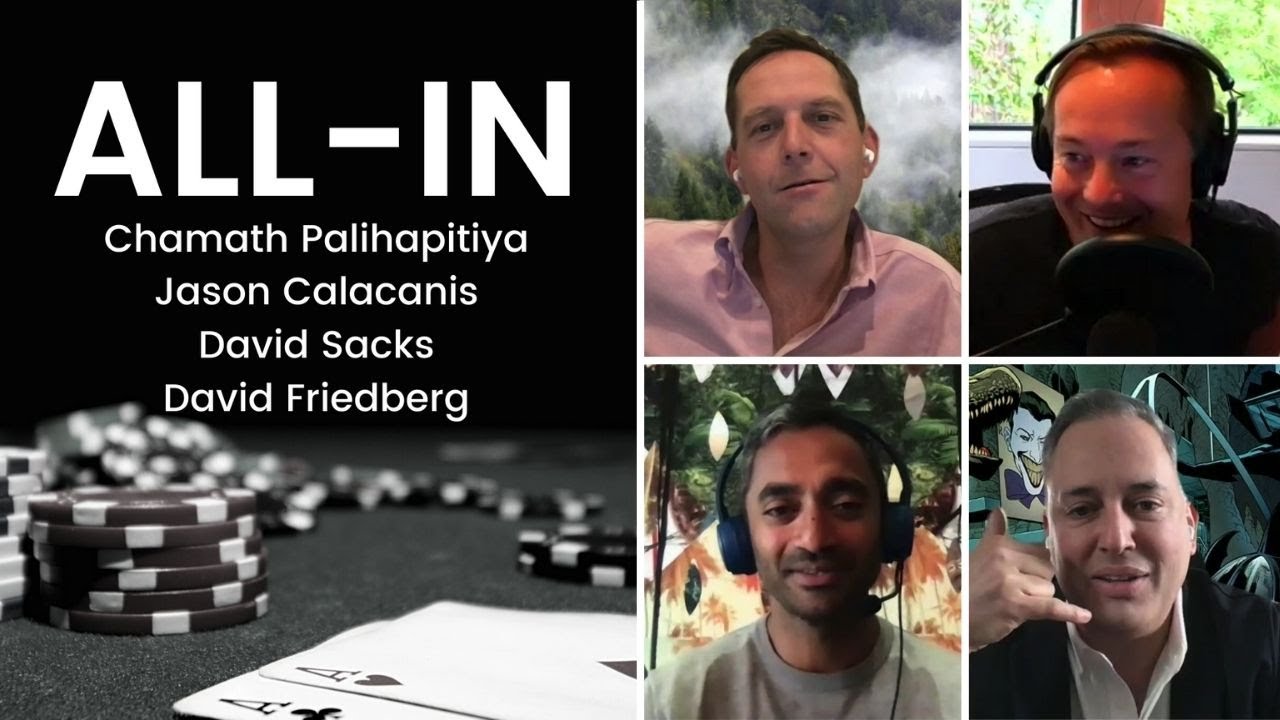
Episode 7 starts as a California vent session, sharpens into a real fight over AB5, gets serious on police reform, then ends with a revealing split on whether Biden's low-drama campaign is enough to beat Trump. The Jerome Powell and SPAC section is bullish and mostly harmonious, so the real spice sits elsewhere: labor rules, policing, and election math. Jason has a strong product-and-policy episode, Chamath brings the best top-down political framing, and Sacks is strongest when he talks incentives instead of predictions.
Spice rack
Should California force Uber and Lyft toward employee-style labor rules, or protect flexible contracting even if that leaves less labor protection in place?
Original point: Jason pivots from housing to AB5 and argues that California is paternalistically taking flexibility away from drivers, freelancers, and other contractors even when many of them prefer independent work.
What everyone argued
Chamath Palihapitiya
Chamath is less indignant than Jason or Sacks. His argument is that AB5 is partly a fight over surplus capture: when a few platforms create large margins, unions and governments will predictably move in to take a share. He says the law will hurt company margins and public-market expectations far more than it changes the basic desire of many drivers to work part-time, and he expects the business model to mutate through clever operating structures such as franchising.
Jason Calacanis
Jason argues AB5 is a classic California overreach. In his telling, drivers, freelancers, and entry-level workers are being denied the freedom to choose their own schedules even after the platforms offered some benefits funding. He keeps returning to the concrete user-level problem: if someone wants to work ten or twenty hours between other obligations, the state should not force a full employment model on them.
David Sacks
Sacks makes the cleanest anti-AB5 case. He argues the bill was driven by Teamsters-style regulatory capture, not by a serious effort to improve welfare. His core point is that banning people from making the kind of contract they actually want creates deadweight loss: consumers get a worse product, drivers lose flexibility, and the market becomes less efficient.
David Friedberg
Friedberg mostly predicts compromise and restructuring. He argues consumers naturally want a few simple services rather than dozens of fragmented apps, so regulation that disrupts the current model can make the product much worse. At the same time, he thinks the state, platforms, and courts are likely to negotiate toward a new equilibrium rather than permanently freeze the market in its most rigid form.
Winner circle
Jason and Sacks win this debate. Hindsight favors their core claim that California's first pass was too blunt: voters later approved Proposition 22 to preserve app-based contractor status with a narrower benefit framework instead of forcing a full employee model. Chamath was right that surplus capture and capital-structure assumptions were part of the fight, and Friedberg was right that the market would not stay frozen in the original AB5 posture. But the cleanest read was still Jason and Sacks: flexibility was central, the law overreached, and the state eventually had to carve the sector back out.
Commentary
Chamath Palihapitiya
Assumptions and fact checks
AB5 is fundamentally a fight over capturing excess platform economics rather than a neutral attempt to define worker dignity.
Why it mattersThat is not the whole story, but it is a real part of the story. The law sat at the intersection of labor policy, union power, and the fact that rideshare platforms had created visible, concentrated economic rents.
The long-run business response will be structural redesign, not simply the end of flexible work.
Why it mattersPlatform businesses do adapt, but the path is not frictionless. Chamath is directionally right that capital will search for a workaround, yet he understates the near-term disruption and legal uncertainty involved.
Jason Calacanis
Jason's advantage is that he keeps the issue tangible: hours, shifts, side gigs, and service disappearance in low-density places. He oversells the idea that the companies' portable-benefit gestures solved the labor problem, but his core warning about blunt reclassification proved more durable than the law's backers expected.
Assumptions and fact checks
Preserving schedule flexibility is more valuable to many rideshare drivers than forcing a conventional employee model on them.
Why it mattersThe later carve-out in Proposition 22 strongly suggests that political demand for preserving app-based flexibility was real. That does not prove every driver preferred the contractor model, but Jason was right that flexibility was central rather than incidental.
The state should not block a voluntary contractor relationship simply because a more protective labor model exists in theory.
Why it mattersThat position is coherent in a libertarian frame, but it discounts bargaining-power asymmetries and the fact that worker preference can be shaped by the absence of viable alternatives. Jason's freedom argument is strong, but not costless.
AB5 limited freelance writers, editors, and newspaper cartoonists to no more than 35 content submissions per year to a putative employer before they lost the exemption.
CheckThe enacted AB5 text says freelance writers, editors, and newspaper cartoonists qualify for the professional-services exemption only if they do not provide content submissions to the hiring entity more than 35 times per year.
California later adopted a statewide rule that app-based rideshare and delivery drivers remain independent contractors if companies do not prescribe specific dates, times, or minimum hours, while adding limited earnings and benefit requirements.
CheckProposition 22 later classified app-based drivers as independent contractors when specified conditions are met, including no prescribed minimum shifts, and added an earnings floor plus benefit requirements such as a healthcare subsidy and expense compensation.
David Sacks
Sacks is the sharpest debater in this segment because he distinguishes redistribution from deadweight loss. He would have been even stronger if he had granted more openly that some workers genuinely were exposed to benefit and security gaps under the pre-AB5 model.
Assumptions and fact checks
Forcing this kind of reclassification creates meaningful deadweight loss rather than merely shifting surplus from shareholders to workers.
Why it mattersSacks is right that the likely effect is not a simple transfer. When service coverage shrinks, wait times rise, and platform economics worsen in edge markets, some value is destroyed rather than merely reallocated.
AB5 was more about union leverage and political capture than about solving a genuine classification problem.
Why it mattersUnion leverage was clearly part of the politics, but the underlying classification question was not imaginary. The law targeted a real dispute about who counts as an employee, even if the chosen fix was clumsy.
David Friedberg
Friedberg contributes a useful product and market-structure lens, especially on why fragmentation makes the consumer experience worse. His negotiated-middle instinct aged better than the strict AB5 line, but it was Jason and Sacks who saw more clearly that the original law was too blunt for this category.
Assumptions and fact checks
Consumer demand for simplicity and dense marketplace liquidity naturally pushes this category toward concentration.
Why it mattersThat is a strong market-structure point. Transportation and delivery platforms benefit from network density, and consumers generally do not want to juggle many overlapping services.
California would ultimately settle on a negotiated or hybrid arrangement rather than leave the market in a binary employee-versus-contractor fight.
Why it mattersThat broad intuition held up, though not through neat elite negotiation. The eventual carve-out came through Proposition 22 and years of litigation rather than through the smoother compromise Friedberg seemed to imagine.
Will police violence fall mainly through structural reform inside policing, or is America's saturation with guns the deeper problem that overwhelms every downstream fix?
Original point: Chamath interrupts the market pivot because California's failure to lead on police reform bothers him more than any of the tax or governance stories, and the group shifts into a concrete argument about what reforms would matter most.
What everyone argued
Chamath Palihapitiya
Chamath presents the most complete reform package in the episode: end qualified immunity, route more crisis calls to de-escalation specialists, rationalize low-level drug enforcement, end no-knock warrants, and reverse police militarization. His broader argument is that California's progressive self-image is hollow if it cannot pass the kind of police reform its own coalition says it wants.
Jason Calacanis
Jason wants the reform conversation to become operational. He keeps returning to training, the Jacob Blake shooting, and the basic visibility problem. In his version, if police are trained for too short a period and not reliably recorded, the system will keep producing bad outcomes and then asking the public to trust opaque after-the-fact explanations.
David Sacks
Sacks agrees with better training, oversight, and body-camera expansion, but he pushes back hard on the idea that America is about to disarm itself. His contribution is mostly a feasibility argument: a lot of people believe they need guns for self-defense, and the current surge in fear and unrest is pushing demand for firearms up, not down.
David Friedberg
Friedberg offers the most radical theory of the problem: guns are the butterfly at the source of the storm. In his view, the entire downstream bureaucracy around police violence, training, body cameras, and reform complexity exists because officers and civilians inhabit a heavily armed environment. Remove that background threat and the whole logic of routine deadly-force fear changes.
Winner circle
Chamath and Jason win this debate. Friedberg is right that America's gun environment is a major upstream cause of police fear and escalation, but the strongest answer in practice is still institutional reform inside policing itself: training, accountability, camera coverage, crisis-response redesign, and narrower use-of-force doctrine. Sacks is right about the feasibility constraints around national disarmament, but he does less than Chamath or Jason to specify the actual reform path. The more useful and more durable position is the one that tries to fix police systems directly while acknowledging, rather than waiting to solve, the country's larger gun problem.
Commentary
Chamath Palihapitiya
Chamath gives the best substantive answer because he actually names reforms instead of just rehearsing outrage. Some of his package is easier to say than to enact, but he correctly focuses on policies that governments can change without waiting for a wholesale rewrite of American society.
Assumptions and fact checks
Structural changes inside policing can materially reduce violence even if the country remains heavily armed.
Why it mattersThat is the most practical reform logic in the segment. Better policy around force, warrants, crisis response, and accountability can change outcomes even if it does not remove every background risk.
California's political coalition should have made it easier, not harder, for the state to move first on meaningful police reform.
Why it mattersThat is a fair indictment of the state's internal contradictions. A one-party system that brands itself as reformist cannot plausibly blame total gridlock on external partisan obstruction alone.
Jason Calacanis
Jason is valuable here because he converts moral anger into systems questions: training, documentation, and rules. His six-month shorthand was imprecise, but the larger institutional point is sound and more actionable than generic culture-war rhetoric.
Assumptions and fact checks
Longer training and universal camera coverage would meaningfully improve policing outcomes and public trust.
Why it mattersThose are not magic fixes, but they are high-value institutional improvements. Better training and better records both change behavior at the margin and improve the quality of later accountability.
The Jacob Blake-style use-of-force problem is at least partly a training and doctrine problem, not just a bad-apple problem.
Why it mattersThat is the stronger systemic reading. When similar incidents recur across departments, it is hard to treat the issue as purely individual pathology.
The average basic training program for new police recruits in state and local law-enforcement academies is six months long.
CheckThe Bureau of Justice Statistics reported that, excluding field training, basic academy training lasted an average of about 840 hours, or 21 weeks. That is closer to five months than six, and the official measure also excludes later field training.
David Sacks
Sacks is useful mostly as a realism check. He adds less policy imagination than Chamath or Jason, but he is right that a reform agenda has to survive actual U.S. politics rather than a hypothetical clean slate.
Assumptions and fact checks
Sweeping gun removal is politically unrealistic in the United States, especially in a moment of urban unrest and rising fear.
Why it mattersThat is a sober assessment of American politics. Even people who support tighter gun policy often do not support anything close to mass disarmament.
Incremental police reform is a more plausible path than trying to solve police violence by first solving the country's entire gun problem.
Why it mattersThat is right as a sequencing argument. Structural policing reforms can be pursued directly, while gun policy remains a much larger and less tractable national fight.
David Friedberg
Friedberg's root-cause framing is intellectually strong and helps explain why the U.S. problem feels more intractable than narrower reformers admit. The weakness is priority, not diagnosis: the policy path from his insight to a better near-term reality is much murkier than the structural police reforms on the table.
Assumptions and fact checks
Gun prevalence is the deepest upstream driver of why American police interactions are more dangerous and more force-saturated than comparable rich countries.
Why it mattersThat is directionally right. The omnipresent possibility of civilian gun possession changes police posture, tactics, and perceived threat in a way that is much less common in less-armed peer countries.
Because guns are the upstream cause, they are the most important place to intervene first.
Why it mattersBeing upstream does not automatically make an intervention politically or institutionally first-best. Friedberg identifies a real background cause, but his preferred remedy is far less actionable than the reforms Chamath and Jason describe.
Was Biden the durable 'do no harm' favorite, or had Trump already found a winning late-summer path back through law-and-order politics and improving COVID optics?
Original point: Jason turns the show toward the presidential race and asks whether the market's even-money feel is right, setting up a disagreement between the 'Biden just has to not be Trump' theory and the 'Trump is finding a comeback pitch' theory.
What everyone argued
Chamath Palihapitiya
Chamath thinks Biden is in a stronger position than many people realize because Biden does not have to inspire voters with a grand project. He just has to be the acceptable non-Trump option. Chamath says that kind of low-friction, low-demand candidacy can be politically powerful, especially when the public is exhausted.
Jason Calacanis
Jason worries that Trump may be lining up a dangerous narrative arc: falling daily deaths, schools reopening, better testing, a possible vaccine surprise, and a booming market could all let him claim he solved the crisis just in time for the debates. Jason is not fully calling the race for Trump, but he thinks Democrats are underestimating the comeback setup.
David Sacks
Sacks is the most pro-Trump voice in the segment. He argues Biden's basement strategy was losing power as the economy improved and as unrest in Democratic-run cities gave Trump a sharper law-and-order sales pitch. He explicitly predicts Trump at this stage.
David Friedberg
Friedberg treats the race as a coin flip and then zooms out. His real interest is not horse-race punditry but the larger democratic mood: he thinks both sides are voting out of institutional anxiety, with each believing the other represents civilizational drift.
Winner circle
Chamath wins this debate. The eventual 306-232 Biden victory vindicates his core model that Biden did not need a grand affirmative mandate so much as broad permission to be the non-Trump alternative. Friedberg's coin-flip restraint aged better than Sacks's firm Trump prediction, and Jason was right to identify the comeback script Trump wanted to run. But the cleanest argument was still Chamath's: in 2020, 'do no harm' was enough.
Commentary
Chamath Palihapitiya
Chamath had the cleanest model of the race. He stripped the election down to a simple behavioral truth: support for Biden did not need to be passionate to be electorally effective.
Assumptions and fact checks
A candidate can win the presidency mainly by being the acceptable alternative rather than by generating strong affirmative enthusiasm.
Why it mattersThat is exactly what negative partisanship often looks like in a polarized electorate. The 2020 outcome makes Chamath's framework look more realistic than the panel's Trump-comeback scenarios.
Biden's visible stability mattered more than ideological excitement at this stage of the race.
Why it mattersThat proved broadly correct. Voters did not need Biden to dominate the mood of the country; they needed him to clear a competence and temperament threshold.
Jason Calacanis
Jason was sharp about the kind of story Trump wanted to tell, and he captured the tactical anxiety of the moment well. What he missed is that the underlying anti-incumbent case against Trump was more resilient than a late improvement narrative.
Assumptions and fact checks
Improving headline COVID optics and market strength could have been enough to restore Trump's electoral position.
Why it mattersThat was a plausible September concern, but it turned out not to be enough. Voters were evaluating Trump on a broader record than a single late-cycle narrative of improvement.
The first debate and late-campaign optics would dominate the final vote more than accumulated anti-incumbent sentiment.
Why it mattersDebates and optics mattered, but not enough to erase the larger anti-Trump coalition. Jason was describing a real tactical path, not the outcome voters ultimately chose.
David Sacks
Sacks reads the tactical openings for Trump better than the final electorate. He sees a plausible comeback script, but he mistakes plausibility for probability and ends up on the wrong side of the result.
Assumptions and fact checks
By early September 2020, the law-and-order frame and improving conditions made Trump likelier than Biden to win.
Why it mattersThat read did not hold up. The National Archives records Biden winning the Electoral College 306 to 232, and Trump's late-cycle message was not enough to overcome the broader coalition against him.
Voters would punish Democrats more for unrest in blue cities than they would punish Trump for the overall national mood.
Why it mattersThat issue mattered to some voters, but not enough to dominate the race. Sacks identified a real line of attack, but he overestimated its capacity to reset the election.
David Friedberg
Friedberg avoids the biggest pundit mistake in the segment by refusing to convert a noisy environment into too much certainty. His macro reading of democratic anxiety is stronger than his horse-race usefulness.
Assumptions and fact checks
As of early September 2020, the race was effectively close enough to describe as a coin flip.
Why it mattersThat was more defensible than a hard Trump prediction, even if hindsight makes it look somewhat too generous to Trump's chances. Friedberg's caution aged better than Sacks's certainty.
The deeper political story was democratic exhaustion and institutional distrust rather than conventional policy persuasion.
Why it mattersThat frame travels well beyond this single election. Even though Friedberg does not pick the winner cleanly, he describes the emotional structure of the race accurately.
Joe Biden ultimately won the 2020 presidential election with 306 electoral votes to Donald Trump's 232.
CheckThe National Archives records the certified 2020 Electoral College result as 306 votes for Biden and 232 for Trump.
Chamath is strongest when he explains the incentive structure behind AB5 instead of treating the law as pure ideology. He is weaker when he downplays how much the fight was really about worker flexibility and not just about redistributing public-market upside.