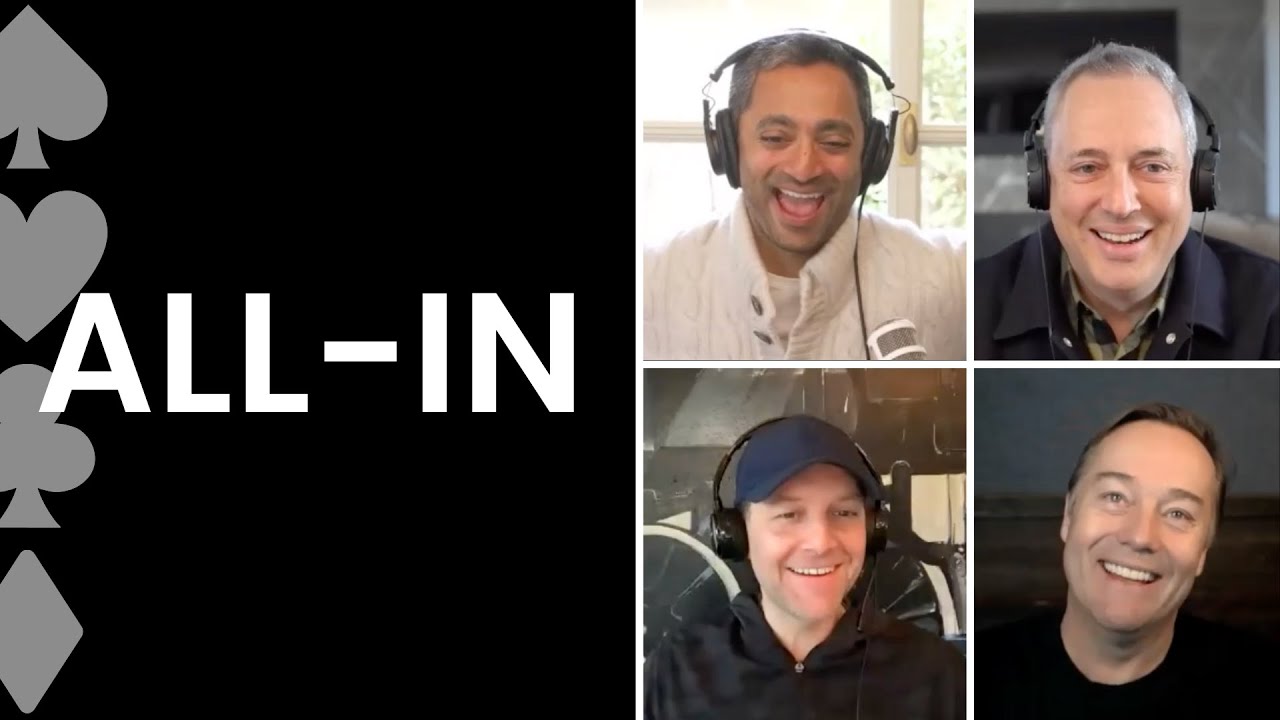
Featuring
Episode 64 starts as a cleanup operation after the Episode 63 backlash and then turns into a sharper, better show. The real action comes in three places: Lina Khan's attempt to rewrite antitrust, the question of whether 2022's tech bloodbath meant recession or just the death of easy-money nonsense, and the long Fauci-lab-leak segment where Sacks goes after the conflict story while Friedberg keeps insisting that suspicion is not the same thing as proof. Friedberg has the best hindsight call on the market segment, and Sacks lands the cleanest institutional critique of the episode.
Spice rack
Did Fauci and the NIH suppress the lab-leak debate because of a real conflict of interest, or does the evidence still fall short of Sacks's certainty about the virus's origin?
Original point: Chamath asks Sacks to explain what is happening with Fauci and the newly public emails, framing the segment around whether officials buried the lab-leak discussion.
What everyone argued
Chamath Palihapitiya
Chamath plays the synthesizer. He thinks the accounting matters because the implications matter, from biodefense to school policy, and he keeps asking for a cleaner public explanation. He does not insist on a specific origin as strongly as Sacks does, but he clearly believes the episode demands much more transparency than the public got.
Jason Calacanis
Jason keeps flagging the partisan contamination of the issue. He notes that mainstream outlets helped break parts of the story, then later asks why independent follow-through seemed to disappear. His contribution is less about virology than about how the press and political incentives warped the discussion.
David Sacks
Sacks argues that Fauci, Collins, Daszak, and the NIH ecosystem had both motive and institutional power to stigmatize the lab-leak theory. He says the conflict is obvious because U.S. money flowed through EcoHealth to Wuhan-linked research, Daszak misrepresented his impartiality, and officials moved from private uncertainty to public certainty far too fast.
David Friedberg
Friedberg resists certainty about intent or origin while accepting that the world needs a much clearer biodefense framework. His point is that whether SARS-CoV-2 came from an animal or a lab, the toolkit for engineering dangerous pathogens is becoming widely accessible, so the lesson cannot stop at blame.
Winner circle
Sacks and Friedberg split the win. Sacks is right that the conflict-of-interest story around EcoHealth, Daszak, and the early campaign against lab-leak discussion was serious and discrediting. Friedberg is right that the evidence still does not justify saying the origin question is settled, and that the more responsible policy frame is biodefense plus transparent accounting. The later official record rewards Sacks for smelling the institutional rot and Friedberg for refusing to overclaim what the evidence proves.
Commentary
Chamath Palihapitiya
Assumptions and fact checks
Even if the precise origin remains uncertain, the governance failures around disclosure and debate are important on their own.
Why it mattersThat is the best version of Chamath's contribution. Accountability and origin certainty are related but not identical questions.
Jason Calacanis
Jason sees the media failure more clearly than the underlying science. His role here is useful, but it is still a secondary frame around the main evidentiary dispute.
Assumptions and fact checks
The partisan coding of the lab-leak story materially discouraged clearer mainstream investigation.
Why it mattersThat is plausible and consistent with how the topic evolved in U.S. media and politics, even if the transcript does not prove every step of the mechanism.
David Sacks
Sacks is right to hammer the conflict problem and the effort to delegitimize inquiry. He loses precision when he treats a justified suspicion as a solved case.
Assumptions and fact checks
The speed and aggressiveness with which lab-leak discussion was stigmatized is evidence of institutional self-protection rather than neutral scientific caution.
Why it mattersThat is a fair inference from the conflict structure and the public messaging pattern, even if it does not prove every actor had the same motive.
Those conflicts make a lab origin the most likely explanation.
Why it mattersThe conflict evidence raises suspicion and justifies scrutiny, but it does not on its own resolve the origin question.
U.S. grant money flowed through EcoHealth Alliance to the Wuhan Institute of Virology.
CheckPublic reporting on the EcoHealth grant controversy shows NIH-funded EcoHealth work was routed to Wuhan Institute collaborators. That funding link is real even if the exact scope and classification of the research remain disputed.
We know the virus came from the lab.
CheckThe ODNI's June 23, 2023 declassified report says both natural and laboratory-associated origins remain plausible and that the intelligence community has no direct evidence of a specific WIV research-related incident causing the pandemic.
David Friedberg
Friedberg is the adult in the room here. He is less satisfying if you want a villain, but more defensible if you want the claim to survive contact with later evidence.
Assumptions and fact checks
The most durable policy lesson is to improve biodefense and oversight rather than to pretend the origin debate is already settled.
Why it mattersThat is the most responsible conclusion under continuing uncertainty. Governance and prevention do not require pretending the empirical question is closed.
The intelligence community still treats both natural and laboratory-associated origins as plausible.
CheckThe declassified ODNI report explicitly says both hypotheses remain plausible and that agencies differ mainly in how they weigh incomplete intelligence and scientific evidence.
Did January 2022's selloff point to a Fed-driven recession, or mainly to speculative assets getting repriced while the underlying economy stayed intact?
Original point: Sacks says Jeremy Grantham's 'superbubble' framing and the collapsing prices in growth assets may be early signs that aggressive policy tightening could turn into recession risk.
What everyone argued
Chamath Palihapitiya
Chamath argues the Fed is walking into a dangerous overcorrection. He points to China cutting rates, says Powell effectively caused a 2019 recession by moving too quickly, and warns that incomplete data could make officials crush demand after the market has already vaporized trillions in paper value.
Jason Calacanis
Jason presses the intuitive retail investor case: if Peloton, Zoom, Rivian, and other high-fliers were down 50 to 80 percent, surely that means they had been mispriced and that the system is correcting something unhealthy. He also tosses out current unemployment and repricing examples to keep the segment tied to tangible market names.
David Sacks
Sacks argues policymakers are pinballing from one self-inflicted overreaction to another: too much liquidity on the way up, then too much hawkishness on the way down. He thinks the real danger is not just that assets were inflated, but that officials could slam into recession by tightening into weakening global conditions.
David Friedberg
Friedberg pushes back that markets are not the economy. He says free money created many mini-bubbles in NFTs, random crypto, art, collectibles, and speculative growth names, but that bubble deflation does not by itself mean the productive core of the economy is in recession territory.
Winner circle
Friedberg wins. Jason is right that many pandemic-era favorites had been absurdly priced, and Sacks and Chamath are right that policy whiplash can create self-inflicted damage. But Friedberg is the one who keeps the key distinction intact: a speculative washout is not automatically the same thing as a broken underlying economy. Hindsight backs him because the repricing was dramatic while the immediate recession thesis proved overstated.
Commentary
Chamath Palihapitiya
Chamath's macro framing sounds sophisticated, but his confidence outruns the record. He gets the fragility of speculative assets right, yet he mistakes market pain for a cleaner signal about the real economy than it actually was.
Assumptions and fact checks
By January 2022, recession risk had overtaken inflation risk.
Why it mattersThat call was early. Hindsight shows inflation remained the harder macro problem for much of 2022, even though recession fears were understandable in growth markets.
The United States entered a recession in 2019 because the Fed raised rates too quickly.
CheckNBER's official business-cycle chronology shows the most recent pre-pandemic peak occurred in February 2020, not in 2019. The United States did not have an NBER-dated recession in 2019.
Jason Calacanis
Jason is right about froth, but his examples do not answer the harder question of whether froth equals recession. He helps the listener see the repricing; he does not really settle the macro diagnosis.
Assumptions and fact checks
A violent correction in obvious pandemic winners is strong evidence that markets were irrationally euphoric beforehand.
Why it mattersThat is broadly right. The speed and scale of declines in several growth names support the view that speculative pricing had outrun fundamentals.
U.S. unemployment was 3.7 percent in January 2022.
CheckThe Bureau of Labor Statistics reported a 4.0 percent unemployment rate in January 2022, with 6.5 million unemployed persons.
David Sacks
Sacks is analytically sharper here than the average doom narrator, but he still lets the market tape drive too much of the macro story. He sees the policy-whiplash risk clearly and still lands on the wrong balance of fears.
Assumptions and fact checks
The main macro danger in early 2022 was overtightening rather than persistent inflation.
Why it mattersHindsight does not support that as the dominant risk at that moment. Inflation stayed stubborn enough that the Fed's tightening cycle was not an obvious mistake.
David Friedberg
Friedberg is the clear winner because he keeps the categories straight. He neither denies the bubble nor mistakes it for the whole economy.
Assumptions and fact checks
Speculative asset deflation can happen without a broad recession if the labor market and productive businesses remain healthy.
Why it mattersThat distinction held up well in hindsight. The bursting of speculative pockets did not automatically translate into an NBER recession.
The January 2022 unemployment rate was 4.0 percent and the labor market was still relatively tight.
CheckThe BLS reported 4.0 percent unemployment in January 2022. Friedberg's broader point about a still-tight labor market is consistent with that data.
The United States did not enter a new NBER-dated recession in 2022 or 2023 after this discussion.
CheckNBER's current business-cycle chronology still lists February 2020 as the most recent peak and April 2020 as the most recent trough, meaning no later recession has been officially dated.
Should antitrust move beyond consumer harm and price effects, or does Lina Khan's broader enforcement logic become too subjective to administer?
Original point: Jason tees up Lina Khan's view that regulators should intervene before dominance hardens, even when a deal might look good for consumers on price or bundling.
What everyone argued
Chamath Palihapitiya
Chamath says Khan is at least identifying a real problem: capitalism assumes excess returns get competed away, and tech moats can distort that equilibrium. He thinks the mood in Washington has clearly shifted against Big Tech, but he also concedes the measurement problem is ugly and the implementation could become arbitrary.
Jason Calacanis
Jason plays translator for the listener and keeps pushing the concrete consumer question: if a merger gives people more content or better bundled services at the same price, why should regulators block it? His examples lean on the intuitive appeal of integrated consumer products.
David Sacks
Sacks says Khan has noticed real Big Tech power problems, especially in markets where users do not pay cash, but he thinks her remedies are too political and too uncertain. Once labor and other soft factors enter the test, he argues, merger review stops looking like law and starts looking like discretionary power.
David Friedberg
Friedberg worries that moving beyond consumer harm hands too much discretion to interpreters of what counts as competitive. His basic point is that a subjective enforcement standard will eventually create consumer harm anyway by blocking deals that could lower costs or improve products.
Winner circle
Sacks wins the core argument. Chamath is right that Big Tech power can outgrow a narrow consumer-price test, and Friedberg is right that subjective standards are dangerous. But Sacks best combines those two truths: the old framework is incomplete, yet Khan's replacement logic invites politicized and uncertain enforcement unless it can be translated into clearer legal rules than the episode provides. The later history of merger enforcement fits that conclusion better than the optimistic version of a cleaner regulatory reset.
Commentary
Chamath Palihapitiya
Chamath sees the structural tension correctly, but he does not solve the administrability problem. His best contribution is diagnosing why the old test looks incomplete, not proving Khan's replacement is durable.
Assumptions and fact checks
Big Tech's long-run market power cannot be captured adequately by a narrow consumer-price test.
Why it mattersThat is the strongest pro-Khan premise in the debate. Zero-price products and platform effects can hide real power even when sticker prices do not rise.
Regulators can widen the framework without creating major arbitrariness.
Why it mattersThis is where the case weakens. The broader the standard gets, the harder it becomes to distinguish principled competition law from ad hoc industrial policy.
Labor-market effects are now part of modern U.S. merger guidance.
CheckThe final 2023 FTC and DOJ Merger Guidelines explicitly say the agencies examine whether a merger may substantially lessen competition for workers or other sellers.
Jason Calacanis
Jason is helpful as the proxy for ordinary consumer intuition, but his framework is too short-term for the actual antitrust question. Better bundles can coexist with worse long-run market structure.
Assumptions and fact checks
If consumers immediately benefit on price or convenience, regulators should usually stay out of the way.
Why it mattersThat is an appealing rule of thumb, but it can miss future foreclosure, acquisition of nascent rivals, and bargaining power over creators or workers.
Microsoft announced a $68.7 billion all-cash acquisition of Activision Blizzard.
CheckMicrosoft's January 18, 2022 press release announced a $95 per share all-cash transaction valued at $68.7 billion including Activision Blizzard's net cash.
David Sacks
Sacks wins because he combines a concession with a limit. He grants that tech power can escape a price-only test, then shows why Khan's replacement standard risks becoming an open-ended political instrument.
Assumptions and fact checks
Competition law loses legitimacy when regulators cannot state a stable, knowable rule for firms in advance.
Why it mattersThat concern is well grounded. A legal regime that leaves major deals dependent on shifting political interpretation invites both lobbying and inconsistent results.
Labor concerns belong only weakly, if at all, in merger analysis.
Why it mattersThis is too categorical. Worker-side market power can be real, but Sacks is right that importing it raises measurement and line-drawing problems.
David Friedberg
Friedberg does not build a full antitrust theory here, but he lands the essential implementation warning clearly. His skepticism ages well because the problem turned out to be less recognizing new harms than proving them under workable rules.
Assumptions and fact checks
A more subjective enforcement test will eventually hurt consumers because good deals will be blocked along with bad ones.
Why it mattersThat is a reasonable institutional prediction. The more ambiguous the rule, the more likely it is to deter efficient transactions as well as anticompetitive ones.
Chamath is most useful when he narrows the conversation from internet tribalism to consequences. He adds discipline without pretending the evidence is simpler than it is.