Featuring
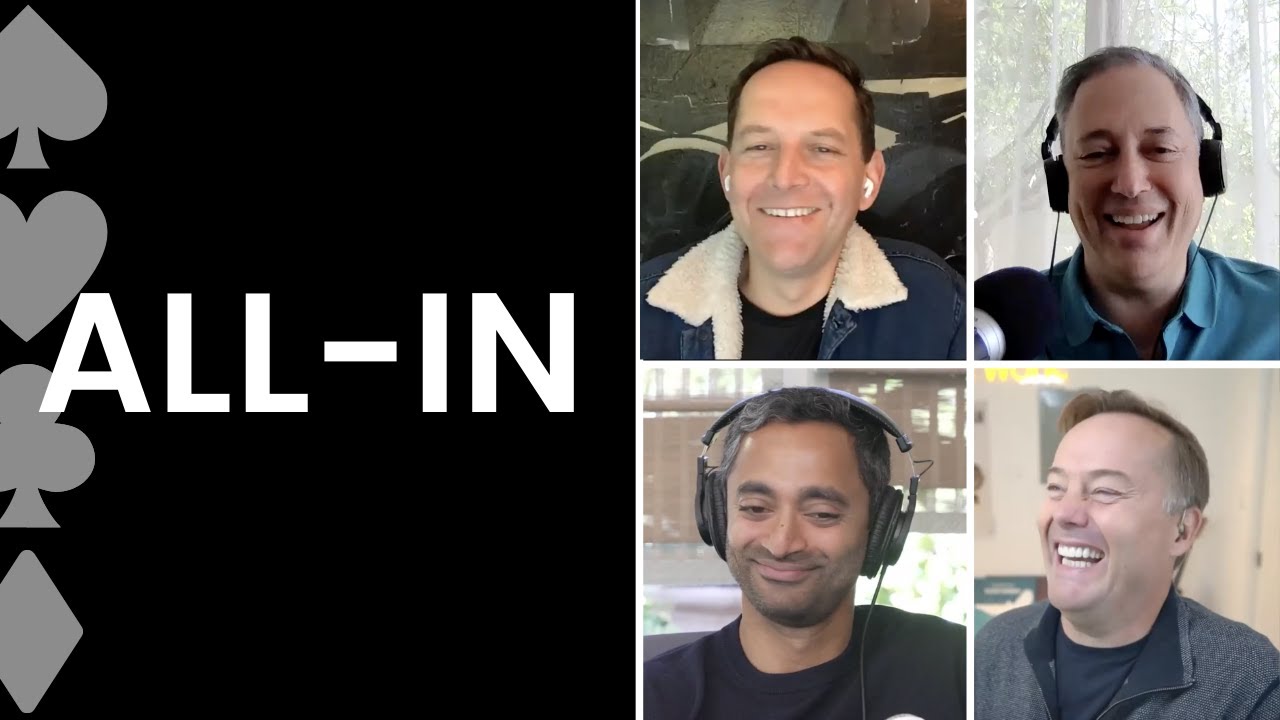
Episode 51 is the besties in peak 2021 form: port backups, inflation dread, a Netflix culture-war flare-up, Tether reserve panic, and a long fight over FDA process and vaccine mandates. The macro opening aged the best. Chamath and Friedberg were early to say the inflation shock looked sticky, while Sacks correctly saw the stagflation risk even if he got too cute with some of the blame assignment. Friedberg has the cleanest episode overall: steady on supply chains, sharp on scientific uncertainty, and allergic to turning every dispute into theater.
Spice rack
Were supply-chain disruptions a temporary bottleneck or the start of persistent inflation and stagflation pressure?
Original point: Chamath argues that labor scarcity and raw-material inflation are not transitory and says the market is underestimating how persistent the shock will be.
What everyone argued
Chamath Palihapitiya
Chamath says the market is misreading the situation as temporary. He argues that labor is structurally scarcer, wages are repricing higher, raw materials are 'going bananas,' and the only way out is paying materially more for work and inputs.
Jason Calacanis
Jason frames the disruption through concrete consumer pain points such as chip shortages and ports, then floats a partial silver-lining case: if workers are making materially more, maybe the middle class gets stronger even if the system feels jammed for a while.
David Sacks
Sacks argues the bigger risk is stagflation: prices up, wages up, but output constrained. He blames ports, unions, COVID-era labor incentives, Chinese energy constraints, and policy mistakes, then warns that debt and politics may leave the Fed less room to fight inflation than people assume.
David Friedberg
Friedberg offers the most systems-oriented read. He agrees the logjam can create a self-reinforcing inflationary spike, but he also points to balancing forces: automation, vertical integration, and corporate capex could eventually relieve the pressure and become deflationary.
Winner circle
The better side of the debate was the one warning that inflation pressure was not just a brief reopening hiccup. Chamath and Friedberg were directionally right that labor, inputs, and bottlenecks had moved the economy into a more persistent inflation regime than markets wanted to admit in October 2021. Sacks also deserves credit for seeing the stagflation risk, but his causal story got too neat and some of his evidence was overstated. Friedberg wins the narrowest and best version of the argument because he paired the inflation warning with a realistic description of how business adaptation might eventually ease it.
Commentary
Chamath Palihapitiya
Assumptions and fact checks
Higher nominal wages in labor-starved sectors would prove persistent rather than quickly mean-revert.
Why it mattersThat was a reasonable assumption in late 2021 and it fit what happened in 2022, even if the exact path varied by sector.
Worker behavior had changed enough after the pandemic that labor-force normalization would be slow.
Why it mattersThere was some truth here, but Chamath bundled together health effects, wealth effects, and cultural shifts more confidently than the evidence justified.
Chamath says inflation is here to stay rather than a short-term blip.
CheckWith hindsight, inflation stayed elevated well beyond a short reopening blip and forced a far more aggressive Fed response in 2022. The claim overshoots if read as permanent, but it was directionally right against the transitory framing.
Chamath says central bankers around the world had raised rates while the ECB and Fed had not.
CheckMultiple central banks had already begun tightening in 2021 while the Fed and ECB had not yet started rate hikes. The statement is broadly directionally correct, though it is a rough macro characterization rather than a precise census.
Jason Calacanis
Jason's instinct that wage gains are not automatically bad is fair. The gap is that he never fully resolves whether the wage story is a real-income improvement or just an inflation mirror.
Assumptions and fact checks
Higher low-end wages would meaningfully broaden the middle class even if inflation remained elevated.
Why it mattersThat can happen in some conditions, but it was undercut here by broad price pressure that eroded real purchasing power.
Jason says there were around 70 to 80 ships backed up off Los Angeles and Long Beach at the peak.
CheckThe ports backlog was historically large in that period and public reporting placed the queue in roughly that range. The exact peak moved quickly, so treat the number as approximate rather than exact.
David Sacks
Sacks correctly saw that output constraints plus price pressure could become more dangerous than a simple wage story. But his habit of pushing a clean villain narrative, especially around unions and labor-force exits, made the argument sloppier than it needed to be.
Assumptions and fact checks
Debt politics would meaningfully constrain how aggressively the Fed could fight inflation.
Why it mattersThe concern was intellectually serious, but the Fed still tightened sharply in 2022 despite those constraints.
Port frictions and labor policy were a major enough cause to materially threaten recession on their own.
Why it mattersThey mattered, but Sacks overconcentrated blame there relative to broader pandemic and global demand distortions.
Sacks says the September 2021 inflation rate was about 5.1%.
CheckThe CPI rose 5.4% over the prior 12 months in September 2021, not 5.1%.
Sacks says federal debt as a share of GDP had risen above 120% and near 140%.
CheckDebt-to-GDP did move above 120% during the pandemic era, but 'close to 140%' overstates the published series around that moment.
Sacks says four million people dropped out of the labor force last month.
CheckThat figure confuses labor-force exits with broader resignation or jobs-gap narratives. The September 2021 labor report was weak, but it did not show four million people leaving the labor force in a single month.
Sacks says there was not yet a date certain for 24/7 port operations when Biden announced the plan.
CheckThe White House announced a 24/7 expansion effort, but implementation details still depended on broader coordination. Sacks's skepticism about the announcement being less than a fully completed operational shift was substantially fair.
David Friedberg
Friedberg does the hard thing well here: he models the feedback loops without pretending the economy has one clean cause or one clean fix. That makes his forecast the most durable in hindsight.
Assumptions and fact checks
Automation and supply-chain integration would become a meaningful medium-term response to labor and logistics stress.
Why it mattersThat was a solid assumption and later business behavior broadly validated it, even if not fast enough to stop the 2022 inflation surge.
Friedberg says it may take at least about a year to work through the supply-chain logjam.
CheckThat time frame was broadly consistent with the policy and business discussion at the time and proved directionally realistic given how long inflation and logistics pressures lasted.
Did the Tether settlement reveal a giant solvency fraud, or a narrower reserve-misrepresentation scandal?
Original point: Jason reads from the CFTC language and argues the agency effectively confirmed that Tether lied about one-to-one backing, making the stablecoin shady and potentially fraudulent at huge scale.
What everyone argued
Chamath Palihapitiya
Chamath pushes back on scale. He says Jason is making the case sound like a Madoff-style crater when the fine size suggests regulators did not prove anything close to a $70 billion hole or a full collapse-level fraud.
Jason Calacanis
Jason argues that the key issue is simple: Tether said every token was backed one-for-one by dollars in the bank, and the CFTC said that representation was false. He escalates from there to the view that Tether is shady, co-mingled funds, and could be the beginning of the end.
David Sacks
Sacks argues stablecoins are conceptually simple and that the best reading is not 'everything is fake' but rather that Tether likely held real assets while using looser reserve practices and asset mixes than promised. He says he would prefer full dollar backing and cleaner audits, but does not read the case as proof of outright insolvency.
David Friedberg
Friedberg treats the reserve question as an audit and regulatory problem. If a product claims to be a one-to-one tokenized dollar, the backing should be easy to verify; that simplicity is exactly why the discrepancy matters.
Winner circle
Jason was right about the key regulatory fact and wrong about the confidence of the catastrophe extrapolation. The CFTC action showed that Tether's reserve representations were materially false and that commingling and non-fiat reserve practices were real problems, which is a major strike against the company. But Sacks and Friedberg had the better overall answer because they distinguished a serious reserve-misrepresentation scandal from proof of an immediate Madoff-scale solvency crater. The cleanest ruling is that Tether looked far shadier than its marketing claimed, but the 2021 enforcement record did not itself prove the largest version of Jason's thesis.
Commentary
Chamath Palihapitiya
Chamath properly forces the scale question. He is less convincing when he treats penalty size as if it were a clean proxy for the full seriousness of the deception.
Assumptions and fact checks
If regulators had found a literal giant reserve hole, the public enforcement outcome would likely have looked more severe.
Why it mattersThat is not foolproof, but it is a reasonable inference about what the CFTC action did and did not establish.
Chamath says the total fine was about $42 million across Tether and Bitfinex.
CheckThe CFTC announcement set out a $41 million penalty for Tether and a separate $1.5 million penalty for Bitfinex.
Jason Calacanis
Jason is right on the core fraud-adjacent behavior and wrong on his confidence about the exact magnitude. He would have won more cleanly by staying anchored to what the regulator actually found.
Assumptions and fact checks
Reserve misrepresentation at this scale probably signals a much larger solvency crisis underneath.
Why it mattersThat was a fair suspicion in context, but the enforcement record here did not itself prove the largest version of the thesis.
Jason says Tether represented that every USDT was backed one-for-one by dollars in the bank and that regulators found that was false.
CheckThat is the core of the CFTC action. The agency found Tether misrepresented that reserves fully backed tokens the majority of the time in the sample period.
Jason says Tether and Bitfinex co-mingled reserve or customer-related funds.
CheckThe CFTC said reserve funds were commingled with Bitfinex operational and customer funds.
Jason says Tether was banned from trading in Canada.
CheckI did not verify this claim from the checked primary source. The CFTC action does not establish a Canada trading ban, so the statement should not be repeated as fact without a separate source.
David Sacks
Sacks has the most defensible middle position: this is serious misconduct, but not conclusive proof of an immediate zero. That distinction matters, and he keeps it clear.
Assumptions and fact checks
A stablecoin can be solvent while still being materially dishonest about reserve composition and controls.
Why it mattersThat is exactly the kind of middle ground the enforcement record supports.
Sacks says the best-case reading is that Tether had the money but not all in dollars sitting in bank reserves.
CheckThat is consistent with the CFTC finding that Tether included non-fiat assets and unsecured receivables in reserves instead of holding all reserves as represented in dollars.
David Friedberg
Friedberg's frame is the clean one regulators should want: if you sell a digital dollar, act like one. He avoids Jason's leap and still preserves the seriousness of the conduct.
Assumptions and fact checks
Simple reserve products deserve stricter transparency expectations than complex balance-sheet businesses.
Why it mattersThat is a strong and sensible assumption; the simpler the claim, the less excuse there is for opaque backing.
Friedberg says this should be easy to audit if it is really a one-to-one tokenized dollar.
CheckThat is not a controversial factual claim so much as a correct characterization of the product design Tether itself advertised.
Do changing FDA recommendations justify skepticism toward blanket vaccine mandates for low-risk children?
Original point: Friedberg argues the FDA process is doing what it should do: new evidence changes recommendations, and that is a feature of science rather than proof of chaos.
What everyone argued
Jason Calacanis
Jason pushes the conversation toward mandates and tradeoffs. He jokes about YouTube moderation, then presses whether forcing the last holdouts, especially around children and narrow-risk cases, turns a scientific success story into coercion.
David Sacks
Sacks says changing expert guidance shows why people should resist turning probabilistic science into moral absolutism. He supports vaccination for himself, but argues that blanket mandates, especially for five-year-olds before the vaccine even existed for them, deserve stronger scrutiny.
David Friedberg
Friedberg argues science is supposed to update. Advisory votes, revised aspirin guidance, and dosage debates are not chaos; they are exactly how expert review should work. He also concedes that recommendations are probabilistic rather than absolute, but says that is an argument for better framing, not for abolishing expert gatekeeping.
Winner circle
Friedberg gives the best answer because he explains the difference between science updating and science failing. Sacks is right that the public translation of guidance often became overmoralized, and he is also right that child-mandate timing in October 2021 deserved caution. But Friedberg does a better job of holding the line between healthy skepticism about blanket mandates and lazy skepticism about expert process itself. In hindsight, the strongest position was not 'trust everything' or 'trust nothing,' but 'treat the evidence as provisional and be more careful when coercion reaches low-risk children.'
Commentary
Jason Calacanis
Jason is useful here because he keeps dragging the debate back from expert-process talk to actual coercive policy choices. He does not provide the strongest evidence-based answer himself.
Assumptions and fact checks
Forcing every remaining holdout to vaccinate can create more social harm than benefit in low-risk cases.
Why it mattersThat is a serious policy question, but the answer depends heavily on setting, age, transmission, and the exact mandate design.
Jason says Kyrie Irving was risking roughly $200 million by not getting vaccinated.
CheckThat figure was widely discussed at the time as a rough estimate of salary plus extension opportunity, though the exact number depended on contract assumptions.
David Sacks
Sacks is most persuasive when he criticizes the moralization of uncertain science. He is less persuasive when he edges toward treating that communication failure as stronger validation of generalized anti-vax doubt.
Assumptions and fact checks
Shifting recommendations legitimately increase public skepticism toward blanket mandates in low-risk populations.
Why it mattersThat is a fair assumption as long as the skepticism is targeted at policy design and timing rather than turned into a blanket anti-vaccine argument.
The upside for young children was so small that mandates were especially hard to justify in October 2021.
Why it mattersAs a timing-specific statement in October 2021, before authorization for ages 5 through 11 and amid evolving evidence, that caution was warranted.
Sacks says the Pfizer advisory panel vote was 16-2 against boosters for everyone and 18-0 for older or higher-risk groups.
CheckThat is consistent with contemporaneous reporting on the FDA advisory meeting.
Sacks says Gavin Newsom had just signed a California rule requiring public school children, including kindergarteners, to be vaccinated even though the vaccine did not yet exist for them.
CheckNewsom did announce a statewide student vaccine requirement, but it was contingent on full FDA approval for the relevant age groups rather than an immediate live mandate for kindergarteners. At the time of the episode, children ages 5 through 11 had not yet received FDA emergency authorization.
David Friedberg
Friedberg threads the needle better than anyone else. He neither mystifies the FDA nor trashes it; he treats uncertainty as normal and still defends the need for disciplined institutions.
Assumptions and fact checks
An expert regulatory process that updates with new evidence is still better than a free-for-all market for medical claims.
Why it mattersThat assumption is well grounded and Friedberg defends it without pretending the process is infallible.
Friedberg says the FDA advisory process had recently split on broad Pfizer boosters and later backed a half-dose Moderna booster for older or at-risk adults.
CheckContemporaneous reporting supports both the limited Pfizer booster recommendation and the later half-dose Moderna booster recommendation.
Friedberg says aspirin recommendations were being revised because bleeding risk outweighed benefit for many lower-risk adults.
CheckThat was the substance of the evolving preventive-care guidance in that period.
Was Netflix defending principle in the Chappelle fight, or just protecting a star too big to cancel?
Original point: Jason reads Sarandos's memo defending The Closer and asks whether Netflix, like Spotify and Coinbase, is signaling the end of cancel culture inside large companies.
What everyone argued
Chamath Palihapitiya
Chamath lands between the camps. He agrees there is massive economic incentive to protect Chappelle and says Netflix is ultimately following the customer, but he also thinks cancel culture may fade over time because everyone younger is too digitally exposed to sustain permanent moral purity tests.
Jason Calacanis
Jason reads the Sarandos memo as a manifesto. To him, Netflix is putting its foot down: customers can turn it off, employees can leave, but the company is going to defend provocative content and stop letting internal outrage dictate programming.
David Sacks
Sacks argues this is mostly about scale, leverage, and economics. Chappelle and Rogan are too big to cancel because platforms already paid them huge sums and know fans would revolt, but mid-tier creators would not get the same freedom or institutional courage.
David Friedberg
Friedberg defends the artistic case more directly. Good art should challenge people, offend sometimes, and expose audiences to uncomfortable ideas; if viewers keep rewarding that work, Netflix has reason to keep backing it.
Winner circle
Sacks has the best read of what was actually happening. Jason was right that the memo sounded unusually forceful and that Netflix did not cave on this specific special, but he overread one famous, expensive controversy as a sweeping corporate doctrine shift. Friedberg's defense of provocative art is strong on the merits, yet that is not the same as proving Netflix was acting from principle. In hindsight, this looks like a bottom-line-backed defense that happened to align with a speech-protective outcome, not a universal rule for all creators.
Commentary
Chamath Palihapitiya
Chamath is more persuasive when he talks incentives than when he shifts into memetic grand theory. The business explanation carries much more weight than the civilization-scale prediction.
Assumptions and fact checks
Digital overexposure will make future generations less able to sustain rigid cancellation norms.
Why it mattersIt is plausible, but it is more sociological speculation than something settled by evidence.
Chamath says there was a huge economic incentive for Netflix to stand by Chappelle.
CheckContemporaneous reporting made clear that Chappelle was a major asset for Netflix and that the controversy sat inside a broader subscriber and content strategy, not a minor internal disagreement.
Jason Calacanis
Jason correctly spots how striking the memo sounded in the moment. He gives it too much doctrinal weight and too little credit to the simple fact that Chappelle was expensive, famous, and hard to replace.
Assumptions and fact checks
This memo represented a durable turning point for large companies rather than a one-off star exception.
Why it mattersThe later record does not clearly support that broad claim. Netflix defended this specific asset, but the company did not prove a universal principle for lesser creators.
Jason says The Closer was released on October 5, 2021.
CheckThat is the release date of the special.
Jason quotes Sarandos as saying content on screen does not directly translate into real-world harm.
CheckThat language was widely reported from Sarandos's internal communication during the controversy.
David Sacks
Sacks keeps the argument disciplined. He does not confuse a useful free-expression outcome with proof that corporate management suddenly became principled absolutists.
Assumptions and fact checks
Large platforms will defend controversial speech more for revenue-dominant stars than for smaller creators.
Why it mattersThat is a strong institutional assumption and fits how firms typically allocate risk.
Sacks says Joe Rogan's Spotify deal was around $100 million.
CheckReporting at the time commonly described the deal at roughly that scale.
Sacks implies Sarandos later backed off the hardest version of his initial posture.
CheckSarandos later said he 'screwed up' and acknowledged that storytelling has real-world impact, which softened the earlier memo's framing.
David Friedberg
Friedberg is persuasive on why controversial art should exist. He is less persuasive on the narrower empirical question Jason asks, because liking the principle does not prove Netflix was guided by it.
Assumptions and fact checks
Provocation is often a sign of artistic value rather than a reason for removal.
Why it mattersThat is a coherent and well-supported artistic principle even if it does not answer every platform-governance question.
Chamath saw the persistence problem early and was willing to say so plainly. His weak point is evidence discipline: the thesis ages well, but several supporting mechanisms are asserted more than demonstrated.