Featuring
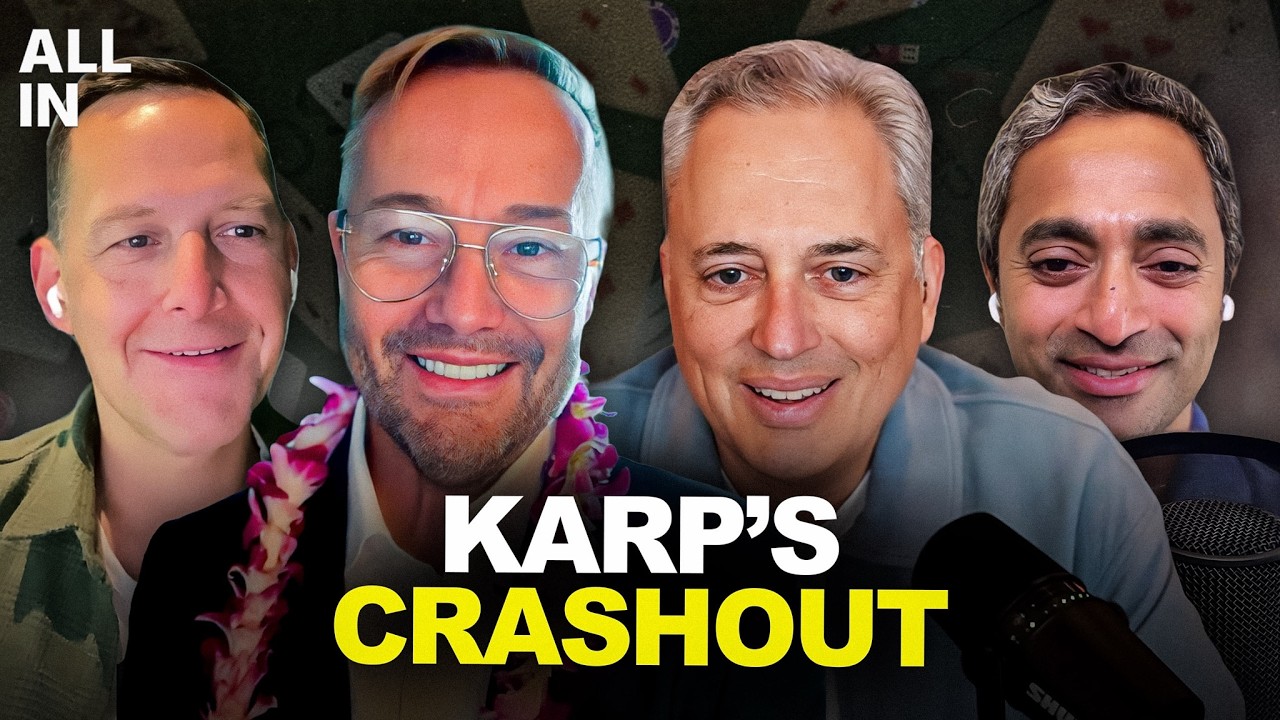
Episode 279 is mostly a fight about control: who controls your models, who controls the labor story around AI, who gets to define citizenship, and who is still pretending California's books are fine. The opening AI section is sharp, but the spiciest exchange comes when Sacks and Jason fight over whether Chinese open models should be treated like dangerous imports or like software America should beat in the open. Friedberg has the best all-around episode because he is the cleanest thinker in both the birthright segment and the California budget teardown, while Sacks lands the strongest evidence-based pushback in the AI jobs debate.
Spice rack
Should the U.S. restrict Chinese open models to force demand toward American models, or does that kind of ban isolate U.S. users and undermine the open ecosystem it needs to win?
Original point: After the Anthropic export-control discussion, Jason pivots to the opposite direction of trade and asks why the U.S. would allow Chinese open models such as DeepSeek or Kimi into the American market if Washington already blocks other Chinese tech categories.
What everyone argued
Chamath Palihapitiya
Chamath is not the main combatant in this segment, but his earlier framing carries into it: the open-model race matters because independent control planes and local deployments can reduce dependence on closed frontier labs. He implicitly strengthens Sacks's argument that open availability changes the security and competitive calculus.
Jason Calacanis
Jason argues that if Washington already restricts Chinese hardware and connected products, it should also consider blocking Chinese open models to strengthen American alternatives. His instinct is industrial and geopolitical: do not let a rival set the open-model standard if U.S. providers can do the job.
David Sacks
Sacks argues that once a model is open, it is no longer meaningfully 'Chinese' in the same way as a closed service. His core case is that U.S. firms can fork it, run it locally, keep data from flowing back abroad, and avoid imposing a needless token tax on themselves while the rest of the world keeps using open models anyway.
David Friedberg
Friedberg only plays a supporting role in this debate, but his adjacent infrastructure argument reinforces Sacks's broader frame: enterprises want their own inference instances and fewer hard dependencies on shared third-party stacks, which makes open alternatives more strategically important.
Winner circle
Sacks has the strongest case because he recognizes that open weights change the policy geometry. Once a model can be forked, audited, and run locally, the better strategy is to compete, harden, and win rather than strand U.S. users behind a self-imposed wall while the rest of the market keeps moving. Jason is asking a real question, but the proposed remedy is too blunt and too easy to turn into an own goal. The most defensible posture is security review plus domestic open-model strength, not broad isolation.
Commentary
Chamath Palihapitiya
Assumptions and fact checks
A strong domestic open-model ecosystem is strategically more valuable than trying to force everyone into a handful of closed U.S. frontier labs.
Why it mattersThat is a persuasive strategic frame because it widens adoption, lowers switching costs, and reduces concentration risk. It also matches the repo episode context around sovereignty and model control.
Jason Calacanis
Jason is doing useful strategic pressure-testing here. The issue is not that his question is silly; it is that the proposed remedy is too coarse for software that becomes much harder to classify geopolitically once it is open and locally controlled.
Assumptions and fact checks
The U.S. could materially accelerate American open-model adoption by cutting off Chinese open-model availability at the border.
Why it mattersIt could shift some marginal demand, but enforcement would be messy once weights are mirrored, forked, or locally adapted. The strategy may create friction without producing clean industrial-policy gains.
The security risk from letting Chinese open models circulate in the U.S. is large enough to justify ecosystem-wide restriction even when the models are run locally.
Why it mattersThat concern is not irrational, especially around backdoors and supply-chain trust. But the segment does not prove that a broad prohibition is more effective than code auditing, hardening, and domestic competition.
Palantir's new government-focused AI engine uses NVIDIA Nemotron open models in closed environments where agencies can run customized models on their own infrastructure and retain ownership of the resulting models and weights.
CheckNVIDIA's June 29, 2026 announcement says Palantir's new intelligent engine uses NVIDIA Nemotron open models in air-gapped environments and states that agencies can train on their own data while retaining full ownership of the resulting models, including the weights.
David Sacks
Sacks wins because he treats the software-distribution reality as the starting point rather than an inconvenience. He preserves security caution without confusing caution for a workable ban regime.
Assumptions and fact checks
Open release substantially changes the policy category because local operators can fork, inspect, and run the model without sending sensitive data back to the originating country.
Why it mattersThat is the key technical distinction in the segment and it is substantially right. The remaining issues are around auditing and trust, not ordinary cloud dependency.
A U.S.-only ban on open Chinese models would leave America paying more while the rest of the world keeps benefiting from open-model economics.
Why it mattersThat asymmetry is persuasive because open weights are hard to contain once released. A unilateral ban could easily turn into self-imposed disadvantage rather than durable strategic insulation.
David Friedberg
Friedberg is mostly a structural corroborator here. The core debate is Jason versus Sacks, but Friedberg's infrastructure lens helps explain why Sacks's answer is more than ideology.
Assumptions and fact checks
The strategic value of open models rises as enterprises seek more local control over inference, uptime, and cost structure.
Why it mattersThat matches both the enterprise-sovereignty theme of the episode and the practical attraction of hybrid deployment models.
Does the Constitution settle birthright citizenship broadly enough to foreclose Congress from narrowing it, or should lawmakers have room to distinguish between residents, temporary visitors, and illegal entrants?
Original point: Jason frames the Supreme Court ruling as a clear loss for Trump's executive-order effort and presses the panel on whether the Constitution already answers the question or whether the law should carve out distinctions between birth tourism, temporary visitors, and long-settled undocumented families.
What everyone argued
Chamath Palihapitiya
Chamath enters later and mostly shifts from the constitutional question toward the assimilation question. On the legal point, he does not supply a strong independent theory beyond conceding that the issue was not fully formed for him before the discussion.
Jason Calacanis
Jason defends the broad constitutional result while also insisting on a moral obligation to long-settled undocumented families. He is impatient with the idea that the hard cases can simply be dismissed as edge cases, and he keeps pulling the conversation back to real people rather than only original-intent abstractions.
David Sacks
Sacks argues that the 14th Amendment was meant to secure citizenship for freed slaves and should not be read as forever stripping Congress of the ability to legislate around modern categories such as illegal immigration or temporary visitors. He treats the current doctrine as an overextension of original purpose.
David Friedberg
Friedberg gives the most careful split between text and intent. He explains that original purpose points one way, textual language another, and then offers a narrower personal policy preference: citizenship should attach to children of legal residents but not to short-term visitors or tourists.
Winner circle
Friedberg has the strongest argument because he cleanly separates three different questions: what the text now means, what the original purpose was, and what policy rule he would personally prefer. That is more intellectually disciplined than Sacks's effort to preserve congressional room the Court has just narrowed, and more legally precise than Jason's moral but less doctrinally careful case. The current law is closer to Jason's broad reading than to Sacks's preferred one, but Friedberg best explains why without pretending policy preference and constitutional meaning are identical.
Commentary
Chamath Palihapitiya
Chamath is more audience than anchor in this legal segment. His real contribution comes later when the panel pivots from constitutional doctrine to immigration philosophy.
Assumptions and fact checks
The existing constitutional framework leaves too little room to distinguish among very different categories of non-citizen presence.
Why it mattersThat is a respectable policy frustration, but it is separate from the narrower legal question of what the Constitution and current precedent already require.
Jason Calacanis
Jason is messy but useful here. He forces the distinction between constitutional interpretation and preferred policy, and he is closer to the actual result than the speakers who keep arguing for a legislative space the Court has now narrowed.
Assumptions and fact checks
Long-settled undocumented families and their U.S.-born children deserve a more generous moral and legal response than the panel's birth-tourism hypotheticals suggest.
Why it mattersThat is a strong moral distinction and it helps reveal how much of the debate turns on very different fact patterns. It does not itself rewrite the Constitution, but it is a valid critique of muddled framing.
The Court's broad reading of the Constitution leaves less room for congressional narrowing than Sacks wants to preserve.
Why it mattersThat is what the current ruling most strongly implies. The present legal landscape is more restrictive for Congress than Sacks argues it should be.
A Chinese national pleaded guilty in 2019 to running a birth-tourism scheme that helped pregnant Chinese clients give birth in the U.S. so their children would obtain birthright citizenship.
CheckThe Justice Department said Dongyuan Li pleaded guilty in September 2019 to conspiracy to commit immigration fraud and visa fraud for operating a birth-tourism business that helped pregnant Chinese nationals come to the United States to give birth so their children would receive U.S. citizenship.
David Sacks
Sacks's policy argument is more persuasive than his account of where the law now stands. He never fully reconciles his preferred legislative flexibility with a Court decision that just narrowed it.
Assumptions and fact checks
The original purpose of the 14th Amendment should significantly narrow how broadly the Citizenship Clause applies to modern immigration categories.
Why it mattersThat is a live interpretive theory, but it is not the one that carried the day in the current ruling. As a jurisprudential position it is serious, but as a description of controlling law it loses force.
Congress should have policy space to distinguish between permanent residents, temporary visitors, and illegal entrants when assigning birthright citizenship consequences.
Why it mattersAs a policy preference this is coherent and easier to defend than the claim that Congress currently has that power under the Court's reading. The problem is legal authority, not the intelligibility of the policy distinction.
David Friedberg
Friedberg wins because he does the least category confusion. He distinguishes legal interpretation, legislative preference, and moral judgment instead of mashing them together.
Assumptions and fact checks
Textual meaning and original intent point in somewhat different directions in this case, and any honest analysis has to say so plainly.
Why it mattersThat is the strongest interpretive observation in the debate. It clarifies why speakers were often talking past one another.
A residency-based policy rule would make more practical sense than the broader current constitutional baseline.
Why it mattersThat is a plausible policy preference, but it is not the same as the best reading of existing constitutional law after the current ruling.
The Supreme Court recently affirmed birthright citizenship in a June 2026 ruling against Trump's order restricting citizenship for children born in the U.S. to undocumented immigrants or temporary visitors.
CheckAP reported that the Court upheld birthright citizenship in late June 2026, rejecting Trump's order and reaffirming the broad constitutional guarantee for people born on U.S. soil regardless of parental immigration status.
Is California's budget actually balanced and structurally sound, or is the state papering over a deeper fiscal spiral that ends in tax flight, debt restructuring, or something worse?
Original point: Friedberg opens the segment by saying California's so-called balanced budget is mostly accounting theater layered over ballooning costs, revenue concentration, out-migration, and massive long-dated liabilities.
What everyone argued
Chamath Palihapitiya
Chamath broadly agrees with Friedberg's diagnosis but predicts a harder reset than Friedberg does. He thinks the eventual endgame is negotiated restructuring, pension pain, and a political realignment forced by visible failure rather than a clean federal bailout.
Jason Calacanis
Jason says California had every conceivable advantage and still squandered them through incompetence. He emphasizes per-capita service value, high taxes relative to outcomes, and the idea that moderation rather than socialist escalation is the only politically survivable path.
David Sacks
Sacks agrees the budget picture is grim but disputes Chamath's idea that fiscal pain naturally produces a red-wave correction. He thinks the likelier political reflex is more blue-state redistribution, more confiscatory politics, and more pressure from the billionaire-tax movement rather than a clean self-correction.
David Friedberg
Friedberg gives the most detailed fiscal case: a large budget signed as 'balanced,' dependence on volatile high-income taxpayers, deferred liabilities, new taxes layered onto ordinary Californians, and a longer-run mismatch between promised obligations and durable revenue capacity.
Winner circle
Friedberg has the strongest argument because he is the only one who really walks the listener through the machinery of the problem. Jason contributes a fair performance critique, Chamath supplies the harshest-reset scenario, and Sacks adds the most useful warning that political incentives can make fiscal distress worse rather than better. But the debate's center of gravity is Friedberg's point that 'balanced' on paper is not the same thing as structurally sound. His long-run catastrophe language sometimes outruns the evidence, yet his underlying fiscal diagnosis is still the most defensible.
Commentary
Chamath Palihapitiya
Chamath is strongest on the inevitability of a reckoning and weakest on the confidence of his cure. He treats a possible sequence as if it were the most likely one.
Assumptions and fact checks
If California's structural imbalance worsens enough, pension and debt restructuring is more plausible than an uncomplicated federal rescue.
Why it mattersThat is conceivable, but the transcript does not establish enough institutional detail to rank it confidently above all other political outcomes.
Visible fiscal pain would eventually trigger a meaningful political correction rather than just more of the same governing model.
Why it mattersSacks makes a stronger case that fiscal stress does not automatically create ideological moderation. Political systems often double down before they reform.
Jason Calacanis
Jason is right that performance matters more than branding. He is less convincing when he substitutes ridicule for a more granular account of the fiscal mechanics.
Assumptions and fact checks
California's fiscal problems are significantly a competence problem rather than only a tax-base volatility problem.
Why it mattersThat is persuasive because political choices about spending growth, deferrals, and tax design are part of the story. Revenue volatility matters, but it does not explain everything.
Moderate voters will ultimately reject escalating redistribution strongly enough to force a cleaner political correction.
Why it mattersThat is possible, but the transcript itself supplies evidence that leftward pressure inside California politics is still strong and may intensify before it recedes.
David Sacks
Sacks's rhetoric is the least disciplined part of his segment, but his substantive point about political dynamics is important. Fiscal deterioration does not automatically produce prudence.
Assumptions and fact checks
Fiscal stress in a deep-blue state is at least as likely to intensify redistribution politics as to produce a center-right reform turn.
Why it mattersThat is a strong political caution because governing coalitions often radicalize under pressure instead of moderating. The current billionaire-tax fight is consistent with that risk.
The billionaire-tax push is politically real enough that Newsom's opposition was not sufficient to stop it from becoming a live statewide fight.
Why it mattersThe reviewed reporting supports the claim that Newsom opposed the measure and failed to keep it off the ballot. That makes Sacks's political read more than pure flourish.
David Friedberg
Friedberg wins because he gives the debate an actual fiscal spine. He sometimes lets the end-of-the-union rhetoric get ahead of the evidence, but he still explains the structural problem better than anyone else.
Assumptions and fact checks
A budget can be legally balanced while still masking a deeper structural problem through deferrals, borrowing, reserve draws, and future obligations.
Why it mattersThat is one of the most defensible points in the whole segment. Formal balance and structural resilience are not the same thing.
California's combination of spending growth, tax-base concentration, and wealth-flight risk leaves it meaningfully more fragile than the governor's framing suggests.
Why it mattersThat is well supported by the reviewed reporting and by the state's own long-running reliance on high-income taxpayers and stock-market-sensitive revenues.
Newsom signed a nearly $352 billion California budget at the end of June 2026 and presented it as balanced and fiscally responsible.
CheckAP reported that Newsom signed a nearly $352 billion spending plan on June 30, 2026 and cast it publicly as fiscally responsible. Separate reporting earlier in the year also described the state's ongoing shortfall and differing deficit estimates.
Is AI already causing broad job loss, or are current deployments mainly creating growth while only gradually displacing narrower categories of work?
Original point: Friedberg argues that the popular story of an imminent AI-driven employment bloodbath is collapsing under actual enterprise usage data, because deployments are clunky, gradual, and more growth-oriented than the media narrative admits.
What everyone argued
Chamath Palihapitiya
Chamath says the current data can show hiring growth and still be consistent with future displacement. His position is that customer support, BPO-style work, driving, and other repetitive roles are plainly in the automation crosshairs even if the layoffs have not yet shown up at scale in present-tense payroll data.
Jason Calacanis
Jason takes the strongest displacement line. He says consumer preference and company incentives will retire obvious roles such as basic support, drivers, warehouse sorting, and last-mile delivery, even if the rollout is uneven and hits foreign labor markets first.
David Sacks
Sacks argues the current evidence cuts against the apocalypse story. He cites recent firm-level hiring data, says companies using AI most intensely are actually growing faster, and contends that many high-profile 'AI layoffs' claims were really hype, overhiring cleanup, or executives free-riding on the media's preferred narrative.
David Friedberg
Friedberg says the labor story is being misread because enterprise AI is more awkward and complementary than revolutionary. He thinks the immediate pattern is revenue growth, workflow experimentation, and a premium on human judgment rather than a fast collapse in headcount.
Winner circle
Sacks has the strongest case because he keeps the question anchored to current evidence instead of future conviction. Friedberg is a close second because his clunky-deployment framing helps explain why AI adoption can grow headcount before it eliminates tasks. Jason and Chamath identify real exposure zones, but they repeatedly substitute plausible forecasting for demonstrated current labor effects. The best synthesis is that displacement risk is real, but the broad near-term bloodbath story remains ahead of the data.
Commentary
Chamath Palihapitiya
Chamath's forecast could still prove directionally right, but he argues it as if the future has already arrived. Sacks is justified in forcing him back onto the present evidence.
Assumptions and fact checks
Current payroll data can look healthy even while meaningful category-level automation is already underway beneath the surface.
Why it mattersThat is a reasonable interpretation because adoption can first reallocate tasks and only later reduce headcount. Early-stage deployment friction and revenue growth can mask eventual displacement.
The currently most visible AI effect is the retirement of large blocks of routine customer support and driving jobs.
Why it mattersThose categories are exposed, but the transcript does not supply decisive present-tense evidence that the displacement is already happening at the scale Chamath implies.
Jason Calacanis
Jason is strongest when he identifies the vulnerable job categories and weakest when he treats forecast confidence as a substitute for evidence that the change has already happened.
Assumptions and fact checks
Consumer-facing and repetitive operational roles will be among the first categories where AI and robotics substantially reduce human labor demand.
Why it mattersThat is a plausible exposure ranking and matches how firms usually target automation. The unresolved issue is timing, not direction.
Present anecdotal momentum from robotics and autonomy is strong enough to treat large-scale job retirement as effectively underway now.
Why it mattersThat goes beyond what the transcript and reviewed reporting support. Exposure and investment interest are not the same as broad realized labor substitution.
David Sacks
Sacks wins by making the narrow claim the evidence can actually bear. He does not deny future displacement; he just refuses to call it a current fact without current proof.
Assumptions and fact checks
Current claims of sweeping AI-driven job loss are overstated relative to the evidence available today.
Why it mattersThat is the strongest reading of the evidence cited in the episode. The reviewed firm-level data and the panel's own anecdotes point more to uneven integration than mass displacement.
Human-in-the-loop service and higher-tier support work will remain more durable than the panic narrative suggests.
Why it mattersThat fits both the human-premium argument and the practical reality that firms still value escalation paths, trust, and judgment in customer-facing workflows.
A recent Ramp and Revelio Labs study of roughly 22,000 U.S. firms found that heavy AI adopters increased total headcount by about 10% over two years and entry-level headcount by about 12%.
CheckBusiness Insider's summary of the Ramp and Revelio Labs analysis reported nearly 22,000 firms and described high-intensity AI adopters as growing overall headcount by about 10.2% and entry-level headcount by about 12% over the measured period.
David Friedberg
Friedberg gives the best systems-level story of why the labor market has not broken the way the loudest forecasts predicted. His argument becomes strongest when paired with Sacks's harder evidence standard.
Assumptions and fact checks
Current enterprise AI adoption is still clunky enough that firms are more likely to add complementary labor than to remove large amounts of it immediately.
Why it mattersThat is consistent with the reviewed adoption data and with the broader pattern that integration work creates new coordination and validation needs before it eliminates staff.
Human interaction will become more, not less, economically valuable in many workflows once automation becomes common.
Why it mattersThat is plausible in many premium or trust-sensitive categories, but it is still more of a market intuition than a settled empirical result.
Chamath is adjacent rather than central here, but his earlier case for sovereign deployment gives Sacks's anti-ban position more strategic depth.