Featuring
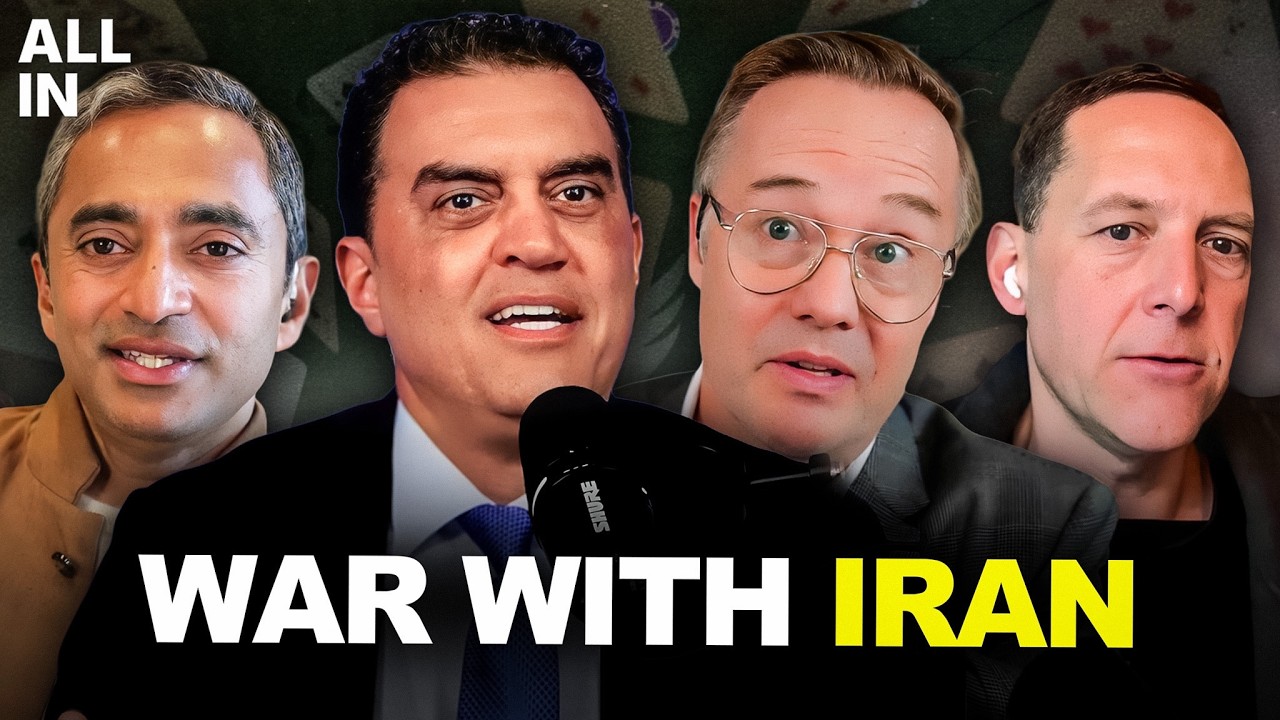
Under Secretary of War Emil Michael joined Jason, Chamath, and Friedberg for an emergency tour through the Iran war, autonomous weapons, and the fight over Claude inside the Pentagon. The sharpest clash came when Friedberg pressed Michael on whether a real vendor-dependency problem justified branding Anthropic a supply-chain risk. Chamath had the boldest geopolitical theory, but Friedberg had the best episode: he kept separating operational necessity from the breadth of the remedy.
Spice rack
Did Anthropic's contract restrictions justify a defense supply-chain-risk designation?
Original point: If Anthropic's operating philosophy no longer fit the Pentagon, the government could migrate to other models; Friedberg asked why it also needed the punitive supply-chain-risk label.
What everyone argued
David Friedberg
Friedberg accepted that the Pentagon and Anthropic had incompatible operating rules, then challenged the remedy: replace Claude and move on instead of applying a designation with consequences across the defense supply chain.
Emil Michael
Michael argued that Anthropic's policy preferences and control over model updates created a poisoning, refusal, or shutdown risk anywhere in the defense enterprise. On that theory, letting Lockheed Martin or Boeing use Claude for weapons work could reintroduce the same dependency even after the Pentagon migrated its own systems.
Winner circle
Friedberg wins the remedy question; Michael wins the warning. The Pentagon was entitled to stop relying on a vendor whose terms it could not accept, and Michael persuasively exposed the danger of a privately controlled single point of failure. But the evidence in the episode did not bridge the gap from that dependency to a sweeping supply-chain-risk designation, and later judicial scrutiny reinforced the proportionality problem.
Commentary
David Friedberg
Assumptions and fact checks
The designation was punitive rather than tailored to the operational dependency Michael described.
Why it mattersThe Pentagon had a legitimate continuity problem, but the designation reached contractors and uses beyond the embedded military workflows. The preliminary injunction specifically treated the broad measures as likely punitive and unsupported by the governing supply-chain rationale.
The supply-chain-risk designation was an additional action beyond simply abandoning Anthropic and using other vendors.
CheckCRS reported that the designation barred defense contractors, suppliers, and partners from working with Anthropic and provided for a transition away from its products, making it materially broader than ending one contract.
Emil Michael
Michael identifies the right engineering failure and overstates the legal remedy. The strongest version of his case is not that Anthropic has the wrong politics; it is that no private model vendor should retain untested control over a mission-critical dependency. That principle supports replaceability and tight contracts more directly than a sweeping blacklist.
Assumptions and fact checks
A model supplier's ability to update, refuse, or withdraw service is a national-security continuity risk when its system is deeply embedded.
Why it mattersMission-critical systems need version control, redundancy, assured support, and tested failover. A supplier-policy dispute can expose poor architecture even if the supplier never acts maliciously.
That continuity risk justified treating all defense-related use of Anthropic products as a statutory supply-chain threat.
Why it mattersThe transcript establishes a vendor-governance risk, not sabotage or malicious subversion across every contractor use. The missing comparison is whether narrower procurement, escrow, audit, transition, and multi-model controls could address the actual failure modes.
Anthropic was deeply deployed in mission-critical national-security work and a transition risk existed.
CheckAnthropic's February statement said Claude was extensively deployed for intelligence analysis, simulation, operational planning, and cyber operations; its March statement offered continuing engineering support during a transition so warfighters would not lose tools mid-operation.
Anthropic sought case-by-case authority over particular military operations.
CheckAnthropic publicly said it accepted that the military makes operational decisions and described two standing use restrictions—mass domestic surveillance and fully autonomous weapons without proper safeguards—not ad hoc vetoes over individual missions. Private negotiating exchanges cannot be independently verified from the public record.
Was pressure on Iran and Venezuela mainly designed to create leverage over China?
Original point: The Iran and Venezuela operations created leverage over China's oil supply ahead of a possible U.S.-China grand bargain.
What everyone argued
Chamath Palihapitiya
Chamath made the strongest version of Friedberg's theory: slower Chinese growth could make external conflict more attractive, while U.S. pressure on Iran, Venezuela, and potentially Russia could hem in China's oil supply and create leverage for a deal.
David Friedberg
Friedberg argued that reducing Iran's and Venezuela's ability to supply China created negotiating leverage before high-stakes U.S.-China meetings. He expected the administration to prefer a grand bargain over regime change or a prolonged regional war.
Emil Michael
Michael said China leverage was a second-order benefit. He centered the stated operation on degrading Iran's ability to supply armed groups, drones, ballistic missiles, and nuclear capability rather than on engineering a U.S.-China bargain.
Winner circle
Michael wins the narrow burden-of-proof round. Friedberg and Chamath identified a real source of leverage, but they promoted a plausible second-order effect into the central explanation without evidence of internal intent. Their case also leaned on inflated supplier shares and an overly mechanical claim that slower Chinese growth makes a Taiwan invasion rational.
Commentary
Chamath Palihapitiya
Chamath supplied the episode's boldest strategic model, but two leaps weaken it: supplier shares became larger in the telling, and economic stress became a near-mechanical reason to invade Taiwan. A stronger case would treat oil pressure as one bargaining asset among many rather than the master explanation.
Assumptions and fact checks
Slower growth makes invading Taiwan an obvious, rational way for China's leadership to absorb unemployment and stimulate production.
Why it mattersDiversionary-war incentives are conceivable, but war over Taiwan would threaten trade, capital access, infrastructure, military credibility, and regime stability. The claim ignores the decision-maker's full risk ledger.
Constraining several oil suppliers would materially improve U.S. bargaining leverage over China.
Why it mattersChina depends heavily on imported crude, so supply risk matters. The leverage is not absolute: suppliers are diversified, Russia retains pipeline access, and EIA estimated China held roughly 1.5 billion barrels of strategic inventory in early 2026.
China set a 2026 GDP growth target of 4.5% to 5%.
CheckChina's government work report set a 4.5% to 5% target and said policymakers would strive for a better result.
Iran and Venezuela supplied about one-fifth of China's crude imports, and Russia raised the combined share to about 40%.
CheckEIA's latest complete supplier breakdown put Iran at 11%, Venezuela at 2%, and Russia at 20% of China's 2024 crude and condensate imports. The combined shares were about 13% without Russia and 33% with Russia, not roughly 20% and 40%.
David Friedberg
Friedberg's theory is valuable as a second-order-effects map and too thin as a claim about primary intent. He would have won a narrower debate—whether China feels the oil pressure—but not this one about why the operations occurred.
Assumptions and fact checks
Creating oil leverage over China was a core motivation for the Iran and Venezuela operations.
Why it mattersThe strategy is coherent, but public supplier data cannot establish private presidential intent. Michael, the administration official in the room, called it a second-order benefit rather than the central purpose.
The leverage could produce a broad U.S.-China bargain rather than retaliation or accelerated diversification.
Why it mattersSupply vulnerability can encourage negotiation, but it can also encourage stockpiling, alternative routes, closer ties with Russia, and counterpressure. The episode did not compare those responses.
About 90% of the oil exported by Iran went to China.
CheckEIA tanker-tracking analysis found China took nearly 90% of Iran's crude oil and condensate exports in 2023. That describes Iran's export destination, not Iran's share of China's total oil supply.
Emil Michael
Michael wins mostly by respecting the evidence limit. His answer would be stronger if he separated the administration's formal rationale from his personal view and acknowledged how a secondary oil effect could still shape timing.
Assumptions and fact checks
China leverage was secondary to the operation's direct Iran-focused security objectives.
Why it mattersThis matches the publicly stated objectives and demands fewer unsupported inferences about internal strategy. It does not rule out China leverage as a meaningful benefit.
Should Anthropic repair the Pentagon rupture with political outreach or binding product commitments?
Original point: Anthropic should stop looking hostile to the administration, show up for the president, and demonstrate patriotism even without making political donations.
What everyone argued
Chamath Palihapitiya
Chamath called Jason's political-outreach advice terrible and proposed a customer remedy: admit the misstep, permit everything lawful, and make the terms stable enough that the Pentagon could trust the product not to change underneath it.
Jason Calacanis
Jason argued that Anthropic had made itself look unpatriotic and politically isolated. His repair plan was visible engagement: support the president, attend administration events, and stop behaving as though neutrality required distance.
Emil Michael
Michael endorsed Chamath's proposal because he wanted a steady partner whose model would support emerging autonomous applications without changing posture during a crisis. He added that Anthropic's attacks on President Trump created a separate political repair problem.
Winner circle
Chamath wins the practical advice round. Jason was right that hostile optics carry a cost, and Anthropic's later tone apology bears that out. But only Chamath addressed the core customer problem: the Pentagon needed predictable permissions and stable service, though a sound agreement should define precise safeguards rather than rely on the phrase 'all lawful use.'
Commentary
Chamath Palihapitiya
Chamath wins by aiming at the contract instead of the dinner calendar. His cure is still too binary: reliability does not require a vendor to abandon every red line, but it does require clear, stable terms and a technical design that prevents surprise refusals.
Assumptions and fact checks
Contractual reliability mattered more than political attendance or donations to restoring the Pentagon relationship.
Why it mattersThe stated dispute concerned allowable uses, model control, and continuity. Political outreach might soften negotiations, but it would not resolve incompatible product terms.
Anthropic should have accepted every lawful use without preserving its two standing safeguards.
Why it mattersA durable agreement could instead define human-control thresholds, surveillance boundaries, audit rights, version guarantees, and emergency exceptions. 'Lawful' is a floor, not a complete safety or procurement specification.
Anthropic could have ended the dispute by accepting an all-lawful-use standard and stable terms.
CheckThe Pentagon publicly identified all lawful purposes as its fundamental requirement, and Michael immediately confirmed that Chamath's proposed assurance was what he wanted. Whether senior leadership would still have restored the relationship after the public rupture cannot be known.
Jason Calacanis
Jason identified a real trust problem but prescribed theater for an engineering and contracting dispute. His best contribution is the narrower point that needlessly antagonistic tone makes a hard negotiation harder.
Assumptions and fact checks
Visible support for the president would materially improve Anthropic's chance of restoring the contract.
Why it mattersRelationship repair can reopen a room, but the stated disagreement concerned product use and control. Jason offered no mechanism by which event attendance would close that gap.
Anthropic later apologized for the tone of its public response during the rupture.
CheckAmodei's March 5 statement apologized for the tone of an internal post written during the fast-moving dispute while maintaining Anthropic's legal and substantive position.
Emil Michael
Michael confirms why Chamath's answer is more relevant than Jason's: it addresses the customer's feared failure mode. The missing detail is that a slogan cannot replace a safety and continuity architecture.
Assumptions and fact checks
A stable all-lawful-use commitment would make Anthropic a reliable enough military partner.
Why it mattersStable terms would solve one governance problem, but reliability also requires model validation, version control, secure deployment, incident response, auditability, and redundant suppliers.
Friedberg did the useful thing an interviewer should do here: concede the migration problem and isolate whether the chosen penalty matched it. His case would be stronger with an explicit narrower remedy—redundant models, fixed transition support, and procurement limits tied to mission-critical systems.