Featuring
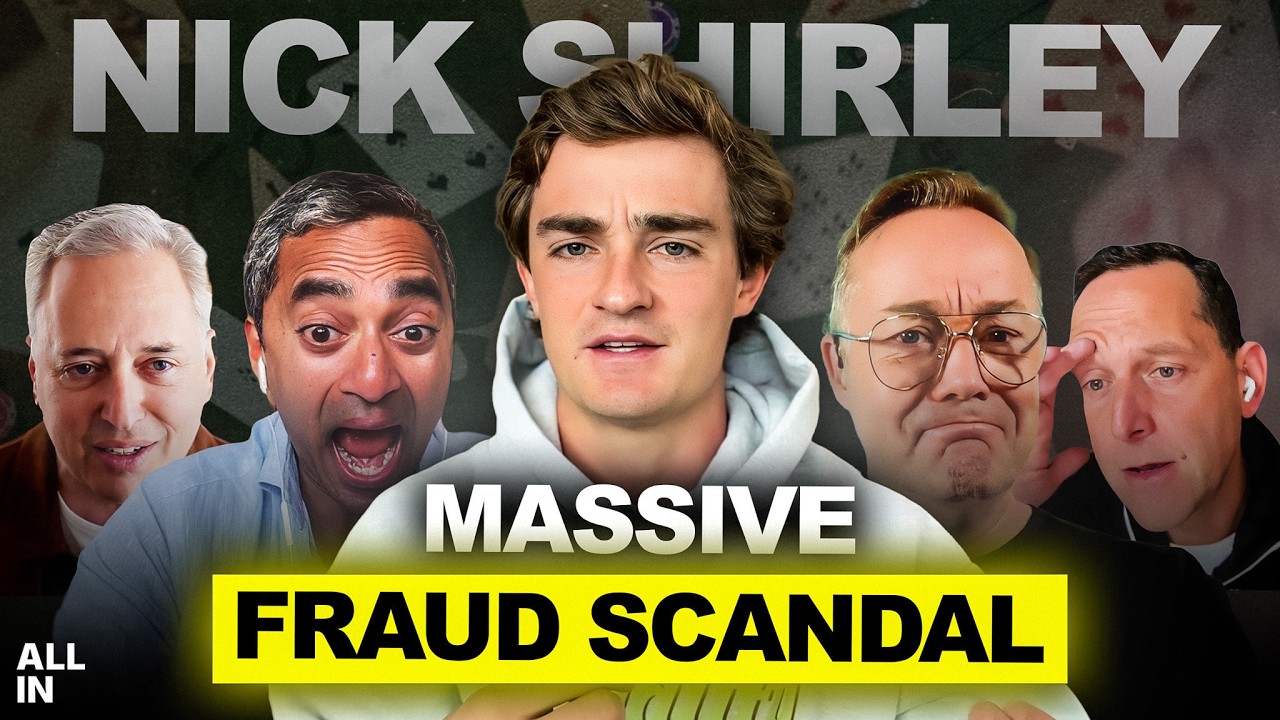
Nick Shirley joins the besties after his Minnesota daycare investigation went viral, then the table moves from government fraud to California's billionaire-tax initiative and America's punishing health-care bill. The sharpest exchanges ask whether Democrats can credibly become fraud hawks, whether fraud recovery can replace spending cuts, and whether universal coverage or market pressure is the better cure for health-care costs. Jason had the strongest episode: he kept asking for an actual governing answer while Sacks reached for partisan fatalism and Chamath made one useful insurance critique do too much work.
Spice rack
Can Democrats credibly make government fraud and waste a reform platform?
Original point: A Democratic governor who embraced aggressive audits, prosecutions, and program cleanup could rebuild the party around competence and win voters back.
What everyone argued
Jason Calacanis
Jason argues that fraud prevention is a rare consensus issue and that a Democratic governor could reboot the party by endorsing audits, prosecutions, and tighter programs. His case is strategic rather than ideological: voters care more about whether public money works than which party discovered the abuse.
David Sacks
Sacks says Democrats cannot sincerely attack government waste because expanding government is the party's purpose and fraudulent recipients become political patrons. Even when Ro Khanna supports an investigation, Sacks says he does not believe the commitment.
Winner circle
Jason wins. He offers a falsifiable route to credibility—audits, stopped payments, prosecutions, and cleaner programs—while Sacks treats party identity as destiny. The reform may fail or prove electorally weak, but institutional skepticism is not proof of institutional impossibility.
Commentary
Jason Calacanis
Assumptions and fact checks
An audit-and-enforcement platform would be the easiest way for Democratic leaders to rebuild national credibility.
Why it mattersThe message addresses a broadly legible failure, but no evidence presented in the exchange establishes that it outranks health costs, wages, housing, immigration, or other electoral concerns.
David Sacks
Sacks spots incentives worth auditing and then replaces evidence with essence: Democrats cannot reform because they are Democrats. A claim designed to survive every counterexample is rhetoric, not diagnosis.
Assumptions and fact checks
Because Democrats favor a larger public sector, they are structurally incapable of credible fraud enforcement.
Why it mattersA larger public sector raises the amount that requires oversight, but it does not logically prevent audits, payment holds, prosecutions, or program redesign. Minnesota's 2025 anti-fraud order is one concrete counterexample, though its effectiveness still needs measurement.
Major Minnesota program fraud has been prosecuted rather than simply accepted by government.
CheckDOJ charged 47 defendants in the original $250 million Feeding Our Future case in 2022, and enforcement continued afterward. That does not excuse oversight failures, but it contradicts the idea that the political system uniformly protects every scheme.
Does America need universal health coverage, or mainly more market pressure?
Original point: America's failure to guarantee a basic level of health care fuels financial fear and political resentment, and technology leaders should help build a universal solution.
What everyone argued
Chamath Palihapitiya
Chamath says the ACA's medical-loss-ratio rule caps insurer margins and can reward a larger claims base: 15 percent of a larger premium pool is more dollars. He proposes unwinding that rule to move the cost curve back toward normal.
Jason Calacanis
Jason argues that basic coverage is a social floor and that fear of medical bankruptcy feeds resentment toward wealthy people. He points to America's much higher procedure and system costs, presses the others for an actual plan, and sees technology and competition as tools inside a universal framework.
David Sacks
Sacks says government involvement raises prices and that market forces produce better quality at lower cost, as in technology. He accepts a safety net for poor people but challenges Jason's claim that countries with universal systems offer care he would personally choose.
Winner circle
Jason wins the diagnosis and the debate, not yet the policy memo. America pays radically more than peers and still leaves people exposed, so 'market forces' is not a sufficient answer. Chamath earns credit for a real MLR distortion, but neither he nor Sacks supplies a replacement that guarantees access while controlling provider prices and preserving quality.
Commentary
Chamath Palihapitiya
Chamath brings the best mechanism and oversells it. He found a loose gear in the machine, not proof that removing it repairs the whole engine.
Assumptions and fact checks
Repealing the MLR rule would materially bend the national health-care cost curve downward.
Why it mattersThe rule can distort claims spending, but repeal could also increase administrative costs and profit unless paired with competition and rate discipline. The cited evidence does not estimate the national savings from repeal.
The ACA limits the share of premiums insurers may retain for administration and profit through an 80 or 85 percent medical-loss-ratio requirement.
CheckCMS requires insurers to spend at least 80 percent of individual and small-group premiums, or 85 percent of large-group premiums, on care and quality improvement or issue rebates.
The medical-loss-ratio rule caused premiums to rise steadily and is Obamacare's central fatal flaw.
CheckA causal NBER study found the rule increased claims costs for affected insurers, consistent with Chamath's incentive story, but found premiums were unaffected. The evidence supports a distortion, not his sweeping causal conclusion.
Jason Calacanis
Jason is strongest when he asks, 'What is your plan?' and weakest when he turns a murder into a policy metaphor. He establishes the scale of the U.S. cost problem but leaves universal coverage as a destination without a route.
Assumptions and fact checks
Guaranteeing a universal baseline would materially reduce the resentment driving support for wealth taxes.
Why it mattersHealth insecurity plausibly contributes to resentment, but the exchange provides no evidence isolating it from housing, wages, education, inequality, or partisan identity.
Failure to guarantee universal coverage helps explain the murder of UnitedHealthcare's CEO.
Why it mattersSystem anger may shape public reaction, but attributing an individual murder to a policy failure without evidence is inflammatory and analytically unnecessary.
The United States pays far more for health care than peer countries without receiving proportionally better value.
CheckOECD reports U.S. spending of $14,885 per person versus a $5,967 OECD average, and 17.2 percent of GDP versus 9.3 percent. CMS separately reports $5.3 trillion and 18.0 percent of GDP in 2024.
David Sacks
Sacks turns a system question into a concierge-choice question: where would a rich person schedule surgery? That misses Jason's central concern about whether everyone can obtain necessary care without financial ruin.
Assumptions and fact checks
More government involvement generally makes health care more expensive, while market forces reliably lower its cost.
Why it mattersOECD peers with universal systems spend far less per person than the United States. That does not prove every public intervention works, but it defeats the blanket direction-of-causation claim.
Can rooting out fraud balance public budgets without broader spending cuts?
Original point: Fraud control is necessary, but fiscal responsibility will also require some austerity because the budget gap is larger than theft alone.
What everyone argued
Chamath Palihapitiya
Chamath rejects austerity and says existing programs can work if government stops theft, spends appropriations as promised, measures results, and demands proof before asking for more money.
Jason Calacanis
Jason agrees fraud should be attacked first, then says balancing budgets also requires a public mandate for fiscal responsibility and some level of austerity. He distinguishes the popular task of stopping theft from the harder task of reducing the deficit.
Winner circle
Jason wins the narrow question. Fraud enforcement should come first, but the numbers do not support Chamath's claim that competence alone eliminates the need for broader fiscal choices. Jason owes readers a definition of austerity; Chamath owes them roughly another $1.4 trillion.
Commentary
Chamath Palihapitiya
Chamath has the right first move and the wrong stopping point. Recover every misspent dollar before cutting a useful service, yes; pretend the remaining arithmetic disappears, no.
Assumptions and fact checks
Most apparent program failure comes from theft rather than lawful benefit design, demographics, prices, or promised obligations.
Why it mattersFraud materially worsens the budget, but CBO identifies Social Security, Medicare, and interest costs—not an assumption of trillion-dollar theft—as major drivers of long-run deficits.
Eliminating fraud would by itself remove the need for broader federal fiscal adjustment.
CheckGAO estimated $233 billion to $521 billion in annual federal fraud losses using 2018–2022 data. CBO projects a $1.9 trillion deficit in 2026. Even perfect prevention at GAO's upper bound would leave most of the gap, before accounting for recovery costs or state-local differences.
Jason Calacanis
Jason wins the arithmetic and punts the allocation. 'Some austerity' is honest but incomplete until he says whose benefits, contracts, tax breaks, or services change.
Assumptions and fact checks
Voters will accept material fiscal restraint if a leader first demonstrates credible fraud enforcement.
Why it mattersSequencing enforcement before sacrifice is politically sensible, but the transcript supplies no evidence that voters will support the specific cuts or revenue changes needed after fraud savings are booked.
The United States still has a large federal deficit despite years of political attention to reducing it.
CheckCBO projects a $1.9 trillion federal deficit for fiscal 2026, equal to 5.8 percent of GDP, with debt held by the public at 101 percent of GDP.
Jason wins the burden-of-proof contest by proposing observable tests: audit agencies, stop payments, prosecute crimes, and publish results. Calling it the easiest electoral path is campaign fan fiction until voters weigh in.