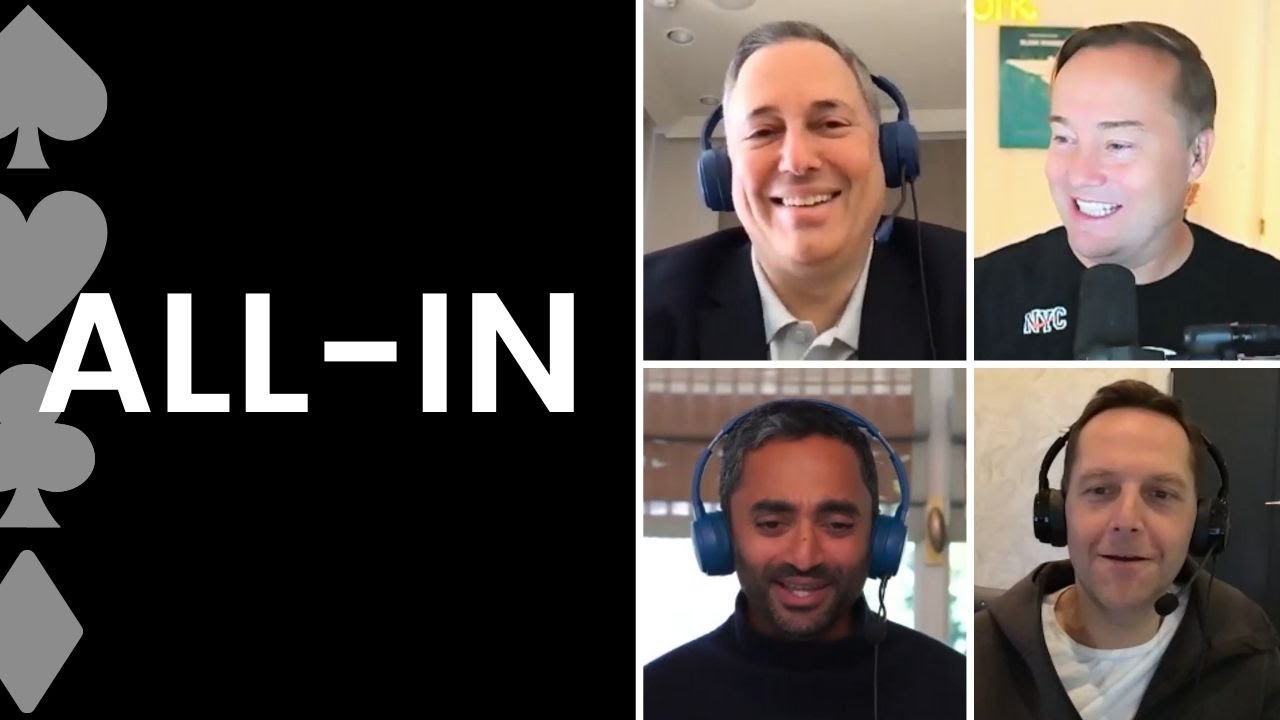
Featuring
Episode 25 catches the All-In crew at a very 2021 moment: confidence on vaccines, absolute chaos in digital asset pricing, and an inflation argument that ends up aging much better on one side than the other. The best opening stretch is the vaccine fight, where Friedberg supplies the science and Sacks hammers California for turning rollout into a bureaucracy contest after the real need had shifted toward speed and simplicity. The middle is pure NFT fever dream, with Beeple, burned Banksys, provenance rails, and just enough self-awareness for everyone to realize a useful technology and a ridiculous market can coexist. The sharpest true disagreement comes late when Chamath tries to sell inflation as a practical equalizer and Sacks responds with the adult answer: making asset owners uncomfortable is not the same thing as making society healthier. Friedberg has the strongest all-around episode, Sacks wins the macro ruling, and Jason is at his best whenever he drags the discussion back to what people actually do in the real world.
Spice rack
Did the NFT boom represent a durable new ownership rail for digital and physical assets, or mostly a frothy speculation cycle looking for a story?
Original point: Jason kicks off the segment with Beeple's $69 million sale and asks whether the absurd prices mean NFTs are finally a real category or just the week's loudest speculative stunt.
What everyone argued
Chamath Palihapitiya
Chamath treats the Beeple sale as both art-market theater and proof that a generational transfer in taste is happening. He says NFTs are not just expensive JPEGs; they are blockchain-native proof of ownership that can eventually extend to houses, cars, watches, clothing, and other title-heavy assets, while also expanding who gets to set cultural value.
Jason Calacanis
Jason plays the role of incredulous but curious operator. He keeps returning to the absurd pricing, the age mix of bidders, the Burnt Banksy stunt, and the obvious possibility that speculators are using attention loops to bootstrap a new market into existence.
David Sacks
Sacks draws the cleanest line between the rail and the mania. He says NFTs are a legitimate provenance technology and may matter for title-heavy assets, but that does not mean most NFTs are worth much, nor that Beeple's price can be justified by the technology alone.
David Friedberg
Friedberg zooms out and says NFT demand is partly a symptom of excess capital chasing non-productive assets when productive assets already look crowded. In his frame, art, gold, and many digital collectibles are stores of value people buy because they hope someone else will pay more later, and those markets tend to empty fast when liquidity tightens.
Winner circle
Sacks and Friedberg have the best of the debate. Sacks separates the technology from the trade, and Friedberg explains why the trade got so manic in the first place. Chamath is right that provenance and title rails are real, but he oversells how directly that translates into broad social value. Jason's skepticism ages well because the market did turn out to be much more self-referential than the true believers wanted to admit.
Commentary
Chamath Palihapitiya
Assumptions and fact checks
Transparent blockchain title could eventually improve lending, trading, and provenance for many asset classes beyond digital art.
Why it mattersThat is a real and durable idea. The problem is not conceptual usefulness but the much slower path from neat architecture to legally and operationally trusted markets.
Broader tokenization would meaningfully reduce inequality by making opaque asset markets more transparent and accessible.
Why it mattersBetter title rails can lower friction, but they do not by themselves change who owns scarce assets, who controls platforms, or who can absorb risk. That claim asks too much from the technology.
Jason Calacanis
Jason's instinctive skepticism is the right solvent for this segment. He does not deny the technology; he denies that spectacular auction prices are enough to prove a mature category.
Assumptions and fact checks
The earliest NFT price discovery was being shaped heavily by insiders, promoters, and recursive attention rather than by stable fundamental value.
Why it mattersThat is the best reading of the 2021 boom. The technology was real, but price formation was plainly entangled with narrative engineering and reflexive speculation.
The ability to tokenize culture does not itself answer questions about copyright, monetization rights, or economic usefulness.
Why it mattersThat skepticism aged very well. The market repeatedly ran ahead of legal and practical clarity on what ownership of a token actually granted.
A Banksy print was burned, turned into an NFT, and the resulting token sold for roughly $380,000 in cryptocurrency.
CheckContemporaneous reporting described the Burnt Banksy group buying a Banksy print, burning it, minting the image as an NFT, and selling the token for about $380,000 in ETH.
David Sacks
Sacks gives the most durable framework in the segment. He neither laughs off provenance nor confuses it with automatic value creation.
Assumptions and fact checks
Most individual NFTs would fail as investments even if the underlying token standard and provenance mechanism survived.
Why it mattersThat is exactly how the story played out. The infrastructure survived in limited forms; many headline-era collectibles did not.
Ownership records on a blockchain are valuable only when they connect to a legally or socially recognized claim outside the chain itself.
Why it mattersThat is the missing realism in a lot of 2021 discourse. A token can certify an entry on a ledger, but the surrounding property, copyright, and enforcement regime still determines much of the value.
David Friedberg
Friedberg lands the best synthesis: the token standard may last, but the auction fireworks are mostly a macro story about too much money and too little discipline.
Assumptions and fact checks
The NFT boom was amplified by excess liquidity and a market environment in which traditional productive assets already looked expensive.
Why it mattersThat is one of the best hindsight explanations for the timing and scale of the boom. It connects the cultural story to the monetary one.
When liquidity reverses, capital leaves non-productive stores of value faster than it leaves assets with clearer cash-flow anchors.
Why it mattersThat general pattern is consistent with how speculative NFT pricing unwound after 2021. The exit door gets narrow when narrative demand is doing most of the work.
Is inflation a useful way to compress wealth inequality, or does it mostly make society poorer while better-protected asset owners still come out ahead?
Original point: Jason turns from the stimulus bill to second-order effects and asks the group what inflation would do over the next year and a half.
What everyone argued
Chamath Palihapitiya
Chamath argues that inflation is one of the few mechanisms that can actually narrow wealth gaps because it punishes financial-asset holders, lifts wages, rewards homeowners, and weakens the rich's stored claims on future purchasing power. He treats it as a more realistic equalizer than direct redistribution.
Jason Calacanis
Jason mostly plays moderator, but he keeps pulling the conversation toward practical pricing power, real-world SaaS bills, commodity inputs, and what ordinary participants are actually supposed to do in a more inflationary environment.
David Sacks
Sacks pushes back that even if inflation narrows some nominal wealth gaps, the late 1970s showed it can still leave the country poorer and more miserable. He points to the 1980 combination of double-digit inflation and elevated unemployment as evidence that equal pain is not a worthy policy goal.
David Friedberg
Friedberg partially agrees with Chamath on the mechanism, noting that inflation can hurt duration-heavy assets and shift capital toward harder-asset businesses. But he is less celebratory and more descriptive, treating inflation as a change in relative winners rather than a clean social good.
Winner circle
Sacks has the strongest argument because he keeps the standard on overall welfare rather than on whether inflation can nick the rich. Chamath identifies a real mechanism but mistakes a side effect for a policy virtue. Friedberg contributes the most useful sector-level analysis, yet his own explanation ultimately supports Sacks's caution more than Chamath's enthusiasm. Inflation is not a serious equality program just because it sometimes punishes duration-heavy wealth.
Commentary
Chamath Palihapitiya
Chamath sees one side of the mechanism but overclaims its social desirability. Inflation can humble duration-heavy portfolios; that does not make it a humane or dependable equality program.
Assumptions and fact checks
Inflation reliably hurts the rich more than everyone else because they hold more financial assets and borrowed capital.
Why it mattersRich households often have better access to inflation hedges, pricing power, real assets, and financial advice. Inflation can compress some valuations, but it does not reliably leave lower- and middle-income households better off in lived terms.
Inflation is one of the most effective practical redistributive tools available to a society.
Why it mattersIt is too blunt, too hard to target, and too capable of damaging wages, savings, and planning for the people with the least cushion. Redistribution by macro accident is usually worse than redistribution by design.
Jason Calacanis
Jason's value here is forcing the macro thesis back into company-level and household-level reality. That is a useful corrective to Chamath's cleaner but more abstract equalization story.
Assumptions and fact checks
If inflation takes hold, businesses with pricing power will protect themselves faster than workers and buyers can protect themselves.
Why it mattersThat is a good practical reading of many inflationary episodes. Who can reprice quickly matters as much as who nominally owns assets.
Ordinary operators care less about macro theory than about which categories can raise prices, defend margins, or get squeezed.
Why it mattersThat operational lens is exactly what later made inflation debates more concrete: rent, food, cars, software, salaries, and financing costs all moved at different speeds.
David Sacks
Sacks is the clearest winner because he applies the right standard. The issue is not whether inflation can bruise asset owners; it is whether that bruise is worth the collateral damage. The answer is usually no.
Assumptions and fact checks
A policy regime should not celebrate inflation simply because it compresses some wealth gaps if the broader economy becomes more unstable and materially poorer.
Why it mattersThat is the right welfare test. Distribution matters, but so do output, planning, household stress, and the ability of institutions to restore stability without causing recession.
Rich people are usually better positioned than the middle class to protect themselves against sustained inflation.
Why it mattersThat is generally true because wealthier households own more real assets, have more flexibility, and get better access to hedging and credit. It is a strong rebuttal to the idea that inflation is inherently anti-rich.
Using BLS data, 1980 was an extremely uncomfortable macro year: annual CPI averaged 82.4 versus 72.6 in 1979, which is about 13.5% inflation, while the average monthly unemployment rate was about 7.2%, yielding a misery-index style reading near 20.
CheckThe BLS CPI API reports an annual average CPI of 72.6 in 1979 and 82.4 in 1980, which implies roughly 13.5% annual inflation. The BLS unemployment series averages about 7.2% across 1980's monthly readings, so the combined picture is indeed close to 20.
David Friedberg
Friedberg adds the most useful market texture, but Sacks wins the normative question. Friedberg explains the chessboard; Sacks explains why you should not confuse one side's losses with a good social outcome.
Assumptions and fact checks
Inflation tends to rotate relative performance toward businesses and assets with harder collateral, commodity exposure, or shorter-duration economics.
Why it mattersThat is broadly right and matched much of the market behavior during the later inflation shock. Asset duration and input exposure mattered a lot.
Explaining inflation's mechanics is not the same thing as endorsing it as a policy cure for inequality.
Why it mattersThat distinction is crucial and Friedberg handles it better than Chamath. Mechanism clarity does not imply normative approval.
Should vaccine policy in March 2021 have prioritized speed and open access, or was equity-targeted rationing still worth the friction it created?
Original point: Jason opens with Biden expanding eligibility by May 1 and asks what that means for California's slower, rules-heavy rollout.
What everyone argued
Chamath Palihapitiya
Chamath says the state's use of the word "equity" is masking a self-defeating allocation policy. His core point is that delaying shots in the name of moral choreography is worse for the very low-income workers the policy claims to protect, because the fastest way to reduce risk is to vaccinate as many people as possible, as quickly as possible.
Jason Calacanis
Jason frames vaccination as a network problem: every additional person vaccinated helps the whole system, not just that individual. He argues that public messaging should stop moralizing access and focus on ending spread fast enough to shut the pandemic down.
David Sacks
Sacks argues California's rollout had crossed from prioritization into paralysis. He says unused inventory, appointment friction, and equity carve-outs were slowing deployment enough to prolong viral spread and create needless political theater around people getting vaccinated.
David Friedberg
Friedberg gives the scientific backbone to the speed-first case. He explains that the social value of vaccination is reducing the network's ability to transmit the virus, then points to real-world Israeli data suggesting strong protection after the Pfizer shot and likely lower transmission from vaccinated people.
Winner circle
Friedberg and Sacks are the closest to the right answer, with Jason reinforcing the better public-health framing and Chamath adding the sharpest moral attack on bureaucratic drift. The key hindsight point is that equity as an objective was not nonsense, but equity through heavy eligibility friction was a bad fit for the stage of the rollout they were describing. Once supply and appointment availability were expanding, speed and clarity became the more defensible form of fairness.
Commentary
Chamath Palihapitiya
Chamath is blunt to the point of caricature, but he is directionally right about a policy regime that kept treating access as a sorting problem after the bottleneck was shifting toward speed and convenience.
Assumptions and fact checks
In late-stage vaccine rollout, broad availability reduces inequity more effectively than tightly managed prioritization because delays hurt lower-income workers the most.
Why it mattersThat mechanism is persuasive once supply is no longer the primary bottleneck. Administrative friction tends to fall hardest on people with less schedule flexibility, weaker internet access, and fewer healthcare relationships.
Equity-focused eligibility rules had become more performative than useful by the time of this episode.
Why it mattersThe balance of the evidence from later 2021 supports that view. Equity concerns were real, but complex gatekeeping aged badly once abundant doses and empty appointment slots started appearing.
Jason Calacanis
Jason keeps the debate honest by turning it back into a practical systems question: what policy gets the pandemic over sooner? That frame ages better than the rhetorical fights over who deserves to feel first in line.
Assumptions and fact checks
The public-health benefit of vaccinating another willing person quickly can outweigh fine-grained fairness in queue order once high-risk groups have substantial access.
Why it mattersThat is a sound operational assumption for an airborne virus once severe scarcity begins to ease. Speed becomes part of fairness when delay itself imposes disease burden.
People respond to vaccine policy partly through social narratives about guilt, privilege, and permission, not just formal eligibility criteria.
Why it mattersThe transcript and later rollout patterns support that. Confusing or moralized guidance can suppress uptake just when officials need behavior to become simpler.
David Sacks
Sacks is at his best here because he notices the moment when a fairness framework starts defeating its own public-health purpose. His semantic grandstanding about equity is more heat than light, but the underlying diagnosis is strong.
Assumptions and fact checks
A vaccine policy that leaves doses unused while demand still exists is failing its first obligation, even if its stated intention is distributive fairness.
Why it mattersThat is the right burden for a time-sensitive pandemic intervention. In a fast-moving outbreak, unused supply is not neutral; it is foregone disease prevention.
The political and cultural guilt around getting vaccinated was meaningfully discouraging people from simply taking available appointments.
Why it mattersThat likely mattered at the margin, but the stronger point is the institutional friction itself. The transcript probably overstates how much cancellation fear, rather than pure confusion and access hassles, drove behavior.
David Friedberg
Friedberg makes the best case because he connects the science to the logistics. The strongest version of the pro-equity position would have admitted the moral concern while still conceding that speed had become the dominant public-health variable.
Assumptions and fact checks
During mass vaccination, the relevant policy goal is to reduce overall transmission and severe outcomes as fast as possible, not to optimize every individual's place in line indefinitely.
Why it mattersThat is the right systems view once high-risk people are no longer completely excluded. Friedberg captures the epidemiological objective better than the more moralized framing around queue order.
It was reasonable, even before definitive data, to infer that vaccinated people would generally be less likely to transmit because they were less likely to develop large systemic infections.
Why it mattersThat inference was sensible at the time and later proved substantially correct, though variant evolution made the transmission benefit less durable than early 2021 optimism implied.
A large real-world NEJM study of the Pfizer vaccine showed strong protection against infection, hospitalization, severe disease, and death, with clear benefits appearing after the first dose and becoming especially strong by the fourth week.
CheckThe NEJM nationwide study from Israel reported substantial effectiveness for documented infection, hospitalization, severe disease, and death, with protection rising materially after the first dose and becoming stronger after the second-dose interval.
Chamath sees the real infrastructure idea early, but he also lets the boom's own sales pitch bleed into the argument. Provenance rails were real; the equality story was marketing.