Featuring
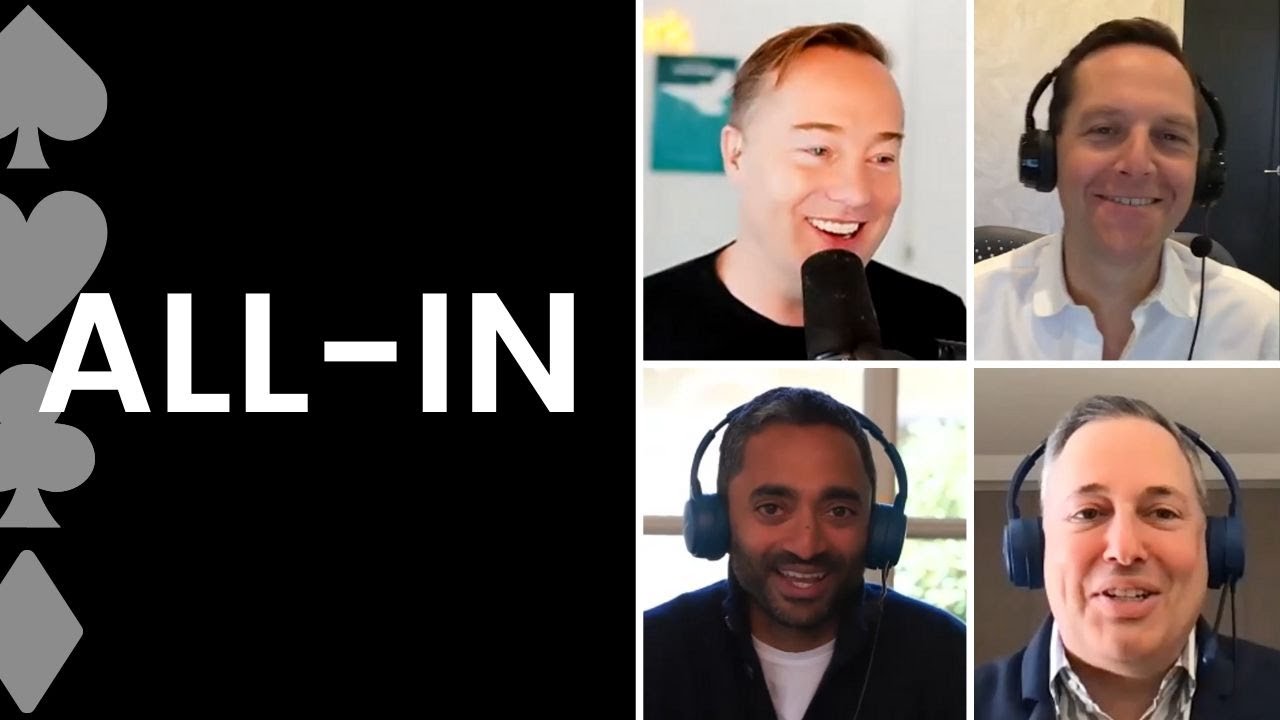
Episode 24 is the sound of 2021 trying to decide whether the emergency is actually over. Tech stocks are bleeding, stimulus money is sloshing around like a busted fire hydrant, Gavin Newsom is getting torched, and the besties are already fighting about whether post-vaccine life should snap back or calcify into a new rulebook. The hottest stretch is the run from "Zeroism" to the "biological Patriot Act," where Sacks argues the emergency logic should die the second every adult can get a shot, while Chamath warns that governments and private institutions will normalize medical-status checks much faster than people expect. Sacks has the strongest episode: best on sunset clauses, best on hindsight, and closest to where the passport and reopening story actually landed.
Spice rack
Would vaccine passports become a durable 'biological Patriot Act,' or fade once the emergency phase of COVID ended?
Original point: Friedberg frames vaccine passports as a privacy slippery slope: once governments or supranational bodies can require digital proof of one medical intervention for free movement, the category of information they may demand could expand.
What everyone argued
Chamath Palihapitiya
Chamath argues the slope is more likely than Sacks thinks. He predicts that private businesses and institutions will demand vaccination proof, that anti-vaccination tolerance will fall, and that courts will likely allow private decision-makers to set their own rules.
Jason Calacanis
Jason takes a pragmatic middle position. He can tolerate proof requirements in a short bridge period for dense events like games, concerts, or Burning Man, but he does not want that authority normalized in the long run.
David Sacks
Sacks argues the passport idea is likely to fade once COVID is no longer an emergency. His core view is that the real danger is government hanging on to extraordinary powers after the factual basis for them has expired, so the answer is to sunset the emergency logic quickly.
David Friedberg
Friedberg treats the issue as a civil-liberties wedge. His concern is not just COVID, but the precedent of converting a medical status into a condition for movement and access, especially in digital form.
Winner circle
Sacks had the better long-run call, though Chamath had the better short-run one. Chamath correctly anticipated that proof requirements would become real in workplaces, venues, and travel systems, so the slippery-slope concern was not imaginary. But the larger 'biological Patriot Act' thesis overshot: the resulting systems were substantial yet mostly temporary, and they did not lock the United States into a permanent generalized health-ID regime. Jason's bridge-period distinction also ages well because it captures what actually happened more accurately than either extreme.
Commentary
Chamath Palihapitiya
Assumptions and fact checks
Private institutions would move faster than governments in requiring proof of vaccination.
Why it mattersThat was substantially correct. Employers, schools, and some venues became major pressure points.
Short-term proof systems would naturally expand into a broad long-term medical-status regime.
Why it mattersThe historical record supports a temporary expansion more than a durable generalized one. The strongest slippery-slope version did not become the stable equilibrium.
Private employers can impose COVID-19 vaccination requirements, subject to disability and religious accommodations.
CheckEEOC guidance expressly stated that EEO laws do not prevent employers from imposing vaccination requirements, while still requiring accommodation analysis for some employees.
The issue would be resolved by a Supreme Court-style rule that businesses could simply choose to withhold service from the unvaccinated under a Masterpiece Cakeshop-type logic.
CheckPrivate vaccine requirements did emerge, but not because the Supreme Court adopted Chamath's specific Masterpiece Cakeshop-style framing. His legal prediction about the path and doctrinal hook was overstated.
Jason Calacanis
Jason lands on the most practical compromise, but he leaves the guardrail implicit. In this kind of emergency-power debate, the hard part is not approving the bridge rule; it is writing the sunset.
Assumptions and fact checks
A narrow, temporary use for high-density events is meaningfully different from a generalized passport regime.
Why it mattersThat is a valid distinction. The scope, duration, and enforcement context matter a great deal in civil-liberties analysis.
David Sacks
Sacks reads the long-run trajectory better than the others. He still understates how much temporary mandate infrastructure would appear in 2021 and 2022, but he is right that the broadest nightmare framing did not become the settled baseline.
Assumptions and fact checks
Most passport-like rules would lose political and practical justification once vaccine access became broad.
Why it mattersThat largely matches the historical outcome. The measures proved real but time-bounded rather than permanently hegemonic.
The larger danger was emergency-power persistence rather than a stable private-market demand for medical proofs everywhere.
Why it mattersThat was the more accurate priority. The longest-lived disputes were about mandates and administrative power, not universalized daily passport checks.
David Friedberg
Friedberg asks the right civil-liberties question, but he compresses several different regimes into one path: border/travel rules, venue access, employment policies, and generalized medical disclosure are not the same thing. The analysis gets weaker when those categories blur.
Assumptions and fact checks
A temporary emergency certificate creates a real precedent that can be repurposed later.
Why it mattersThat concern is valid. Temporary infrastructures can become durable tools, even if in this case the maximal slippery-slope outcome did not dominate.
The EU was moving toward a digitally verified certificate that would allow freer travel if someone could show vaccination, recovery, or testing status.
CheckThat is directionally correct. The EU's digital certificate framework rolled out in mid-2021 to facilitate cross-border movement using vaccination, testing, or recovery status.
Would post-vaccine caution persist because the public was psychologically scarred, or because officials kept signaling that normal life was still unsafe?
Original point: Friedberg argues that COVID fear will linger like post-9/11 security culture, shaping both individual behavior and public policy long after the acute emergency fades.
What everyone argued
Chamath Palihapitiya
Chamath partly splits the difference. He says some individual caution is understandable because institutions burned trust over the prior year, so people are rational to be skeptical even if their absolute risk is much lower after vaccination.
Jason Calacanis
Jason reinforces Sacks's point in a more populist register: public-health leaders should have been saying the vaccine ends the terrifying outcomes people actually fear. His proposed billboard line is simple and blunt: get vaccinated and you will not die.
David Sacks
Sacks pushes back that people are ready to get back out, and that the bigger problem is official messaging. He argues health authorities are being so conservative that they are effectively telling vaccinated people the vaccine does not really restore normal life, which weakens urgency to get the shot.
David Friedberg
Friedberg argues that the crisis has trained people to over-weight low-probability risks. His analogy is post-9/11: once fear becomes culturally normal, it can justify years of rule expansion and behavior changes that feel irrational in hindsight.
Winner circle
Sacks had the better answer. In hindsight, Americans did not remain broadly frozen in place once vaccines spread and rules loosened; they resumed normal activity unevenly but decisively. Friedberg was right that crisis psychology and mistrust left a residue, and Chamath was right that institutional credibility problems made some caution rational. But the more important live variable in early 2021 was official messaging: institutions were still speaking as if vaccination had not meaningfully changed the practical terms of normal life.
Commentary
Chamath Palihapitiya
Chamath's trust argument ages better than the absolute-risk rhetoric around him. Still, he mostly comments on why caution is understandable, not on whether it would remain the main force driving public behavior.
Assumptions and fact checks
Institutional credibility had been damaged enough that some continued caution was rational even after vaccines arrived.
Why it mattersThat is a fair reading of early 2021. Trust in the CDC, WHO, and political leaders had become fractured, and that shaped how people processed new guidance.
Jason Calacanis
Jason's political instinct is good: people do respond to crisp payoff language. But he traded accuracy for force. In a debate about public trust, overclaiming vaccine perfection is exactly the kind of shortcut that can backfire.
Assumptions and fact checks
The public mainly needed a simpler and more confident risk-reduction message in order to vaccinate faster.
Why it mattersThat was likely an important part of the problem, though not the only one. Logistics, partisanship, and institutional trust also mattered.
Nobody had died, gone to the ICU, or needed a ventilator after getting a shot.
CheckThose outcomes became much rarer after vaccination, but they were not literally zero. By spring 2021, CDC breakthrough reporting already documented severe and fatal exceptions.
David Sacks
Sacks wins the causal argument, but he weakens himself by turning a very strong risk-reduction story into an absolute claim about zero deaths. He did not need vaccine perfection to make his broader point about overcautious messaging.
Assumptions and fact checks
Institutional messaging was a larger driver of lingering caution than raw public fear.
Why it mattersThat is the better fit for what followed. People responded strongly when official guidance loosened, which suggests the signal from authorities mattered materially.
Vaccines had already changed the risk enough by March 2021 that messaging should have been more normalizing.
Why it mattersDirectionally reasonable, but this still depended on real uncertainties about uptake, variants, and transmission at that specific moment.
CDC guidance in March 2021 still told fully vaccinated people to keep masking and distancing in public even while allowing some limited indoor visits.
CheckThat was the thrust of the CDC's March 8 guidance for fully vaccinated people: modest indoor freedoms in limited settings, but continued masking and distancing in public.
Biden said the United States was on track to have enough vaccine supply for every adult by the end of May 2021.
CheckBiden publicly said on March 2, 2021 that the country was on track to have enough supply for every adult by the end of May.
If you've been vaccinated, you will not die.
CheckVaccination dramatically reduced death risk, but it did not make death literally impossible. CDC-reported breakthrough data in spring 2021 already included a small number of deaths among fully vaccinated people.
David Friedberg
Friedberg sees the social-psychology problem clearly, but his framing is too one-directional. By 2022 the dominant pattern was not permanent mass retreat; it was uneven normalization, with some people staying cautious and many others moving on quickly once rules loosened.
Assumptions and fact checks
Large-scale crises leave a durable behavioral scar that outlasts the direct threat.
Why it mattersThat general mechanism is well supported historically. The overreach is in assuming the persistence would dominate public behavior rather than coexist with a strong reopening impulse.
Once fear is culturally embedded, policymakers can use it to justify broader powers than the underlying risk warrants.
Why it mattersThat risk model is plausible and consistent with emergency politics. The harder question is duration and scope, not whether the mechanism exists at all.
Chamath deserves credit for seeing where short-term coercive pressure would really come from. But he lets a good near-term forecast inflate into a much bigger permanence claim than the evidence ultimately supports.