Featuring
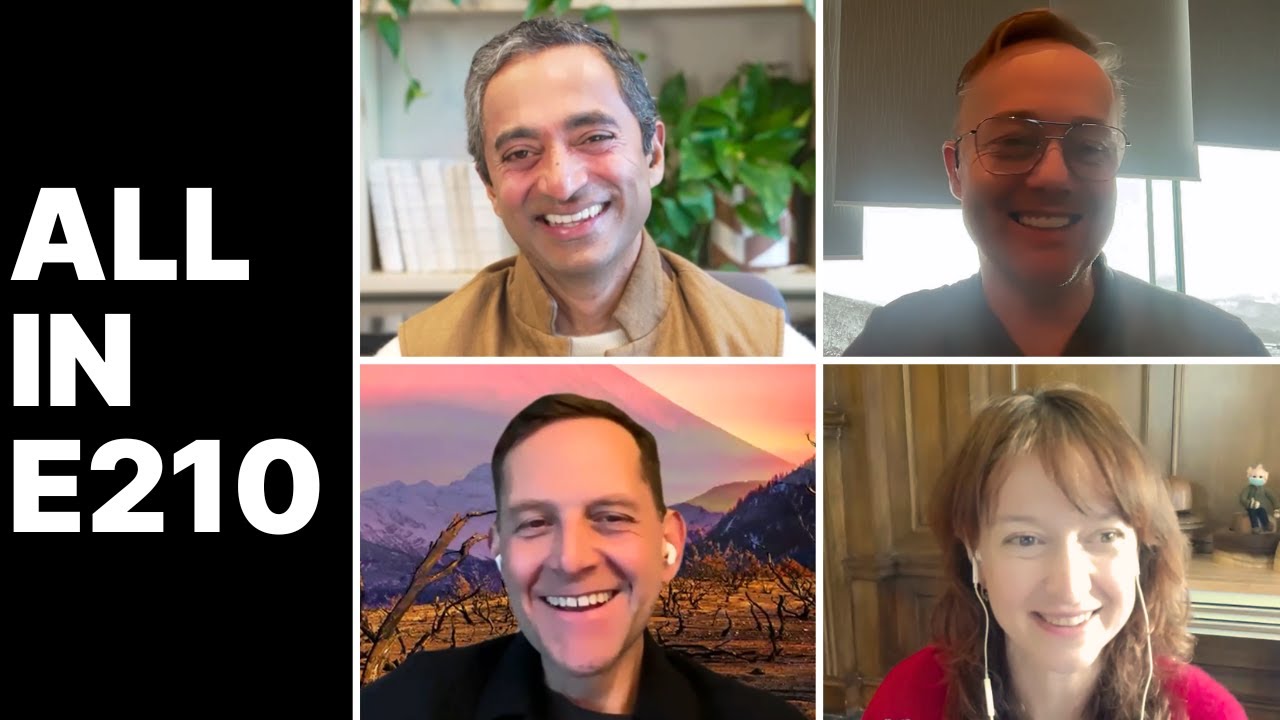
Cyan Banister joins Episode 210 as Los Angeles burns, Zuckerberg changes Meta's speech rules, Nvidia pushes AI toward the edge, and Trump eyes Greenland. The sharpest exchange is a character trial for Zuck: Jason calls the reversal cowardly opportunism while Chamath and Friedberg argue that political pressure and corporate survival deserve more weight. Friedberg has the best episode, pairing a clear wildfire risk model with the most disciplined case for judging Zuckerberg on evidence rather than mind-reading.
Spice rack
Was Zuckerberg's free-speech turn principled or politically expedient?
Original point: Cyan argued that Zuckerberg had always leaned libertarian and was returning to an authentic commitment to free speech after years of presenting a more neutral, corporate persona.
What everyone argued
Chamath Palihapitiya
Chamath called Zuckerberg a phenomenal businessman and read both the earlier moderation regime and the January reversal as value-maximizing responses to the political environment. He resisted Jason's moral verdict because outsiders do not know Zuckerberg's private beliefs and argued that Elon's public risk-taking is an exceptional, unfair benchmark for every CEO.
Jason Calacanis
Jason argued that Zuckerberg had repeatedly followed political winds, delegated hard moderation calls to the Oversight Board despite controlling Meta, and reversed course only after Trump threatened him. He welcomed the policy outcome but called the path to it a failure of courage and moral integrity.
David Friedberg
Friedberg pressed Jason to consider coercion and institutional survival, asking whether congressional and executive pressure constrained Meta's choices. He used Google's years of censored search in China as evidence that even open-internet founders sometimes compromise before drawing a line.
Cyan Banister
Cyan argued that Zuckerberg's early libertarian orientation and later personal changes made a genuine return to free-speech roots plausible. She also accepted government pressure and suggested fighting and a more public persona had taught him to stop acquiescing.
Winner circle
Chamath and Friedberg win the motive question by keeping their claims proportionate to the evidence. Jason persuasively identified political expediency, but he did not meet the heavier burden required to turn timing into a categorical moral judgment. The most likely answer is mixed motives: a strategically timed business reversal that may also reflect real regret and a renewed free-speech preference.
Commentary
Chamath Palihapitiya
Assumptions and fact checks
Political and regulatory conditions were the main driver of both Meta's earlier moderation and its reversal.
Why it mattersThe timing and documented pressure make this a strong incentive-based account, although principle and expediency can coexist.
A public-company CEO should generally optimize shareholder value rather than emulate Elon's personal moral risk-taking.
Why it mattersFiduciary and operational constraints matter, but they do not erase a controlling founder's responsibility for foreseeable civil and political effects.
Meta's prior moderation posture responded in part to pressure from the Biden administration.
CheckZuckerberg told Congress that senior Biden administration officials repeatedly pressured Meta over COVID-19 content. The Supreme Court later resolved Murthy v. Missouri on standing and did not establish that every moderation decision was government-caused.
Meta's January 2025 announcement ended US third-party fact-checking and moved toward Community Notes.
CheckMeta's announcement explicitly ended the US third-party fact-checking program, reduced several speech restrictions, and began a Community Notes rollout.
Jason Calacanis
Jason was strongest on the alignment between political timing and policy change. He weakened that case by turning an incentive critique into an unfalsifiable moral diagnosis and by understating the pressures a global platform actually faced.
Assumptions and fact checks
The January timing shows Zuckerberg would have retained the old policy under a Harris administration.
Why it mattersThis counterfactual cannot be proved, but the immediate post-election timing and overt political signals make it more likely than not.
A controlling billionaire could have resisted political pressure without material danger to Meta.
Why it mattersControl and wealth increase room to resist, but antitrust, regulation, litigation, and platform safety risks were real; Jason treated their cost as close to zero.
Facebook suspended Trump for two years after January 6.
CheckMeta imposed a two-year suspension effective January 7, 2021, after the Oversight Board upheld the initial suspension but rejected its indefinite form.
Zuckerberg created the Oversight Board simply to avoid making hard decisions himself.
CheckThe board did provide an independent and sometimes binding review mechanism, but its existence does not establish Zuckerberg's personal motive. In the Trump case it upheld the suspension while forcing Meta itself to replace the indefinite penalty with a defined one.
David Friedberg
Friedberg improved the debate by forcing a comparison between moral purity and actual legal, commercial, and governance risk. He should have dropped the unsupported prison formulation and made the pressure case from documented communications instead.
Assumptions and fact checks
A rational, capable founder may compromise on speech to preserve a company without abandoning all underlying principles.
Why it mattersThat is a plausible tradeoff model and fits the Google analogy, though it does not automatically justify every compromise.
Giving Zuckerberg the benefit of the doubt is more appropriate than inferring character from policy outcomes.
Why it mattersThe evidence supports mixed motives and constraints; the burden for a categorical moral accusation was not met.
Government officials threatened Zuckerberg with prison unless Meta moderated as directed.
CheckThere is strong evidence of repeated government pressure, but the checked public record does not establish a direct 'moderate this or go to prison' threat. Murthy also emphasized the platforms' independent incentives and did not reach a merits holding of coercion.
Google operated a censored search service in China for roughly four years before stopping in 2010.
CheckGoogle launched Google.cn in 2006 with filtered results and announced in March 2010 that it would no longer continue censoring search there after attacks and renewed free-expression concerns.
Cyan Banister
Cyan's willingness to acknowledge uncertainty was a strength. Her argument would be much stronger with internal policy evidence rather than lifestyle and branding cues.
Assumptions and fact checks
Zuckerberg's early libertarian signals reveal a durable private commitment to free speech.
Why it mattersEarly views are relevant context, but they do not fix later policy choices or prove present motivation.
His fighting hobby and less scripted public persona caused greater willingness to resist pressure.
Why it mattersThe chronology may be suggestive, but it is too indirect to support a causal conclusion.
Meta followed through by launching Community Notes in the United States.
CheckMeta began testing in March 2025 and ended new US third-party fact-check labels in April as Community Notes began appearing.
Was the Palisades disaster mainly extreme weather or preventable government failure?
Original point: Friedberg argued that failed planning and uncontrollable conditions were not mutually exclusive: prevention mattered, but 100 mph winds acting on an exceptionally dry landscape could overwhelm even better preparation.
What everyone argued
Chamath Palihapitiya
Chamath rejected extreme winds as an adequate excuse because severe events were foreseeable after earlier fires and insurance withdrawals. He cited vegetation, permitting, rejected prevention measures, and spending priorities as evidence of incompetence bordering on negligence.
Jason Calacanis
Jason framed the fire as a test of competence and priorities while rejecting crude blame of the lesbian fire chief. He highlighted leadership communication, budget disputes, rebuilding rules, home hardening, and the tension between demanding smaller government and expecting expensive disaster readiness.
David Friedberg
Friedberg argued for a compound risk model: exceptionally dry fuel and extreme Santa Ana winds can produce losses that brush clearing alone cannot prevent, while bad planning, insurance regulation, building materials, and public-service priorities can still worsen exposure and recovery.
Cyan Banister
Cyan emphasized long-term prevention, fire-resistant construction, competent priorities, and learning from repeated disasters. She agreed that DEI was not the direct cause but argued that bureaucracy can distract a public agency from its core mission.
Winner circle
Friedberg wins because his multi-causal model survived the later evidence. The fire was not merely an act of nature, and stronger mitigation may have reduced losses, but the combination of an alleged holdover arson fire, extreme dryness, and hurricane-force winds defeats the claim that ordinary competence could simply have prevented the catastrophe. Chamath was right about foreseeability; he overreached on causation.
Commentary
Chamath Palihapitiya
Chamath was right that foreseeable extremes demand preparation, not resignation. His case would have been stronger if he had isolated specific local controls and shown their likely effect instead of treating a broad list of disliked policies as one causal mechanism.
Assumptions and fact checks
Broader vegetation removal and streamlined permits would have materially reduced Palisades losses.
Why it mattersFuel work and home hardening can reduce risk, but the episode did not connect statewide forest metrics to the specific coastal fire footprint or quantify effectiveness under hurricane-force winds.
Reallocating homelessness or other social spending would have produced the missing protective capacity.
Why it mattersThis skips the institutional and operational link between unrelated budgets and the specific prevention, water, staffing, or evacuation controls that failed.
The extreme wind event was foreseeable rather than a surprise.
CheckOfficials tracked the event in advance and pre-positioned engines, crews, aircraft, and other resources on January 6 before the January 7 firestorm.
Earlier regional fires made destructive Santa Ana-driven fire a known risk.
CheckSouthern California's official weather history documents repeated destructive Santa Ana fire events; the 2025 episode produced gusts up to 100 mph in the mountains and 94 mph at Fremont Canyon.
Jason Calacanis
Jason did useful work separating the chief's identity from job performance and naming the spending-versus-readiness tradeoff. His partisan conclusion ran ahead of the incident-specific evidence available during a breaking event.
Assumptions and fact checks
Executive competence and clearer priorities could have materially reduced the disaster.
Why it mattersPreparedness, evacuation, water resilience, and communication matter, though the episode did not establish the size of the counterfactual reduction.
The fire demonstrates a general failure of progressive governance.
Why it mattersOne disaster can expose institutional failures, but it cannot by itself validate a broad ideology-level causal claim, especially amid extraordinary weather and alleged arson.
The Palisades Fire destroyed thousands of structures and caused deaths.
CheckCAL FIRE's final incident page lists 6,845 structures destroyed, 975 damaged, and 12 civilian fatalities in the Palisades Fire.
The 2024-25 LAFD budget was simply cut by $17 million.
CheckThe adopted budget contained line-item reductions and later compensation changes; official city budget records show a more complicated total funding picture than a single net $17 million operational cut. Jason himself acknowledged the live dispute during the episode.
David Friedberg
Friedberg best separated ignition, hazard, exposure, mitigation, and response. That structure kept him from pretending either nature or government alone explained the loss.
Assumptions and fact checks
Under 100 mph winds, even competent prevention could not have avoided widespread loss.
Why it mattersWind-driven ember transport and grounded aircraft impose hard limits, although resilient construction and defensible space can still alter which structures survive.
Climate-sensitive hazards are becoming frequent enough to require new planning and insurance baselines.
Why it mattersThe risk-management conclusion is sound even where attribution of a single event remains uncertain; pricing and preparedness must respond to observed loss frequency.
The January 7-9 event produced Santa Ana gusts near 100 mph.
CheckThe National Weather Service records gusts as high as 100 mph in the eastern San Gabriel Mountains, 94 mph at Fremont Canyon, and widespread foothill gusts of 55-80 mph.
The Palisades Fire's ignition was not solely a weather event.
CheckFederal investigators allege that the fire was a holdover from the intentionally set January 1 Lachman Fire; heavy winds caused the underground fire to resurface and spread on January 7. The defendant is charged, not yet treated here as convicted.
Cyan Banister
Cyan was persuasive on resilient construction and institutional memory. She should have separated that evidence-based prevention case from the unsupported claim that DEI work consumed decisive readiness capacity.
Assumptions and fact checks
Fire-resistant materials and property-level mitigation can materially reduce losses.
Why it mattersHome hardening and defensible space address structure ignition even when landscape-scale fire cannot be stopped.
DEI bureaucracy materially diverted LAFD attention or resources from wildfire readiness.
Why it mattersThe episode supplied no budget, staffing, training, or after-action evidence connecting those programs to the fire's spread or response.
Chamath made the cleanest epistemic distinction in the exchange: actions and incentives are observable, private conviction is not. He could have strengthened it by naming where shareholder optimization should yield to stable principles.