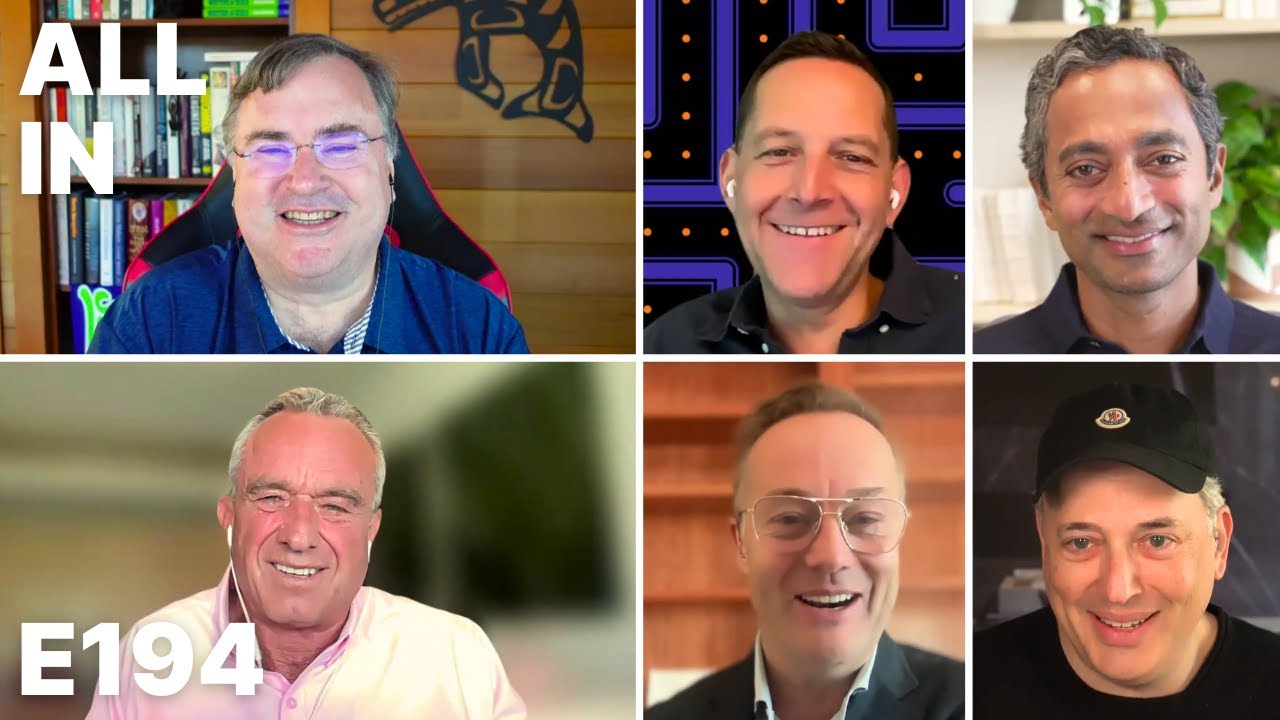
Featuring
Spice rack
Were the cases against Trump partisan lawfare or ordinary rule-of-law accountability?
Original point: The New York business-records prosecution, classified-documents case, and election case used selective or novel theories timed to damage Trump politically, so branding the results as neutral rule of law was misleading.
What everyone argued
David Sacks
Sacks argued that Bragg elevated stale bookkeeping allegations into 34 felonies, Biden was not charged for comparable document retention, and Jack Smith rebuilt an election case after the Supreme Court constrained it. The pattern and timing looked designed to imprison an opponent and interfere with voter choice.
Reid Hoffman
Hoffman argued that juries, appeals, and the same law for rich and poor are the best available truth-finding system. Trump's own vice president and other officials supplied evidence about the election pressure campaign, and adverse rulings should not be dismissed as lawfare merely because they hurt a favored candidate.
Winner circle
Reid Hoffman wins, but not cleanly. His core rule—that evidence should be tested before juries and reviewed on appeal regardless of a defendant's power—fits the record better than calling the whole set lawfare. David Sacks correctly identified real overreach risks and the Supreme Court later vindicated part of his immunity argument, but several of his factual comparisons collapsed different evidence and offenses. Hoffman's false statement that rioters killed officers materially weakens his performance without overturning the institutional case.
Commentary
David Sacks
Assumptions and fact checks
Novel or aggressive legal theories against a leading candidate are probably partisan lawfare.
Why it mattersNovelty and political context demand caution, but unprecedented conduct can create unprecedented cases. Selective-prosecution claims need comparative evidence about facts, intent, obstruction, and ordinary charging practice.
Election-year timing shows the cases were designed to interfere with the vote.
Why it mattersTiming created unavoidable political effects and some cases moved slowly, while Trump's litigation also caused delays. Motive cannot be inferred from the calendar alone.
Biden was guilty of the same classified-document offense for which Trump was prosecuted.
CheckHur found evidence of willful retention and disclosure but concluded criminal charges were not warranted and that the evidence did not establish guilt beyond a reasonable doubt. Trump also faced obstruction allegations after a subpoena, making the evidentiary records materially different.
The Supreme Court substantially weakened Jack Smith's election prosecution before prosecutors filed a narrower superseding indictment.
CheckTrump v. United States recognized absolute immunity for core constitutional powers and presumptive immunity for official acts, requiring a conduct-by-conduct reassessment. Prosecutors then narrowed the indictment.
DOJ had already determined that January 6 was not criminal before Jack Smith invented a fraud theory.
CheckA failure to charge incitement would not establish that separate conspiracies to obstruct certification or defraud the United States were noncriminal. Smith's final report describes extensive evidence for those distinct offenses.
Reid Hoffman
Hoffman had the sounder institutional rule and accepted legal losses as well as wins. His false police-death statement was serious and avoidable; it gave Sacks a clean factual rebuttal in the hottest moment.
Assumptions and fact checks
Multiple indictments and jury findings make rampant political persecution unlikely.
Why it mattersIndependent juries and appellate review are meaningful safeguards, and several findings survived review. They do not immunize prosecutors from selective or overbroad theories case by case.
Courts are the best available proxy for truth in these disputes.
Why it mattersAdversarial evidence, written rulings, juries, and appeals outperform partisan assertion. The same respect must extend to rulings that narrowed or dismissed government cases.
Twelve jurors twice found that Trump assaulted and defamed E. Jean Carroll.
CheckThe civil trials used nine-person juries. The first found sexual abuse and defamation; the later trial assessed additional defamation damages using the first verdict's preclusive findings.
January 6 rioters killed police officers during the attack.
CheckNo officer was killed by rioters. Officer Brian Sicknick was assaulted and died the next day, but the medical examiner ruled his death natural from strokes; other responding officers later died by suicide.
A unanimous 12-person New York jury convicted Trump in the business-records case.
CheckThe official New York court record includes the jury instructions and verdict sheet reflecting guilty verdicts on all 34 counts.
Were 2024 third-party ballot fights principled election enforcement or partisan gamesmanship?
Original point: Democratic-aligned actors tried to remove candidates when they threatened Biden or Harris and keep RFK Jr. listed when he threatened Trump, revealing partisan advantage rather than a consistent democratic principle.
What everyone argued
David Sacks
Sacks contrasted challenges to RFK Jr., Cornel West, and Jill Stein with resistance to RFK's later withdrawal. He argued that changing the desired ballot outcome when the spoiler effect changed was 'naked partisan hackery,' regardless of whether lawyers could identify a procedural hook.
Reid Hoffman
Hoffman said candidates who satisfy the legal process should appear and conceded that funding ballot-removal tactics would be anti-democratic. He defended legal process as the workable rule and distinguished court-reviewed eligibility disputes from illegal pressure to alter vote totals.
Winner circle
David Sacks wins the democratic-consistency argument. He showed why changing one's ballot-access principle with the expected spoiler effect is partisan gamesmanship, and Hoffman eventually agreed that suing candidates off the ballot can be anti-democratic. The win is narrower than Sacks claimed because Michigan and Wisconsin officials and courts were applying state rules, not merely taking instructions from the groups that had challenged RFK elsewhere.
Commentary
David Sacks
Sacks won the principle by asking whether each side would accept the same access rule when the spoiler effect flipped. He overstated the factual unity of the actors, which made lawful state administration sound like a single party operation.
Assumptions and fact checks
A candidate should generally be allowed to withdraw after qualifying for the ballot.
Why it mattersCandidate autonomy matters, but late withdrawal can conflict with party nomination rights, printing deadlines, overseas ballots, and orderly administration. A universal rule needs a clear cutoff.
Inconsistent partisan incentives make the underlying legal challenges anti-democratic.
Why it mattersA valid legal claim can still be deployed opportunistically. The pattern deserved criticism, although the remedy is clearer neutral rules rather than ignoring eligibility defects.
Democratic-aligned actors challenged RFK Jr. and Jill Stein when their candidacies were expected to hurt the Democratic ticket.
CheckNew York litigation removed RFK after a residency finding, and the Democratic National Committee filed the Wisconsin action challenging Green Party ballot access. The legal claims were not invented, but the partisan sponsorship was real.
The same Democratic groups that fought RFK's ballot access later kept him on the Michigan and Wisconsin ballots.
CheckMichigan and Wisconsin decisions turned on election statutes, timing, party nomination, and administrative constraints. Sacks's broader partisan-incentive point survives, but he conflated advocacy groups with election agencies and courts.
The U.S. Supreme Court overruled Colorado's removal of Trump from the presidential ballot.
CheckTrump v. Anderson held that states lack authority to enforce Section 3 of the Fourteenth Amendment against federal candidates and reversed Colorado's judgment.
Reid Hoffman
Hoffman's concession was intellectually honest and prevented a rout. But he answered a substantive consistency challenge with a procedural rule, then ultimately agreed that the targeted tactic was anti-democratic.
Assumptions and fact checks
Court access and compliance with election procedure are sufficient safeguards against anti-democratic ballot tactics.
Why it mattersProcedure supplies legitimacy to outcomes, but litigation cost, selective enforcement, ambiguous deadlines, and partisan sponsorship can still distort access. Neutral rules should reduce strategic discretion.
Independent presidential candidates are usually spoilers under the current two-party system.
Why it mattersPlurality voting creates strong spoiler incentives. That explains the tactics without justifying inconsistent access standards, and it strengthens Hoffman's separate support for ranked-choice voting.
Did OpenAI's commercial structure betray its original nonprofit donors?
Original point: Musk supplied crucial early money when OpenAI was presented as a nonprofit, then received no shares while later investors and employees gained valuable commercial interests; legal form aside, that looks like the donor got screwed.
What everyone argued
David Sacks
Musk donated roughly $44 million to a project that was not supposed to be a conventional for-profit company. Once OpenAI created valuable commercial interests for other people, leaving the seed donor with no equity created a legitimate sense that the deal had changed underneath him.
Reid Hoffman
Hoffman said his own $10 million donation likewise carried no shares, because converting philanthropic gifts into donor equity would itself be private enrichment. OpenAI's nonprofit continued to govern the mission while commercial capital funded the scale that philanthropy could not.
Winner circle
Reid Hoffman wins narrowly. He correctly separated a philanthropic gift from an equity purchase and his description of continuing nonprofit control matches OpenAI's current structure. Sacks raised the better governance warning, but his conclusion rested mainly on Musk receiving no shares and on an inflated contribution figure. Hoffman loses points for calling the suit meritless when the eventual dismissal was based on timing rather than the underlying facts.
Commentary
David Sacks
Sacks found the uncomfortable substance behind the org chart, but he blurred donation and investment. His argument needed evidence that the nonprofit lost control or received inadequate value, not just the fact that later stakeholders obtained equity.
Assumptions and fact checks
A donor is morally entitled to equity when a nonprofit later creates a commercial subsidiary.
Why it mattersA donation is not a convertible investment. The serious question is whether charitable assets and control remained dedicated to the mission, not whether the donor personally received shares.
Commercial upside for later investors proves that early philanthropy was diverted into private enrichment.
Why it mattersThe risk is real, but it depends on governance, transfer pricing, control, and benefit to the nonprofit. The existence of a commercial arm alone does not prove diversion.
Reid Hoffman
Hoffman wins the legal and accounting distinction between a gift and an investment. He would have been more persuasive if he had conceded the genuine conflict risk instead of treating nonprofit control and Musk's wealth as complete answers.
Assumptions and fact checks
Nonprofit voting control is enough to preserve the original charitable bargain.
Why it mattersControl is central, but mission protection also depends on board independence, economics between entities, conflicts, and enforcement. Hoffman treated the label as more conclusive than it is.
Musk sued mainly from sour grapes after declining an investment opportunity he could not control.
Why it mattersCompetitive and personal motives are plausible, but they do not resolve whether the governance complaint had substance. Motive cannot substitute for testing the transaction.
OpenAI's nonprofit continued to control the organization's mission and commercial subsidiary.
CheckOpenAI's October 2025 structure disclosure says the OpenAI Foundation controls OpenAI Group PBC. That validates the governance distinction, though it does not independently prove that every transaction served the nonprofit fairly.
Was Harris's grocery plan a targeted anti-gouging rule or a dangerous price-control answer to inflation?
Original point: Harris offered a price-gouging ban as her answer to a roughly 20% rise in the price level, but broad inflation came from excessive demand and economy-wide cost shocks rather than suddenly greedy grocery companies.
What everyone argued
David Sacks
Sacks argued that Harris's proposal was politically framed as relief from four years of inflation even though commodity and staple prices reflected broad monetary, fiscal, energy, labor, and supply forces. Calling it anti-gouging did not cure the causal mismatch or the risk of government price setting.
David Friedberg
Friedberg emphasized the concrete cost stack behind food inflation—fuel, labor, and other inputs—and warned that government-set prices in free markets are a step toward centralized control. He cited weak profiteering claims as evidence that the diagnosis was politically distorted.
Reid Hoffman
Hoffman distinguished a ban on gouging from a fixed price cap. He agreed that setting the price of eggs would be bad, but argued that concentrated firms can exploit disruptions and that government may correct market abuse just as antitrust law addresses platform power.
Winner circle
Reid Hoffman wins by a nose because he preserved the distinction between policing abusive conduct and fixing prices, and the Kroger record showed that selected markups did outrun costs. David Sacks and David Friedberg win the larger inflation diagnosis: grocery profiteering did not explain the national surge. Their error was treating the narrow proposal Hoffman defended as if Washington would simply set the price of eggs.
Commentary
David Sacks
Sacks won the causal correction but overreached with a one-cause monetary story. His case would have been stronger if he had attacked specific statutory triggers instead of treating every anti-gouging rule as a posted-price schedule.
Assumptions and fact checks
The inflation surge was caused by government printing too much money rather than corporate pricing power.
Why it mattersStimulative fiscal and monetary policy strengthened demand, but the Federal Reserve also identifies pandemic supply constraints, labor disruption, commodity shocks, and reopening imbalances. Market power can affect margins without explaining the entire price level.
A federal anti-gouging rule would function as price fixing.
Why it mattersA vague ban on 'excessive' prices could chill supply and become discretionary control. A narrow rule tied to emergency shocks, abnormal margins, unfair leverage, and cost defenses is materially different from setting the price of eggs.
Americans had suffered about 20% erosion in purchasing power over the preceding four years.
CheckCPI-U rose about 20.3% from January 2021 to August 2024, but the inverse purchasing power of a dollar fell about 16.9%. Sacks accurately described the price-level rise but overstated the purchasing-power decline.
David Friedberg
Friedberg's cost-chain explanation added needed economic substance. He argued against the most centralized version of the proposal, not the narrower conduct rule Hoffman defended.
Assumptions and fact checks
Food-price increases were adequately explained by fuel, labor, and other input inflation.
Why it mattersThose costs mattered greatly, but retailer bargaining power and margin expansion also appeared in the record. The contribution varied by product and period.
Policing grocery gouging necessarily means the government sets market prices.
Why it mattersAntitrust and unfair-practice rules can target conduct or abnormal emergency markups without specifying a normal price. Poorly drafted rules can still converge on de facto controls, which is the legitimate risk he identified.
Reid Hoffman
Hoffman argued with the most care: he rejected literal price caps and kept open the possibility of abuse. He never completed the implementation case, leaving the hardest line-drawing problem to regulators.
Assumptions and fact checks
Regulators can distinguish abusive markups from valid scarcity pricing well enough to improve outcomes.
Why it mattersEvidence can reveal abnormal margins and exclusionary leverage, but vague standards risk deterring supply precisely when higher prices attract it. Design and enforcement discipline decide the result.
Selected examples of retailer margin expansion justify a national grocery anti-gouging regime.
Why it mattersThey justify investigation and perhaps targeted enforcement, not automatically a broad new prohibition. The policy needs evidence about prevalence, existing-law gaps, and shortage effects.
Kroger acknowledged that it raised milk and egg prices faster than its costs during the inflation period.
CheckIn the Kroger-Albertsons hearing, the company's pricing executive was questioned about an internal statement that retail inflation for milk and eggs significantly exceeded cost inflation. That supports the narrow claim, not a conclusion that grocery pricing caused national inflation.
Price-gouging regulation is not necessarily the same as fixing the price of a product.
CheckThe 2024 congressional proposal prohibited grossly excessive prices around exceptional market shocks and contemplated cost and leverage tests; it did not publish a government price for groceries.
Sacks correctly demanded equal treatment and anticipated that presidential immunity would cut deeply into the federal case. He weakened a serious civil-liberties argument by flattening major factual differences and calling uncharged conduct equivalent guilt.