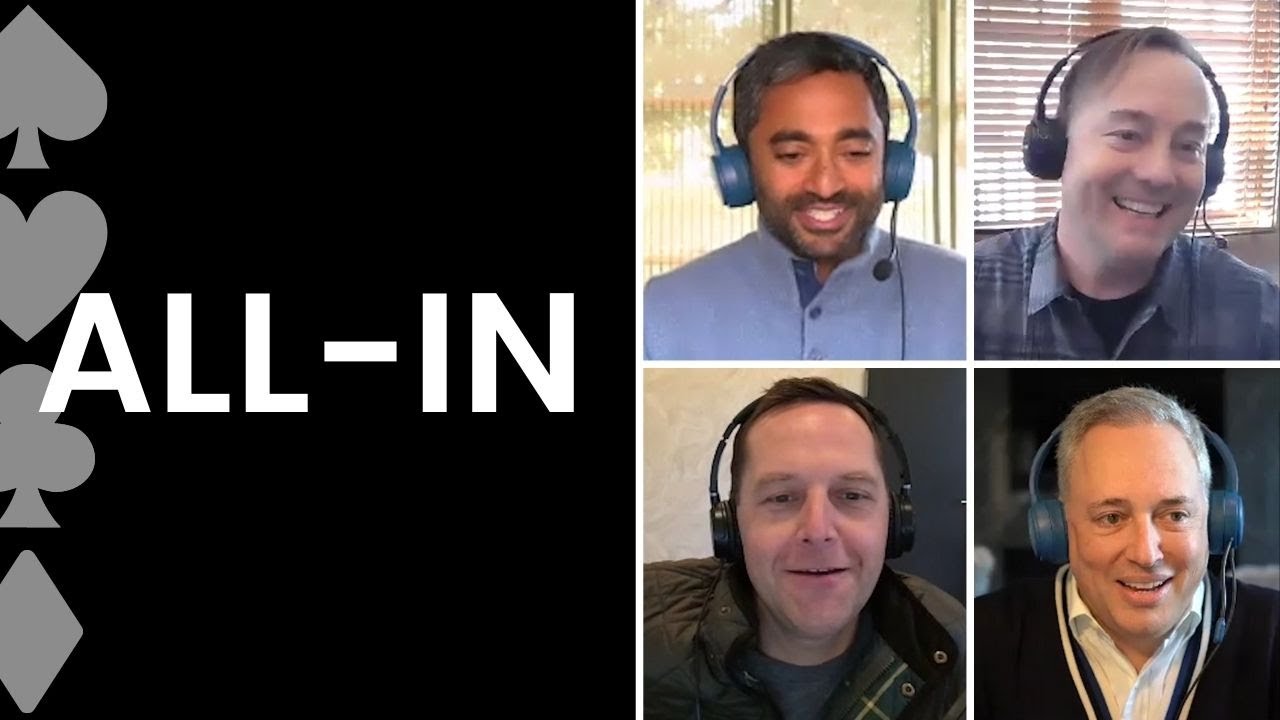
Featuring
Episode 19 is the first great All-In market brawl. Chamath wants Robinhood hauled into the spotlight for blowing up at the exact moment retail traders thought they had Wall Street on the ropes. Jason keeps trying to split anger from proof. Friedberg quietly gives the cleanest explanation of why a "free" trading platform can turn fragile in a volatility stampede. Sacks keeps asking the deeper question: when the little guy finally coordinates, why does the system always seem to rediscover the emergency brake? The spiciest fight is over Robinhood, but the episode's lasting value is how quickly it turns into a debate about system design, decentralization, and whether stock prices are anything more than a giant social belief machine.
Spice rack
Do decentralized retail movements need centralized brakes, or does central control just entrench elites?
Original point: Friedberg argues that uncontrolled swarming behavior can produce destructive feedback loops and that some central rules and due-process mechanisms still matter.
What everyone argued
Chamath Palihapitiya
Chamath argues that repeated arbitrary control by centralized authorities will push entrepreneurs and users toward more decentralized systems for trading, records, credentials, and other domains. He sees decentralization as the natural response to unfair gatekeeping.
Jason Calacanis
Jason lands in the middle: social networks create both mobs and movements, and the trick is to preserve the latter without letting the former dictate outcomes. He sees WallStreetBets as initially closer to a movement than a riot.
David Sacks
Sacks agrees that mob behavior is dangerous, but says social tools also create legitimate movements against entrenched elites. He worries that censorship and platform control almost always end up protecting the already powerful from organized outsider pressure.
David Friedberg
Friedberg argues that decentralization can deliver powerful corrections, but without guardrails it also creates swarm dynamics, mob punishment, and runaway feedback loops. He wants institutions to become fairer and more adaptive rather than simply disappear.
Winner circle
Friedberg and Jason land the best answer here. Sacks and Chamath correctly identify why people lose faith in centralized gatekeepers, but they under-specify how decentralized systems avoid their own feedback loops, coercion, and accountability gaps. The lesson of GameStop is not that elites should keep tighter control, but also not that virality is self-authenticating. Better institutions still matter, and they have to earn trust by being fairer and more transparent than the ones that failed.
Commentary
Chamath Palihapitiya
Chamath names the push factor correctly: arbitrary gatekeepers create decentralization demand. But he leaves the pull-side governance problem too vague. Friedberg is right that replacing a biased referee with no referee is not obviously progress.
Assumptions and fact checks
If centralized systems keep acting arbitrarily, users and builders will migrate to decentralized alternatives.
Why it mattersThat migration logic is strong. Trust failures create demand for alternatives even when the alternatives are messy.
Decentralized systems can be made ethically and legally constrained enough to avoid mob-rule outcomes.
Why it mattersThis is the unresolved part. It is more a design hope than a demonstrated conclusion.
Jason Calacanis
Jason's answer is better than it first sounds because it avoids the false binary. The weakness is that it stays at the level of aspiration; it does not specify what market or speech institutions would actually preserve movements while checking mobs.
Assumptions and fact checks
It is possible to preserve movement-like coordination without fully unleashing mob dynamics.
Why it mattersThat is the right design target, but the mechanics are hard. Many platforms have claimed this balance and failed to sustain it cleanly.
David Sacks
Sacks captures the anti-elite energy of the moment better than anyone else. But he does not fully solve Friedberg's challenge. A tool can empower the public and still become dangerous when the public coordinates around falsehood, status games, or rage.
Assumptions and fact checks
Centralized moderation and market control usually benefit elites over outsiders.
Why it mattersThat risk is real and repeatedly visible, especially when the same institutions set the rules and also bear the reputational or financial downside of popular unrest.
Movements are worth protecting even when the same tools can also create mobs.
Why it mattersThat is a sensible liberal assumption. The harder question is not whether to allow movements, but how to preserve accountability and due process while doing so.
David Friedberg
Friedberg's argument is strong because he does not deny elite abuse; he just refuses to treat decentralized coordination as morally self-justifying. That is exactly the discipline this part of the conversation needed.
Assumptions and fact checks
Pure decentralization will routinely create destructive swarm behavior unless there are procedural brakes.
Why it mattersThat assumption is persuasive because the relevant failure mode is not theoretical. Social and market systems both show repeated examples where virality amplifies error, outrage, and coordination without accountability.
The better answer is improved institutions, not the abolition of institutions.
Why it mattersThat is the strongest practical conclusion in the exchange. Replacing every gatekeeper with a swarm solves one failure mode by introducing another.
Do stocks need to reflect the underlying business, or are they just collective belief machines?
Original point: Jason asks what the endgame is if millions more people keep buying GameStop and whether anyone can explain how the stock and business will look a year later.
What everyone argued
Chamath Palihapitiya
Chamath argues that the week exposed a deeper truth: most stocks trade on the belief that someone else will pay more tomorrow. He says discounted-cash-flow orthodoxy badly understates how much price is really coordinated narrative, momentum, and social conviction.
Jason Calacanis
Jason keeps pressing for an end state and insists GameStop is not Tesla. His core intuition is that a stock cannot stay permanently untethered from the actual business just because enough people want it to.
David Sacks
Sacks reframes the issue as a power question: even if GameStop is overvalued, outsiders should not be frozen out by incumbents when they choose to take the other side of the trade.
Winner circle
Chamath best describes what a squeeze feels like from the inside, but Jason gives the better long-run answer. GameStop's 2021 run showed that prices can become wildly reflexive and socially coordinated in the short run. It did not show that the business stopped mattering. The later retracement and still-weak operating results are exactly why 'this is not Tesla' aged better than 'fundamentals are basically nonsense.' Sacks is also right that none of this excuses gatekeepers from deciding who is allowed to play.
Commentary
Chamath Palihapitiya
Chamath is excellent at describing the mechanics of a mania and too quick to universalize them. The market can act like a belief machine without that being the whole story of capitalism.
Assumptions and fact checks
Most stocks are priced primarily by reflexive expectation rather than by future cash-flow reality.
Why it mattersThat is directionally more true in short windows and speculative episodes than in the long run. Chamath's argument gets too absolute when it treats a mania as the full theory of valuation.
If enough people believe in a stock, the business can become almost secondary.
Why it mattersThat can be true for a while, especially during squeezes, but the GameStop hindsight does not support it as a durable principle.
GameStop's squeeze-era pricing detached sharply from the underlying business and later retraced well below the January 2021 extreme.
CheckThe stock's adjusted close around January 27, 2021 was far above its level around January 27, 2022, which supports the view that the squeeze was a powerful but not durable narrative event.
Jason Calacanis
Jason is right to keep asking the boring question. It sounds less sophisticated than Chamath's market theory, but the boring question is usually the one speculation tries hardest to dodge.
Assumptions and fact checks
Narrative and crowd behavior can move prices sharply, but durable valuation still depends on the business eventually earning the story.
Why it mattersThat is the strongest hindsight reading of GameStop. Short-run market mechanics overpowered fundamentals, but the underlying business still constrained what the story could sustain.
A year later, GameStop still needed to be judged by what the actual business became, not just by the 2021 squeeze story.
CheckBy fiscal 2022 GameStop still reported a net loss, which supports Jason's insistence that the business outcome still mattered despite the squeeze dynamics.
David Sacks
Sacks usefully stops the conversation from turning into pure valuation theology. Fairness of access and correctness of price are not the same issue.
Assumptions and fact checks
Even when a price is wrong, outsider participation rights still matter.
Why it mattersThat is the clean procedural principle running underneath the whole episode.
Chamath wins the mechanism fight. He understood that the issue was not vague platform strain but a capital-and-clearing bottleneck created by a business model that let users pile into volatile options with very little room for error. He loses points for overshooting the evidence on motive and legal culpability.