Featuring
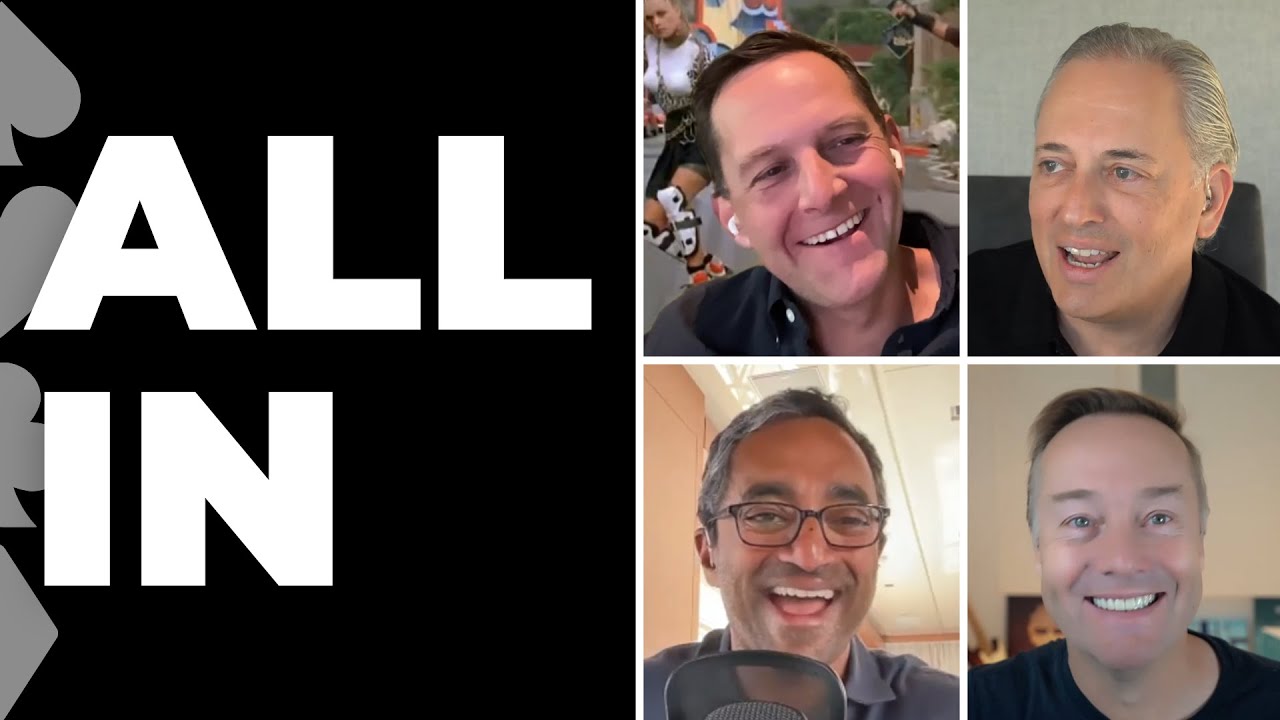
The besties move from LK-99's brief levitation act to broken research incentives, Treasury arithmetic, and Trump's election indictment. The sharpest fight is Jason versus Sacks over whether accountability protects democracy or bends criminal law around a political target. Friedberg has the best episode: his superconductor enthusiasm ages badly, but he brings the strongest fiscal receipts and the most careful answer on prosecution timing.
Spice rack
Was the federal election case against Trump legally sound and democratically wise?
Original point: The false-elector effort and alleged obstruction put Trump in serious criminal jeopardy and warranted accountability.
What everyone argued
Jason Calacanis
Jason argues that Trump knowingly pursued false electors after repeated defeats, pressured Pence, and would have overturned the result if he could. He treats the case as overdue accountability and predicts the evidence will establish criminal guilt.
David Sacks
Sacks calls Trump's conduct indefensible but argues that the charges use novel statutes, face a hard intent burden, and weaponize prosecution against a political opponent. He predicts appellate trouble and says impeachment and elections were the wiser forums.
David Friedberg
Friedberg focuses on timing rather than innocence. Filing years after January 6 and during a presidential campaign, he argues, risked damaging trust in the justice system more than a conviction could repair.
Winner circle
Friedberg wins the argument as made because he acknowledges the accountability interest without pretending the institutional tradeoff is easy. Jason is right that the alleged conduct could not be waved away as mere speech, while Sacks is right that the legal route faced serious uncertainty. Hindsight denied both confident predictions: there was neither a trial proving guilt nor an appellate merits ruling declaring the entire case abusive.
Commentary
Jason Calacanis
Assumptions and fact checks
Adviser testimony and the false-elector evidence would prove Trump's criminal intent beyond a reasonable doubt.
Why it mattersThe special counsel later maintained that the admissible evidence was sufficient, but no jury tested the witnesses, intent evidence, defenses, or revised post-immunity theory.
A prosecution would remove Trump from political life and clear the way for a pardon.
Why it mattersThe prosecutions did not dislodge Trump; he won the 2024 election, and the federal case was dismissed before trial.
The August 2023 indictment charged four counts tied to an alleged effort to overturn the 2020 election result.
CheckThe indictment charged conspiracy to defraud the United States, conspiracy against rights, and two obstruction-related counts, and alleged a knowingly false effort to impair certification.
David Sacks
Sacks correctly forecasts legal friction and then stretches that insight into a claim of political illegitimacy. Novel does not mean invented, and prosecutorial independence cannot be dismissed with an org chart.
Assumptions and fact checks
If incitement could not be charged, the remaining election-related charges were improper substitutes.
Why it mattersThe indictment alleged different conduct and different legal injuries, especially deceit aimed at certification. Failure to charge a speech offense does not answer those theories.
The prosecution would do more democratic damage than declining to prosecute an alleged attempt to defeat certification.
Why it mattersThe timing and candidacy created real legitimacy costs, but categorical non-prosecution also risks teaching future presidents that electoral accountability replaces criminal law.
The election indictment did not charge Trump with incitement of insurrection.
CheckNone of the four counts was an incitement charge; the case targeted alleged conspiracies, false claims, elector certificates, pressure on officials, and obstruction of certification.
Jack Smith's McDonnell prosecution was overturned by a 9-0 Supreme Court ruling.
CheckThe Court unanimously vacated and remanded McDonnell's conviction, but only eight justices participated in June 2016. Calling it 9-0 is numerically wrong, though the unanimity point is fair.
David Friedberg
Friedberg gives the most careful warning, but timing cannot become a candidate's shield. The missing piece is a rule that protects elections without rewarding delay or renewed candidacy.
Assumptions and fact checks
An earlier filing would have allowed the case to finish before the 2024 election cycle.
Why it mattersEarlier action might have helped, but executive-privilege disputes, evidence collection, appeals, immunity, and ordinary defense delay made a clean pre-election finish uncertain.
The institutional harm from campaign-season prosecution exceeded the benefit of enforcing criminal law.
Why it mattersBoth risks are severe and the episode offers no principled way to weigh them. The answer depends on evidence strength, prosecutorial independence, speed, and safeguards against selective enforcement.
Will rising U.S. debt materially crowd out private investment?
Original point: The Fitch downgrade and debt-to-GDP warnings are overblown because sovereign capital must choose among relative alternatives, and the United States remains stronger than its peers.
What everyone argued
Chamath Palihapitiya
Chamath calls the downgrade late and largely irrelevant. Since reserve managers still need an alternative to the dollar and other major economies are weaker, he argues that buyers will line up for Treasuries and the United States will continue to suffer less and win more than peers.
Jason Calacanis
Jason points to low unemployment, abundant job openings, foreign capital in U.S. venture funds, and historical mortgage rates to argue that America can keep investing and innovate its way through the fiscal strain.
David Sacks
Sacks narrows the case: no dollar collapse is needed. More issuance requires a higher yield at the margin; a higher risk-free return raises discount rates, pulls capital from equities and venture, and slows growth across the Western financial system.
David Friedberg
Friedberg frames the borrowing surge as a debt spiral: nearly $2 trillion of expected net borrowing in two quarters, rising interest expense, range-bound foreign participation, and no political appetite for entitlement reform.
Winner circle
Sacks wins the narrow question, with Friedberg providing the strongest data support. Chamath correctly rejects dollar-doom theater, and Jason correctly notes American resilience, but neither answers the marginal mechanism. Treasury demand can remain enormous while higher borrowing still raises the clearing yield and leaves less capital for productive risk-taking.
Commentary
Chamath Palihapitiya
Chamath answers the apocalypse argument well and the actual crowding-out argument poorly. No replacement for the dollar is required for debt to become an expensive albatross.
Assumptions and fact checks
A lack of a superior reserve-currency alternative prevents U.S. debt from materially harming domestic investment.
Why it mattersReserve dominance supports demand, but the marginal buyer still responds to price. Higher yields can crowd out private investment without dethroning the dollar.
U.S. relative economic strength will persist despite fiscal deterioration.
Why it mattersThe United States retains deep markets and strong innovation, but relative strength does not eliminate rising interest costs or guarantee permanent outperformance.
Japan's gross public debt was about 270% of GDP and growing in 2023.
CheckThe IMF estimated Japan's gross public debt near 255% of GDP for 2022 and projected roughly 261% for 2023. The broad comparison was directionally right, but 270% overstated the published figure.
Jason Calacanis
Jason usefully checks the doom loop against the live economy. He confuses resilience with proof that the fiscal bill is free.
Assumptions and fact checks
Strong employment and venture inflows can offset the investment drag from heavier federal borrowing.
Why it mattersThey can soften the observed outcome, but they do not show the drag is absent. Crowding out is measured against a lower-borrowing baseline, not against recession.
David Sacks
Sacks wins by refusing Chamath's false binary. The dollar can remain king while the king pays a much steeper tab.
Assumptions and fact checks
Treasury yields would need to rise into roughly the five-to-seven-percent range to absorb sustained issuance.
Why it mattersThe marginal-price logic is sound, but the numerical range depends on inflation, monetary policy, global saving, maturity mix, and growth.
Higher and rising federal borrowing can crowd out private investment even without a reserve-currency crisis.
CheckCBO's long-run framework finds that government borrowing absorbs national saving, puts upward pressure on interest rates, reduces private capital, and lowers output relative to a lower-debt path.
David Friedberg
Friedberg sees the fiscal feedback loop clearly. His weakest move is turning a composition chart into a stronger de-dollarization claim than the data can carry.
Assumptions and fact checks
Range-bound foreign participation shows that the dollar's reserve role is already in meaningful decline.
Why it mattersThe share has declined, but nominal foreign holdings remained large and later data do not show abandonment of Treasuries.
Treasury expected about $2 trillion in privately held net marketable borrowing over the July-December 2023 period.
CheckTreasury announced $1.007 trillion for July-September and $852 billion for October-December, totaling $1.859 trillion, which reasonably rounds to about $2 trillion.
Foreign holdings fell as a share of publicly held federal debt even while their dollar holdings increased.
CheckCRS data show the foreign share around 30% in recent years while the nominal amount held abroad increased. A falling share alone does not prove outright foreign selling.
Was LK-99 evidence of a room-temperature-superconductor breakthrough?
Original point: Early modeling and uneven replication attempts suggested LK-99 might reveal a new path toward room-temperature superconductivity, even though the material itself remained unverified.
What everyone argued
Chamath Palihapitiya
Chamath asks why anyone should believe the claim before a clean replication and predicts that LK-99 will prove to be an ordinary magnetic material rather than a transformative superconductor.
David Sacks
Sacks says the excitement is pleasant but premature: wake him up when the science is real, especially before venture investors start writing checks.
David Friedberg
Friedberg repeatedly says LK-99 may fall between fraud and revolution. He points to electronic-structure models, heterogeneous samples, and low-temperature results as clues that the recipe might expose a useful materials pathway even if LK-99 itself falls short.
Winner circle
Chamath wins the claim, with Sacks sharing the skeptical side. Friedberg made a strong case for investigating LK-99, but the debate asked what the evidence justified believing. The later record vindicated the higher replication threshold: LK-99 was a lively research prompt, not the Holy Grail.
Commentary
Chamath Palihapitiya
Chamath wins by keeping the claim attached to the measurement that matters. He would have been even cleaner if he had stopped at not proven instead of trying to name the eventual failure mode.
Assumptions and fact checks
Without reproducible zero resistance at room temperature, investors should treat the breakthrough claim as unproven.
Why it mattersLevitation-like behavior and electronic-structure models are not substitutes for the defining transport measurements and repeatable synthesis.
LK-99 was probably merely diamagnetic.
Why it mattersChamath correctly rejected superconductivity, but later work pointed to a semiconductor plus ferromagnetic and impurity effects; his specific mechanism was only a rough guess.
LK-99 had not been independently demonstrated as a room-temperature, ambient-pressure superconductor when the episode was recorded.
CheckThe claim rested on preprints and incomplete replications. Subsequent synthesis and measurement work found semiconducting behavior and impurity-driven effects rather than room-temperature superconductivity.
David Sacks
Sacks supplies the useful commercial boundary: enjoy the internet science fair, but do not confuse a viral preprint with diligence.
Assumptions and fact checks
The social value of scientific excitement does not make an unreplicated claim investable.
Why it mattersAttention can accelerate testing, but capital decisions still need reproducible properties and a plausible manufacturing path.
David Friedberg
Friedberg is excellent at explaining why scientists looked, but less disciplined about how much belief the early clues deserved. Curiosity won; LK-99 did not.
Assumptions and fact checks
Theoretical flat bands and inconsistent early replications made a new superconducting pathway reasonably likely.
Why it mattersThose clues justified investigation, not a high posterior probability. The later impurity explanation showed why transport and phase-purity evidence had to dominate the models.
The global replication sprint had value even if the headline claim failed.
Why it mattersIndependent teams resolved the claim quickly and made an unusually technical subject accessible to a broad audience.
Later evidence established LK-99 as a room-temperature superconductor.
CheckReplication studies attributed the apparent signals to impurities and ordinary magnetic behavior; peer-reviewed calculations and experiments characterized the relevant compound as semiconducting rather than superconducting.
Jason is strongest when he names the conduct and weakest when he turns an indictment into a verdict. Accountability requires the legal process he assumes will be easy.