Featuring
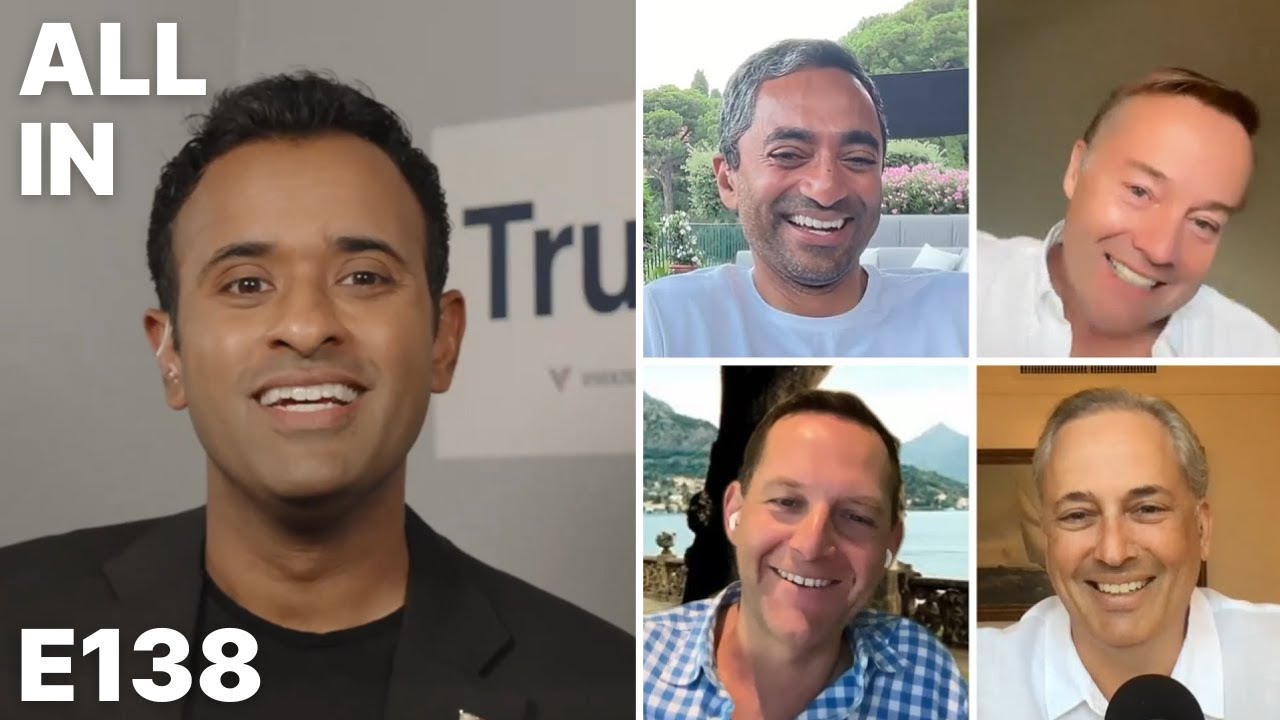
Vivek Ramaswamy joins the full crew for a candidate interview that roams from federal debt to Trump and the 2023 banking panic. The sharpest clash comes when Jason challenges Vivek's claim that Trump's early prosecutions were institutional retaliation, while the best policy exchange pits Vivek's market-discipline answer for Silicon Valley Bank against Friedberg and Sacks's contagion case. Friedberg has the strongest all-around episode: he wins the fiscal argument and helps land the SVB ruling, proving that sometimes the spreadsheet is the spiciest guest at the table.
Spice rack
Were the early Trump prosecutions legitimate criminal cases or political punishment for bad judgment?
Original point: Multiple independent cases and findings made it implausible to wave away every allegation against Trump as a deep-state conspiracy.
What everyone argued
Jason Calacanis
Jason pressed Vivek to say whether Trump had done anything criminal rather than collapsing seven proceedings into one conspiracy. He pointed to the classified-documents indictment, the New York charges, January 6, Georgia, the Carroll verdict, and Trump Organization misconduct as cumulative evidence that the conduct deserved legal scrutiny.
Vivek Ramaswamy
Vivek argued that prosecutors were turning reprehensible choices into crimes because Trump threatened the system. He attacked the New York felony theory and statute-of-limitations path, noted that the classified-documents indictment relied on the Espionage Act rather than the Presidential Records Act, and said Trump's January 6 speech did not satisfy the constitutional test for incitement.
Winner circle
Jason wins narrowly on the central question because there was enough evidence and law to justify case-by-case prosecution, and the New York verdict confirms that at least one early case was legally triable and provable. Vivek wins several subsidiary points: Jason mangled the Oath Keepers attribution, blurred civil and criminal outcomes, and understated serious constitutional concerns. But Vivek's umbrella theory of political retaliation did not meet its burden of proof.
Commentary
Jason Calacanis
Assumptions and fact checks
The number and variety of cases made a coordinated political explanation unlikely.
Why it mattersDifferent sovereigns, courts, juries, statutes, and fact patterns reduce the plausibility of one centrally coordinated plot. Quantity alone is not proof, so each case still needs independent legal scrutiny.
Trump's conduct around January 6 amounted to criminal incitement of the crowd.
Why it mattersTrump used both peaceful language and inflammatory 'fight like hell' rhetoric. The federal election indictment charged conspiracies and obstruction rather than the distinct crime of incitement, so Jason's framing outran the actual charge.
Trump told the Oath Keepers to 'stand back and stand by.'
CheckTrump used that phrase about the Proud Boys during the September 29, 2020 presidential debate, not the Oath Keepers. Jason conflated two different groups.
Trump had been found guilty of sexual assault by July 2023.
CheckThe Carroll matter was a civil case. A jury found Trump liable for sexual abuse and defamation; it was not a criminal guilty verdict. The civil finding was serious, but Jason described the legal posture incorrectly.
The New York business-records prosecution ultimately produced guilty verdicts on all 34 counts.
CheckOn May 30, 2024, the jury returned guilty verdicts on 34 counts of first-degree falsifying business records.
Vivek Ramaswamy
Vivek was at his best when he separated legal theories and acknowledged uncertainty. He lost the thread when he treated later-debatable legal issues as proof of a single political cause and understated the New York prosecution's actual theory.
Assumptions and fact checks
The prosecutions were a coordinated institutional immune response to a political threat.
Why it mattersVivek offered a metaphor, not evidence of coordination or selective-enforcement comparators. Political timing deserved scrutiny, but motive cannot be inferred merely because the defendant was a candidate.
Trump's charged conduct was better characterized as bad judgment than criminal lawbreaking.
Why it mattersThat framing skips the elements prosecutors alleged: false records, willful retention, concealment, and obstruction. The New York jury found the elements proven beyond a reasonable doubt; the federal allegations never received a merits verdict.
Using old or broad statutes against unprecedented conduct is inherently politicized.
Why it mattersNovel application can create fair-notice and separation-of-powers problems, but age and breadth alone do not make a statute illegitimate. The correct test is statutory fit, precedent, evidence, and evenhanded enforcement.
The New York felony charges depended only on treating the hush-money payment as an unreported federal campaign contribution.
CheckThe first-degree charge required intent to commit, aid, or conceal another crime, but the jury was instructed on New York election-law conspiracy and possible unlawful means including FECA, falsified records, and tax-law violations. The prosecution was not limited to the one route Vivek described.
The federal classified-documents indictment did not rely on the Presidential Records Act and instead charged willful retention under the Espionage Act plus obstruction-related offenses.
CheckThe indictment charged national-defense-information retention and obstruction crimes. The absence of a Presidential Records Act charge was real, though not exculpatory: that act does not replace the criminal statutes governing national-defense information or obstruction.
The Supreme Court later held that former presidents have at least presumptive immunity for official acts but no immunity for unofficial acts.
CheckTrump v. United States adopted exactly that framework in 2024. It gave weight to Vivek's concern about criminalizing official presidential conduct, while rejecting absolute immunity for everything a president does.
Was protecting every Silicon Valley Bank depositor necessary to stop contagion, or an avoidable bailout?
Original point: The government should have let SVB resolve normally, with uninsured depositors taking an estimated six-percent haircut, rather than suspend market discipline.
What everyone argued
David Sacks
Sacks argued in the debrief that contagion was already visible in emergency board calls and withdrawals from First Republic and other regional banks. He favored protecting depositors while leaving shareholders and bondholders exposed, and supported higher separately priced deposit insurance for business operating accounts.
David Friedberg
Friedberg said boards across startups, nonprofits, and ordinary businesses were preparing to move cash from smaller banks into the top three. In his risk model, letting uninsured SVB depositors absorb losses would not stay local; it would accelerate a system-wide flight to perceived safety and crush otherwise viable regional banks.
Vivek Ramaswamy
Vivek preferred a normal resolution in which uninsured depositors bore an estimated six-percent haircut. He conceded that the Friday closure changed the panic dynamics, but argued that government protection crowded out market discipline and favored politically connected depositors.
Winner circle
Friedberg and Sacks win. They identified the relevant failure mode: thousands of firms moving operating cash at once could destroy otherwise solvent regional banks. Vivek was right that shareholders and risk-takers should not be rescued, but the actual policy left shareholders and unsecured debt exposed; his assumed six-percent depositor haircut did not address timing or contagion.
Commentary
David Sacks
Sacks's cleanest contribution is separating owners from operating depositors. His case would be stronger with a prospective insurance design rather than relying on emergency discretion after a failure.
Assumptions and fact checks
A targeted guarantee of uninsured deposits was the fastest credible way to halt the run.
Why it mattersOnce depositors were moving funds at digital speed, a clear weekend guarantee directly addressed the coordination problem. Liquidity support alone might not have reassured depositors who feared insolvency losses.
Business transaction accounts deserve higher insurance limits funded through risk-based premiums.
Why it mattersPayroll and operating accounts create different spillovers from speculative cash balances. The design still needs caps, pricing, and anti-evasion rules, but the distinction is economically meaningful.
Deposit flight had spread beyond SVB to other regional banks.
CheckFederal Reserve reviews found that banks with uninsured deposits and securities losses suffered larger outflows, and that stress spread to Signature, First Republic, and more broadly across regional and community banks.
David Friedberg
Friedberg best models the coordination failure: the policy target was not Roku's treasury team but thousands of firms making the same rational transfer at once. He should have acknowledged that emergency protection creates an expectation regulators may repeat it.
Assumptions and fact checks
Without a full depositor guarantee, fear would have cratered a meaningful number of smaller banks.
Why it mattersThe precise counterfactual cannot be observed, but the scale and speed of actual and queued withdrawals, plus subsequent outflows elsewhere, make broader failures a serious rather than speculative risk.
The depositor guarantee was the only workable confidence signal.
Why it mattersA combination of rapid bridge-bank access, liquidity, and clearer loss estimates might have reduced the needed guarantee, but officials had a weekend and highly uncertain asset values. Friedberg's 'only way' phrasing is stronger than the evidence permits.
Small businesses employ about half of U.S. private-sector workers.
CheckThe SBA counted 61.7 million small-business employees in 2023, equal to 46.4 percent of private-sector employment. 'Half' is fair rounding, though it is not half of every worker in the country.
The 2023 banking stress threatened regional and community banks beyond SVB.
CheckFederal Reserve officials later documented outflows at banks with similar vulnerabilities and said contagion threatened broader disruption before the agencies intervened.
Vivek Ramaswamy
Vivek deserves credit for keeping moral hazard and market discipline in the frame. But '94 cents eventually' is not equivalent to 'payroll clears Monday,' and he never solves the contagious-run problem his opponents identified.
Assumptions and fact checks
Uninsured depositors would have received roughly 94 cents on the dollar without the systemic-risk exception.
Why it mattersA high ultimate recovery was plausible because SVB held substantial assets, but the exact recovery, delay, bridge financing, and liquidation discounts were unknown when firms needed payroll cash. Vivek treated a counterfactual estimate as a settled, liquid payout.
Allowing the haircut would restore discipline without causing unacceptable spillovers.
Why it mattersOfficial reviews documented actual contagion and rapid withdrawals at other banks. A market-discipline policy must address those externalities, not only losses at the failed bank.
Guaranteeing uninsured depositors necessarily amounted to favoritism rather than systemic protection.
Why it mattersSVB's clientele benefited, but the same weekend action covered Signature depositors and paired the guarantee with economy-wide liquidity support. The mechanism and later evidence support a systemic rationale even if lobbying and distributional concerns remain fair subjects.
California regulators closed SVB on Friday morning and appointed the FDIC as receiver.
CheckThe California Department of Financial Protection and Innovation closed SVB on March 10, 2023, and named the FDIC receiver after the bank could not meet extraordinary withdrawals.
No losses from the SVB depositor guarantee were borne directly by taxpayers.
CheckThe systemic-risk action protected depositors through the Deposit Insurance Fund, with the uninsured-depositor cost recovered through a special assessment on banks. That is not a general-taxpayer appropriation, though banks can pass some costs to customers.
SVB faced $42 billion of withdrawals on Thursday and about $100 billion more scheduled or expected Friday.
CheckFederal Reserve reporting documents $42 billion withdrawn on March 9 and approximately $100 billion queued or expected for March 10, which the bank could not meet.
Can faster economic growth solve most of America's fiscal problem without near-term spending reform?
Original point: Persistent deficits, entitlement pressure, and a debt load near $33 trillion make the fiscal path unsustainable, so a presidential candidate needs more than an optimistic growth story.
What everyone argued
David Friedberg
Friedberg tied political demand for benefits to a structural spending problem and later rejected Vivek's answer as an implausible version of growing out of the debt. He wanted an explicit mechanism for controlling spending rather than a promise that faster output would make the ratios behave.
Vivek Ramaswamy
Vivek argued that cutting promised benefits amid low trust would inflame populism and that America could grow out of most of its fiscal danger through energy expansion, deregulation, work incentives, and a narrower Federal Reserve mandate. He presented 3-4 percent growth as historically normal and politically safer than immediate benefit cuts.
Winner circle
Friedberg wins. Vivek made the better political observation, but Friedberg asked the decisive policy question: what closes the primary gap if extraordinary growth does not arrive? CBO's baseline showed rising debt despite continued growth, and Vivek never demonstrated why his agenda would be large enough to reverse that path.
Commentary
David Friedberg
Friedberg wins the burden-of-proof exchange because he keeps the denominator and numerator in view: faster GDP helps, but deficits still add debt. He would have been stronger with a concrete reform mix instead of using MMT as a catch-all label.
Assumptions and fact checks
A credible fiscal platform must include near-term spending discipline rather than rely mainly on growth.
Why it mattersGrowth materially improves debt arithmetic, but a plan claiming to solve most of the gap must confront persistent primary deficits and aging-related spending. Friedberg was right to demand that missing mechanism.
Vivek's growth-first answer was essentially modern monetary theory.
Why it mattersMMT concerns monetary sovereignty, inflation constraints, and the financing of public spending. A supply-side growth claim can be overoptimistic without being MMT.
The United States had roughly $33 trillion in gross federal debt in mid-2023.
CheckTreasury reported gross federal debt of $32.6 trillion at the end of July 2023, so Friedberg's rounded figure was accurate.
CBO projected an unsustainable path of rising federal debt.
CheckCBO's June 2023 long-term outlook projected debt held by the public rising from 98 percent of GDP in 2023 to 181 percent in 2053 under current law, with deficits widening as interest, health, and Social Security costs grew.
Vivek Ramaswamy
Vivek's strongest move was refusing to treat benefit cuts as politically costless. His weakest was turning a useful growth agenda into an unquantified substitute for fiscal arithmetic.
Assumptions and fact checks
Energy, deregulation, and stronger work incentives could restore sustained 3-4 percent real GDP growth.
Why it mattersThose policies can lift potential output, but population aging and slower labor-force growth make a durable 3-4 percent rate a demanding target. Vivek supplied no quantified estimate separating temporary gains from long-run potential.
Faster growth could solve most of the fiscal problem without early benefit or revenue reform.
Why it mattersEven a stronger denominator does not erase persistent primary deficits or rising interest expense. A defensible version needed explicit debt-to-GDP arithmetic and fallback reforms if growth missed the target.
Immediate entitlement cuts would worsen distrust and populist anger.
Why it mattersAbrupt cuts without a transition or shared burden could damage trust. That political point supports gradual, credible reform; it does not establish that reform can be skipped.
The U.S. economy had been growing at less than a 1.5 percent annualized rate over the preceding six months.
CheckRevised BEA figures put real GDP growth at 2.2 percent annualized in the first quarter of 2023 and 2.1 percent in the second quarter, both above 1.5 percent. The exact data vintage available on recording day was incomplete, but the six-month characterization did not hold up.
The Federal Reserve currently has a dual mandate rather than a single dollar-stability mandate.
CheckCongress directs the Fed to promote maximum employment and stable prices, commonly called the dual mandate. Vivek presented a single mandate as his preferred reform, not the existing rule.
Jason's core instinct was right: answer the allegations one by one. Ironically, he weakened that demand by throwing civil cases, corporate misconduct, unfiled charges, and a wrong extremist-group attribution into one rapid-fire list.