
Featuring
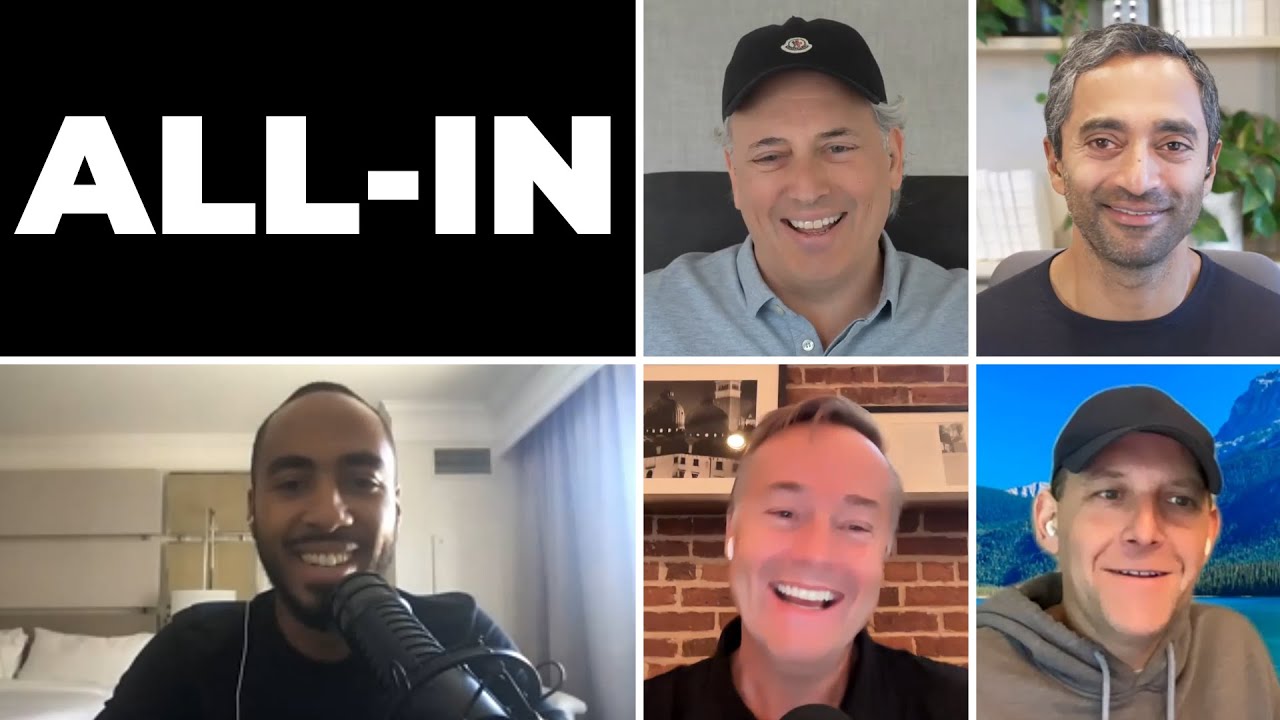
Coleman Hughes joins all four besties to unpack TED's handling of his case for color blindness. The episode also tours Canada's mortifying Nazi ovation and OpenAI's strange ownership stack before ending with a prescient look at multimodal AI. Jason had the sharpest exchange: he made Sacks separate a catastrophic vetting failure from a claim of knowing complicity.
Spice rack
Was Canada's ovation for Yaroslav Hunka merely a vetting failure, or evidence of knowingly ignoring Nazi-linked ultranationalism?
Original point: Support for Ukraine had become so reflexive, Sacks argued, that leaders ignored the history behind a 98-year-old Ukrainian veteran described as having fought Russians in World War II.
What everyone argued
Jason Calacanis
Jason repeatedly separates an appalling failure from intent: nobody had shown that Canadian leaders knowingly invited a Nazi, although pro-Ukraine politics could have discouraged basic scrutiny.
David Sacks
Sacks argues the episode was not just random error. Western alignment with Ukrainian ultranationalists, he says, made leaders willing to overlook Nazi-linked history; he goes further and says Zelensky must have understood which side a Ukrainian fighting Russians in World War II had served.
Winner circle
Jason wins by holding the line between negligence and knowledge. Sacks proves the underlying history was ugly and worth confronting, but he does not prove that Zelensky knew Hunka's service record when he applauded. The fairest conclusion is devastating vetting failure amplified by political groupthink—not demonstrated intentional praise for an SS veteran.
Commentary
Jason Calacanis
Assumptions and fact checks
Political enthusiasm for Ukraine may have caused officials and MPs to skip obvious questions about a Ukrainian who fought Russians during World War II.
Why it mattersRota's introduction itself supplied enough information to trigger a basic historical check. That supports negligence or motivated inattention, but not advance knowledge of Hunka's service.
David Sacks
Sacks is strongest when insisting that Azov's origins and wartime collaboration should not be airbrushed. He loses the central question when 'politically convenient blindness' becomes 'Zelensky knowingly cheered,' a much heavier claim without matching evidence.
Assumptions and fact checks
Zelensky's knowledge of Ukrainian history means he must have instantly inferred Hunka's Waffen-SS service from the Speaker's short introduction.
Why it mattersA live ceremonial introduction, translation, crowd cues, and incomplete attention are plausible alternatives. 'Must have known' needs direct evidence, especially when assigning knowledge of Nazi service.
Western dealings with Ukrainian ultranationalists causally explain Rota's choice to invite and honor Hunka.
Why it mattersThe background may explain why warning signs were missed, but the available invitation trail points to a constituency request and poor vetting. Sacks does not connect foreign-policy relationships to Rota's individual decision.
Yaroslav Hunka served in the Waffen-SS Galicia Division during World War II.
CheckThe incident centered on Hunka's service in a Nazi-commanded Waffen-SS unit, a fact Rota said he did not know when he recognized him.
The Azov unit had neo-Nazi roots and was incorporated into Ukraine's National Guard.
CheckAzov began as a volunteer battalion drawing from far-right circles and later became the National Guard's 12th Special Forces Brigade.
Azov was, in 2023, 'undeniably a neo-Nazi group.'
CheckThe unit's extremist origins are established, but the categorical present-tense label collapses a disputed institutional evolution. By 2024 the U.S. cleared the current brigade for aid after review, while current members rejected extremist ties.
Zelensky knowingly applauded Hunka while understanding that he had fought on Nazi Germany's side.
CheckNo cited evidence establishes Zelensky's advance knowledge. Contemporary accounts said neither Canada's government nor Ukraine's delegation knew about Rota's plan, and later parliamentary testimony did not establish otherwise.
Did Sam Altman effectively own OpenAI's long-term residual value through the nonprofit?
Original point: Because investor returns were capped and excess value flowed to the nonprofit, Sacks speculated that Altman effectively controlled—and therefore effectively owned—the far-out upside.
What everyone argued
Chamath Palihapitiya
Chamath argues that a hidden arrangement giving Altman personal control of enormous nonprofit value would attract lawsuits, leaks, and claims from founders, lawyers, and insiders long before it could operate like private ownership.
David Sacks
Sacks accurately describes capped investor returns and the nonprofit's residual claim, then speculates that Altman controls the nonprofit like a foundation owner and could become a disguised trillionaire while retaining practical use of its assets.
Winner circle
Chamath wins. Sacks correctly understood the capped-return waterfall, but he confused the nonprofit's residual value with Altman's personal property. The board's ability to fire Altman and the later distribution of conventional equity make the 'effective 100% owner' theory untenable.
Commentary
Chamath Palihapitiya
Chamath correctly asks what enforceable right would convert managerial influence into personal wealth. His answer would be stronger if he had named nonprofit fiduciary duties and board removal power directly.
Assumptions and fact checks
A covert attempt to turn OpenAI's nonprofit residual into Altman's personal fortune would trigger internal disclosures, litigation, or governance intervention.
Why it mattersThat scale of value creates powerful incentives for donors, directors, investors, regulators, and founders to challenge self-dealing. Subsequent governance conflict and regulatory review show that the structure did receive intense scrutiny.
David Sacks
Sacks finds the genuinely interesting asset—the nonprofit's residual—but assigns it to the wrong beneficiary. Calling governance a 'fig leaf' does not explain how Altman could lawfully extract, transfer, or personally own the charity's value.
Assumptions and fact checks
Control of a nonprofit foundation is economically equivalent to owning its assets personally.
Why it mattersA public charity has mission-bound assets, board governance, fiduciary duties, regulator oversight, and no owner who can sell or consume its residual value at will. Influence can be substantial without becoming beneficial ownership.
Altman designed the capped-profit structure in advance as a path to disguised personal trillionaire status.
Why it mattersNo evidence offered in the episode establishes that motive. The later board removal and recapitalized ownership structure are inconsistent with the proposed unilateral-control mechanism.
OpenAI's early capped-profit structure limited investor and employee returns, with the nonprofit retaining residual value.
CheckOpenAI's 2019 structure capped first-round investor returns at 100 times investment, expected lower caps later, and assigned excess returns to the nonprofit.
Altman controlled the nonprofit such that he effectively owned 100% of OpenAI's residual value.
CheckThe nonprofit was governed by a board with fiduciary duties to its charitable mission, not to Altman. That board exercised power to remove him in November 2023, and OpenAI stated that he held no personal equity under the capped-profit structure.
The nonprofit would own all of OpenAI's far-out residual value after every investor cap was reached.
CheckThat was the disclosed design of the 2019 capped-profit structure. It described the nonprofit's economic interest, not Altman's personal ownership.
Jason keeps the central distinction intact: a scandal can reveal reckless controls without proving a conscious decision to honor a Nazi collaborator. His questioning forces Sacks to narrow an insinuation into a testable claim.